The Other Trigonometric Functions: Learn It 5

Alternate Forms of the Pythagorean Identity

We can use these fundamental identities to derive alternative forms of the Pythagorean Identity, [latex]{\cos }^{2}t+{\sin }^{2}t=1[/latex]. One form is obtained by dividing both sides by [latex]{\cos }^{2}t:[/latex]

[latex]\begin{gathered}\frac{{\cos }^{2}t}{{\cos }^{2}t}+\frac{{\sin }^{2}t}{{\cos }^{2}t}=\frac{1}{{\cos }^{2}t}\\ \\ 1+{\tan }^{2}t={\sec }^{2}t\end{gathered}[/latex]

The other form is obtained by dividing both sides by [latex]{\sin }^{2}t:[/latex]

[latex]\begin{gathered}\frac{{\cos }^{2}t}{{\sin }^{2}t}+\frac{{\sin }^{2}t}{{\sin }^{2}t}=\frac{1}{{\sin }^{2}t}\\ \\ {\cot }^{2}t+1={\csc }^{2}t\end{gathered}[/latex]

alternate Pythagorean identities

[latex]1+{\tan }^{2}t={\sec }^{2}t[/latex]

[latex]{\cot }^{2}t+1={\csc }^{2}t[/latex]

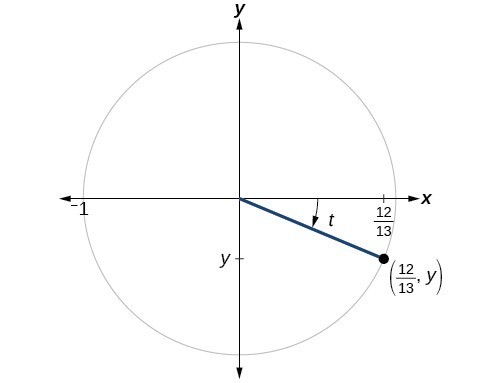
If [latex]\text{cos}\left(t\right)=\frac{12}{13}[/latex] and [latex]t[/latex] is in quadrant IV, as shown in Figure 8, find the values of the other five trigonometric functions.

Graph of circle with angle of t inscribed. Point of (12/13, y) is at intersection of terminal side of angle and edge of circle.
Figure 8

If [latex]\sec \left(t\right)=-\frac{17}{8}[/latex] and [latex]0

periodic functions

A function that repeats its values in regular intervals is known as a periodic function. The trigonometric functions are periodic. For the four trigonometric functions, sine, cosine, cosecant and secant, a revolution of one circle, or [latex]2\pi[/latex], will result in the same outputs for these functions. And for tangent and cotangent, only a half a revolution will result in the same outputs.

Other functions can also be periodic. For example, the lengths of months repeat every four years. If [latex]x[/latex] represents the length time, measured in years, and [latex]f\left(x\right)[/latex] represents the number of days in February, then [latex]f\left(x+4\right)=f\left(x\right)[/latex]. This pattern repeats over and over through time. In other words, every four years, February is guaranteed to have the same number of days as it did 4 years earlier. The positive number 4 is the smallest positive number that satisfies this condition and is called the period. A period is the shortest interval over which a function completes one full cycle—in this example, the period is 4 and represents the time it takes for us to be certain February has the same number of days.

period of a function

The period [latex]P[/latex] of a repeating function [latex]f[/latex] is the number representing the interval such that [latex]f\left(x+P\right)=f\left(x\right)[/latex] for any value of [latex]x[/latex].

The period of the cosine, sine, secant, and cosecant functions is [latex]2\pi[/latex].

The period of the tangent and cotangent functions is [latex]\pi[/latex].

Find the values of the six trigonometric functions of angle [latex]t[/latex] based on Figure 9.

Graph of circle with angle of t inscribed. Point of (1/2, negative square root of 3 over 2) is at intersection of terminal side of angle and edge of circle.
Figure 9

Find the values of the six trigonometric functions of angle [latex]t[/latex] based on Figure 10.

Graph of circle with angle of t inscribed. Point of (0, -1) is at intersection of terminal side of angle and edge of circle.
Figure 10

If [latex]\sin \left(t\right)=-\frac{\sqrt{3}}{2}[/latex] and [latex]\text{cos}\left(t\right)=\frac{1}{2}[/latex], find [latex]\text{sec}\left(t\right),\text{csc}\left(t\right),\text{tan}\left(t\right),\text{ cot}\left(t\right)[/latex].
If [latex]\sin \left(t\right)=\frac{\sqrt{2}}{2}[/latex] and [latex]\cos \left(t\right)=\frac{\sqrt{2}}{2}[/latex], find [latex]\text{sec}\left(t\right),\text{csc}\left(t\right),\text{tan}\left(t\right),\text{ and cot}\left(t\right)[/latex].