Finding Sines and Cosines of Special Angles
Finding Sines and Cosines of 45° Angles
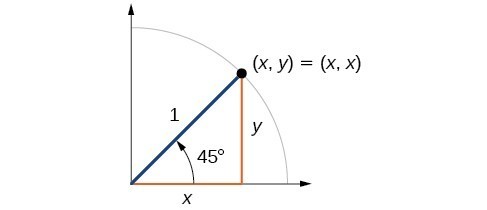
First, we will look at angles of [latex]45^\circ[/latex] or [latex]\frac{\pi }{4}[/latex]. A [latex]45^\circ -45^\circ -90^\circ[/latex] triangle is an isosceles triangle, so the x- and y-coordinates of the corresponding point on the circle are the same. Because the x- and y-values are the same, the sine and cosine values will also be equal.
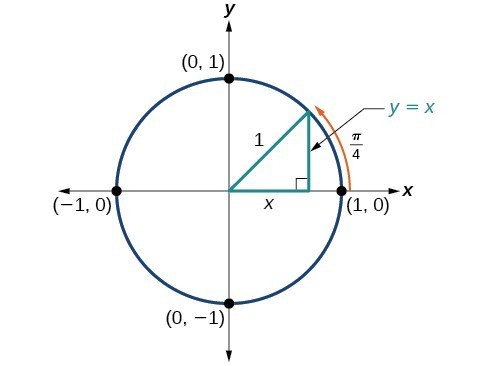 From the Pythagorean Theorem we get
Substituting [latex]y=x[/latex], we get
Combining like terms we get
And solving for [latex]x[/latex], we get
In quadrant I, [latex]x=\frac{1}{\sqrt{2}}[/latex].
At [latex]t=\frac{\pi }{4}[/latex] or 45 degrees,
If we then rationalize the denominators, we get
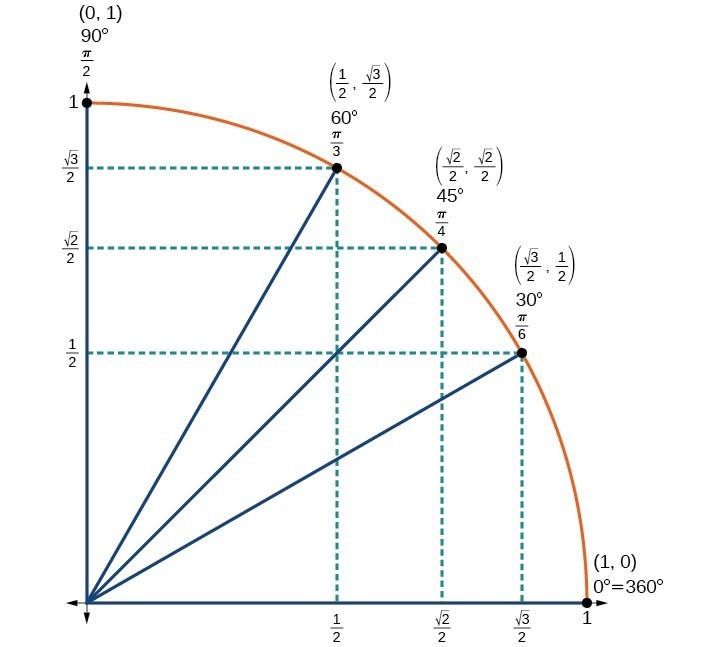
Therefore, the [latex]\left(x,y\right)[/latex] coordinates of a point on a circle of radius [latex]1[/latex] at an angle of [latex]45^\circ[/latex] are [latex]\left(\frac{\sqrt{2}}{2},\frac{\sqrt{2}}{2}\right)[/latex].
Finding Sines and Cosines of 30° and 60° Angles
Next, we will find the cosine and sine at an angle of [latex]30^\circ[/latex], or [latex]\frac{\pi }{6}[/latex] . First, we will draw a triangle inside a circle with one side at an angle of [latex]30^\circ[/latex], and another at an angle of [latex]-30^\circ[/latex]. If the resulting two right triangles are combined into one large triangle, notice that all three angles of this larger triangle will be [latex]60^\circ[/latex].
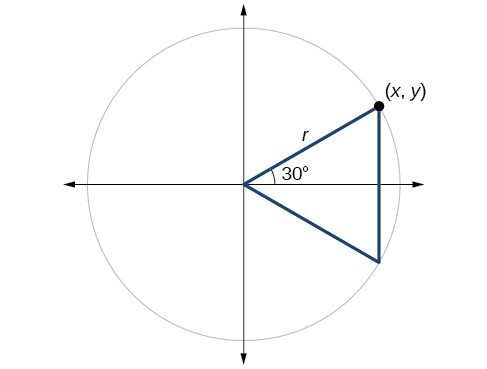
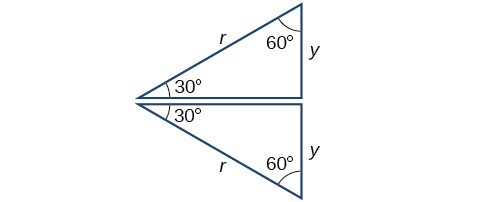
And since [latex]r=1[/latex] in our unit circle,
Using the Pythagorean Identity, we can find the cosine value.
The [latex]\left(x,y\right)[/latex] coordinates for the point on a circle of radius [latex]1[/latex] at an angle of [latex]30^\circ[/latex] are [latex]\left(\frac{\sqrt{3}}{2},\frac{1}{2}\right)[/latex]. At [latex]t=\frac{\pi }{3}[/latex] (60°), the radius of the unit circle, 1, serves as the hypotenuse of a 30-60-90 degree right triangle, [latex]BAD[/latex]. Angle [latex]A[/latex] has measure [latex]60^\circ[/latex]. At point [latex]B[/latex], we draw an angle [latex]ABC[/latex] with measure of [latex]60^\circ[/latex]. We know the angles in a triangle sum to [latex]180^\circ[/latex], so the measure of angle [latex]C[/latex] is also [latex]60^\circ[/latex]. Now we have an equilateral triangle. Because each side of the equilateral triangle [latex]ABC[/latex] is the same length, and we know one side is the radius of the unit circle, all sides must be of length 1.
The measure of angle [latex]ABD[/latex] is 30°. So, if double, angle [latex]ABC[/latex] is 60°. [latex]BD[/latex] is the perpendicular bisector of [latex]AC[/latex], so it cuts [latex]AC[/latex] in half. This means that [latex]AD[/latex] is [latex]\frac{1}{2}[/latex] the radius, or [latex]\frac{1}{2}[/latex]. Notice that [latex]AD[/latex] is the x-coordinate of point [latex]B[/latex], which is at the intersection of the 60° angle and the unit circle. This gives us a triangle [latex]BAD[/latex] with hypotenuse of 1 and side [latex]x[/latex] of length [latex]\frac{1}{2}[/latex].
From the Pythagorean Theorem, we get
Substituting [latex]x=\frac{1}{2}[/latex], we get
Solving for [latex]y[/latex], we get
Since [latex]t=\frac{\pi }{3}[/latex] has the terminal side in quadrant I where the y-coordinate is positive, we choose [latex]y=\frac{\sqrt{3}}{2}[/latex], the positive value.
At [latex]t=\frac{\pi }{3}[/latex] (60°), the [latex]\left(x,y\right)[/latex] coordinates for the point on a circle of radius [latex]1[/latex] at an angle of [latex]60^\circ[/latex] are [latex]\left(\frac{1}{2},\frac{\sqrt{3}}{2}\right)[/latex], so we can find the sine and cosine.
We have now found the cosine and sine values for all of the most commonly encountered angles in the first quadrant of the unit circle. The table below summarizes these values.
| Angle | 0 | [latex]\frac{\pi }{6}[/latex], or 30° | [latex]\frac{\pi }{4}[/latex], or 45° | [latex]\frac{\pi }{3}[/latex], or 60° | [latex]\frac{\pi }{2}[/latex], or 90° |
| Cosine | 1 | [latex]\frac{\sqrt{3}}{2}[/latex] | [latex]\frac{\sqrt{2}}{2}[/latex] | [latex]\frac{1}{2}[/latex] | 0 |
| Sine | 0 | [latex]\frac{1}{2}[/latex] | [latex]\frac{\sqrt{2}}{2}[/latex] | [latex]\frac{\sqrt{3}}{2}[/latex] | 1 |
Using a Calculator to Find Sine and Cosine
To find the cosine and sine of angles other than the special angles, we turn to a computer or calculator. Be aware: Most calculators can be set into “degree” or “radian” mode, which tells the calculator the units for the input value. When we evaluate [latex]\cos \left(30\right)[/latex] on our calculator, it will evaluate it as the cosine of 30 degrees if the calculator is in degree mode, or the cosine of 30 radians if the calculator is in radian mode.
- If the calculator has degree mode and radian mode, set it to radian mode.
- Press the COS key.
- Enter the radian value of the angle and press the close-parentheses key “)”.
- Press ENTER.