The Pythagorean Identity
Now that we can define sine and cosine, we will learn how they relate to each other and the unit circle. Recall that the equation for the unit circle is [latex]{x}^{2}+{y}^{2}=1[/latex]. Because [latex]x=\cos t[/latex] and [latex]y=\sin t[/latex], we can substitute for [latex]x[/latex] and [latex]y[/latex] to get [latex]{\cos }^{2}t+{\sin }^{2}t=1[/latex]. This equation, [latex]{\cos }^{2}t+{\sin }^{2}t=1[/latex], is known as the Pythagorean Identity.
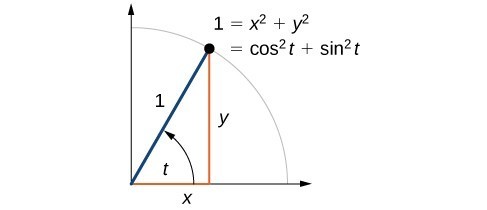
We can use the Pythagorean Identity to find the cosine of an angle if we know the sine, or to find the sine of an angle if we know the cosine. However, because the equation yields two solutions, we need additional knowledge of the angle to choose the solution with the correct sign. If we know the quadrant where the angle is, we can easily choose the correct solution.
Pythagorean identity
The Pythagorean Identity states that, for any real number [latex]t[/latex],
- Substitute the known value of [latex]\sin \left(t\right)[/latex] into the Pythagorean Identity.
- Solve for [latex]\cos \left(t\right)[/latex].
- Choose the solution with the appropriate sign for the x-values in the quadrant where [latex]t[/latex] is located.
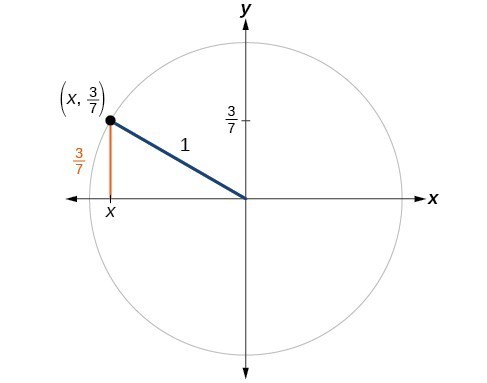 Substituting the known value for sine into the Pythagorean Identity,
- sine is positive in Quadrant I and II
- cosine is positive in Quadrant I and IV