Use linear and angular speed to describe motion on a circular path.
Determining the Length of an Arc
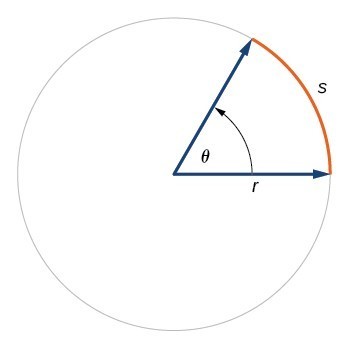
The radian measure [latex]\theta[/latex] of an angle was defined as the ratio of the arc length [latex]s[/latex] of a circular arc to the radius [latex]r[/latex] of the circle, [latex]\theta =\frac{s}{r}[/latex]
From this relationship, we can find arc length along a circle, given an angle.
arc length on a circle
In a circle of radius r, the length of an arc [latex]s[/latex] subtended by an angle with measure [latex]\theta[/latex] in radians is [latex]s=r\theta[/latex]
How To: Given a circle of radius [latex]r[/latex], calculate the length [latex]s[/latex] of the arc subtended by a given angle of measure [latex]\theta[/latex].
If necessary, convert [latex]\theta[/latex] to radians.
Multiply the radius [latex]r[/latex] by the radian measure of [latex]\theta :s=r\theta[/latex].
Assume the orbit of Mercury around the sun is a perfect circle. Mercury is approximately 36 million miles from the sun.
In one Earth day, Mercury completes 0.0114 of its total revolution. How many miles does it travel in one day?
Use your answer from part (a) to determine the radian measure for Mercury’s movement in one Earth day.
Let’s begin by finding the circumference of Mercury’s orbit.
[latex]\begin{align}C&=2\pi r \\ &=2\pi \left(36\text{ million miles}\right) \\ &\approx 226\text{ million miles} \end{align}[/latex]
Since Mercury completes 0.0114 of its total revolution in one Earth day, we can now find the distance traveled:
[latex]\left(0.0114\right)226\text{ million miles = 2}\text{.58 million miles}[/latex]
Now, we convert to radians:
[latex]\begin{align}\text{radian}&=\frac{\text{arclength}}{\text{radius}} \\ &=\frac{2.\text{58 million miles}}{36\text{ million miles}} \\ &=0.0717 \end{align}[/latex]