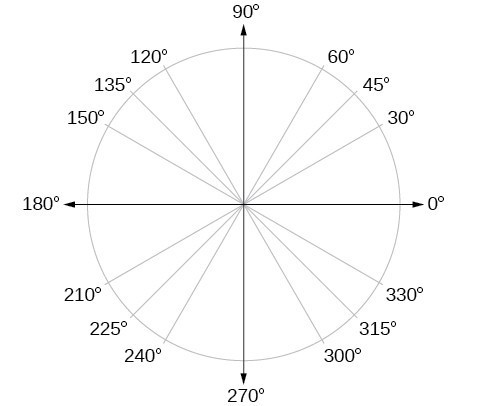
In addition to knowing the measurements in degrees and radians of a quarter revolution, a half revolution, and a full revolution, there are other frequently encountered angles in one revolution of a circle with which we should be familiar. It is common to encounter multiples of 30, 45, 60, and 90 degrees. Memorizing these angles will be very useful as we study the properties associated with angles.
Commonly encountered angles measured in degrees
Converting between Radians and Degrees
Because degrees and radians both measure angles, we need to be able to convert between them. We can easily do so using a proportion.
converting between radians and degrees
To convert between degrees and radians, use the proportion [latex]\dfrac{\theta }{180}=\frac{{\theta }^{R}}{\pi }[/latex]
radian [latex]\times \dfrac{180}{\pi}[/latex]
degree [latex]\times \dfrac{\pi}{180}[/latex]
Convert each radian measure to degrees.
a. [latex]\frac{\pi }{6}[/latex]
b. 3
To convert radians to degrees, multiply by [latex]\frac{180}{\pi}[/latex].
In part (a), the [latex]\pi[/latex] values cancel and the fraction reduces to a whole number. In part (b), since 3 is not a rational multiple of [latex]\pi[/latex], we divide to get an approximate decimal answer.
Convert [latex]15[/latex] degrees to radians.
To convert degrees to radians, multiply by [latex]\frac{\pi}{180}[/latex].