Functions and Function Notation
1. What is the difference between a relation and a function?
2. Why does the vertical line test tell us whether the graph of a relation represents a function?
3. Why does the horizontal line test tell us whether the graph of a function is one-to-one?
For the following exercises, determine whether the relation represents a function.
4. [latex]{(a,b),(b,c),(c,c)}[/latex]
For the following exercises, determine whether the relation represents [latex]y[/latex] as a function of [latex]x[/latex].
5. [latex]x=y^{2}[/latex]
6. [latex]2xy=1[/latex]
7. [latex]y^2=x^2[/latex]
For the following exercises, evaluate the function [latex]f[/latex] at the indicated values [latex]f(−3),f(2),f(−a),−f(a),f(a+h)[/latex].
8. [latex]f(x)=2x−5[/latex]
9. Given the function [latex]g(x)=x^{2}+2x[/latex],evaluate [latex]\frac{g(x)−g(a)}{x−a},x\ne{a}[/latex].
For the following exercises, use the vertical line test to determine which graphs show relations that are functions.For the following exercises, use the function [latex]f[/latex] represented in the table below.
| [latex]x[/latex] | [latex]f(x)[/latex] |
| 0 | 74 |
| 1 | 28 |
| 2 | 1 |
| 3 | 53 |
| 4 | 56 |
| 5 | 3 |
| 6 | 36 |
| 7 | 45 |
| 8 | 14 |
| 9 | 47 |
10. Evaluate [latex]f(3)[/latex].
11. Solve [latex]f(x)=1[/latex].
12. The number of cubic yards of dirt, [latex]D[/latex],needed to cover a garden with area a square feet is given by [latex]D=g(a)[/latex].
A garden with area 5000 ft2 requires 50 yd<sup>3</sup> of dirt. Express this information in terms of the function [latex]g[/latex].
Explain the meaning of the statement [latex]g(100)=1[/latex].
13. Let [latex]h(t)[/latex] be the height above ground, in feet, of a rocket [latex]t[/latex] seconds after launching. Explain the meaning of each statement:
[latex]h(1)=200[/latex]
[latex]h(2)=350[/latex]
Domain and Range
1. Why does the domain differ for different functions?
2. Explain why the domain of [latex]f\left(x\right)=\sqrt[3]{x}[/latex] is different from the domain of [latex]f\left(x\right)=\sqrt[]{x}[/latex].
3. When describing sets of numbers using interval notation, when do you use a parenthesis and when do you use a bracket?
For the following exercises, find the domain of each function using interval notation.
4. [latex]f\left(x\right)=3\sqrt{x - 2}[/latex]
5. [latex]f\left(x\right)=3-\sqrt{6 - 2x}[/latex]
6. [latex]f\left(x\right)=\frac{9}{x - 6}[/latex]
7. [latex]f\left(x\right)=\frac{\sqrt{x+4}}{x - 4}[/latex]
8. [latex]\frac{5}{\sqrt{x - 3}}[/latex]
9. [latex]f\left(x\right)=\frac{\sqrt{x - 4}}{\sqrt{x - 6}}[/latex]
For the following exercises, write the domain and range of each function using interval notation.
10.
![Graph of a function from (2, 8].](https://s3-us-west-2.amazonaws.com/courses-images-archive-read-only/wp-content/uploads/sites/1227/2015/04/03005038/CNX_Precalc_Figure_01_02_202.jpg)
11.
![Graph of a function from [-4, 4].](https://s3-us-west-2.amazonaws.com/courses-images-archive-read-only/wp-content/uploads/sites/1227/2015/04/03005038/CNX_Precalc_Figure_01_02_204.jpg)
12.
![Graph of a function from (-infinity, 2].](https://s3-us-west-2.amazonaws.com/courses-images-archive-read-only/wp-content/uploads/sites/1227/2015/04/03005039/CNX_Precalc_Figure_01_02_208.jpg)
For the following exercises, sketch a graph of the piecewise function. Write the domain in interval notation.
13. [latex]f\left(x\right)=\begin{cases}{2x - 1}&\text{ if }&{ x }<{ 1 }\\ {1+x }&\text{ if }&{ x }\ge{ 1 } \end{cases}[/latex]
14. [latex]f\left(x\right)=\begin{cases}{3} &\text{ if }&{ x } <{ 0 }\\ \sqrt{x}&\text{ if }&{ x }\ge { 0 }\end{cases}[/latex]
15. [latex]f\left(x\right)=\begin{cases}{ 1 }&\text{ if }&{ x }\le{ -3 }\\{ 0 }&\text{ if }&{ x }>{ -3 }\end{cases}[/latex]
16. [latex]f\left(x\right)=\begin{cases}{ 7x+3 }&\text{ if }&{ x }<{ 0 }\\{ 7x+6 }&\text{ if }&{ x }\ge{ 0 }\end{cases}[/latex]
Rates of Change and Behaviors of Graphs
1. If a function [latex]f[/latex] is increasing on [latex]\left(a,b\right)[/latex] and decreasing on [latex]\left(b,c\right)[/latex], then what can be said about the local extremum of [latex]f[/latex] on [latex]\left(a,c\right)?[/latex]
2. How are the absolute maximum and minimum similar to and different from the local extrema?
For exercises 5–15, find the average rate of change of each function on the interval specified for real numbers [latex]b[/latex] or [latex]h[/latex].
3. [latex]f\left(x\right)=4{x}^{2}-7[/latex] on [latex]\left[1,\text{ }b\right][/latex]
4. [latex]p\left(x\right)=3x+4[/latex] on [latex]\left[2,\text{ }2+h\right][/latex]
5. [latex]\frac{f\left(x+h\right)-f\left(x\right)}{h}[/latex] given [latex]f\left(x\right)=2{x}^{2}-3x[/latex] on [latex]\left[x,x+h\right][/latex]
For exercises 16–17, consider the graph of [latex]f[/latex].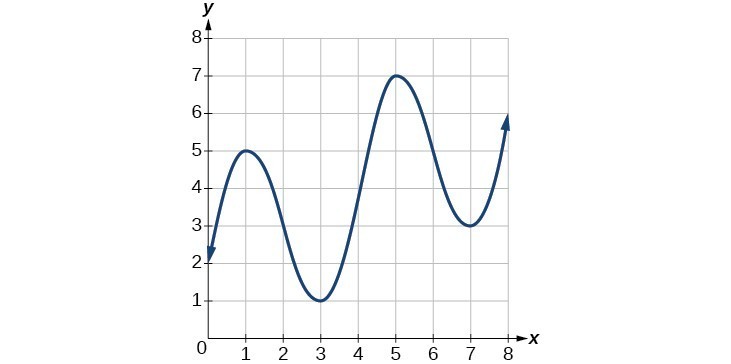
6. Estimate the average rate of change from [latex]x=1[/latex] to [latex]x=4[/latex].
7. Estimate the average rate of change from [latex]x=2[/latex] to [latex]x=5[/latex].
For exercises 22–23, consider the graph shown below.
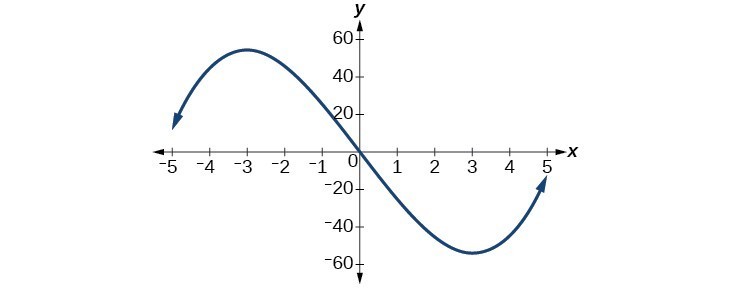
8. Estimate the intervals where the function is increasing or decreasing.
9. Estimate the point(s) at which the graph of [latex]f[/latex] has a local maximum or a local minimum.
10. At the start of a trip, the odometer on a car read 21,395. At the end of the trip, 13.5 hours later, the odometer read 22,125. Assume the scale on the odometer is in miles. What is the average speed the car traveled during this trip?