- Identify a conic in polar form.
- Graph the polar equations of conics.
- Define conics in terms of a focus and a directrix.
Identifying a Conic in Polar Form
The Main Idea
Conics can also be expressed in polar form, where the focus is placed at the pole (origin). In this setting, the general form of a conic is:
\[
r = \dfrac{ed}{1 \pm e\cos\theta} \quad \text{or} \quad
r = \dfrac{ed}{1 \pm e\sin\theta}
\]
Here:
-
[latex]e[/latex] = eccentricity (determines the type of conic).
-
[latex]d[/latex] = directrix constant (distance related to conic definition).
-
The sign/choice of cosine or sine determines orientation: right/left (cosine) or up/down (sine).
Quick Tips: How to Identify the Conic
-
Look at the Eccentricity
-
[latex]e=1[/latex] → parabola.
-
[latex]e<1[/latex] → ellipse (if [latex]e=0[/latex], it’s a circle).
-
[latex]e>1[/latex] → hyperbola.
-
-
Check Orientation
-
[latex]r=\dfrac{ed}{1+e\cos\theta}[/latex] → focus at origin, directrix vertical.
-
[latex]r=\dfrac{ed}{1-e\cos\theta}[/latex] → similar but mirrored.
-
[latex]r=\dfrac{ed}{1\pm e\sin\theta}[/latex] → opens upward or downward.
-
-
Summary Rule
-
The eccentricity [latex]e[/latex] tells you which conic.
-
The function (cos/sin) and sign tell you which direction.
-
Identify the conic represented by each polar equation.
a) [latex]r = \frac{6}{1 + \cos\theta}[/latex]
b) [latex]r = \frac{8}{2 - \sin\theta}[/latex]
c) [latex]r = \frac{12}{3 + 4\cos\theta}[/latex]
You can view the transcript for “Example: Identifying a conic section in polar coordinates” here (opens in new window).
Graphing Polar Equations of Conics
The Main Idea
Conics can be graphed directly in polar coordinates using equations of the form:
\[
r = \dfrac{ed}{1 \pm e\cos\theta} \quad \text{or} \quad
r = \dfrac{ed}{1 \pm e\sin\theta}
\]
Here:
-
[latex]e[/latex] = eccentricity (ellipse if [latex]e<1[/latex], parabola if [latex]e=1[/latex], hyperbola if [latex]e>1[/latex]).
-
[latex]d[/latex] = directrix constant.
-
The choice of cosine vs sine determines orientation (cosine = horizontal, sine = vertical).
-
The sign (+/–) determines whether the conic opens right/left or up/down.
Quick Tips: How to Graph Polar Conics
-
Determine the Type of Conic
-
Compute [latex]e[/latex].
-
[latex]e<1[/latex] → ellipse, [latex]e=1[/latex] → parabola, [latex]e>1[/latex] → hyperbola.
-
-
Find the Orientation
-
Cosine in denominator → horizontal axis.
-
Sine in denominator → vertical axis.
-
Plus/minus sign tells whether it opens left/right or up/down.
-
-
Plot Key Points
-
At [latex]\theta=0, \pi/2, \pi, 3\pi/2[/latex], calculate [latex]r[/latex].
-
Plot these points carefully in polar coordinates.
-
-
Sketch the Curve Using Symmetry
-
Conics in polar form are often symmetric about an axis.
-
Plot enough points to capture curvature, then reflect across symmetry.
-
Graph the polar equation [latex]r = \frac{4}{1 + \cos\theta}[/latex].
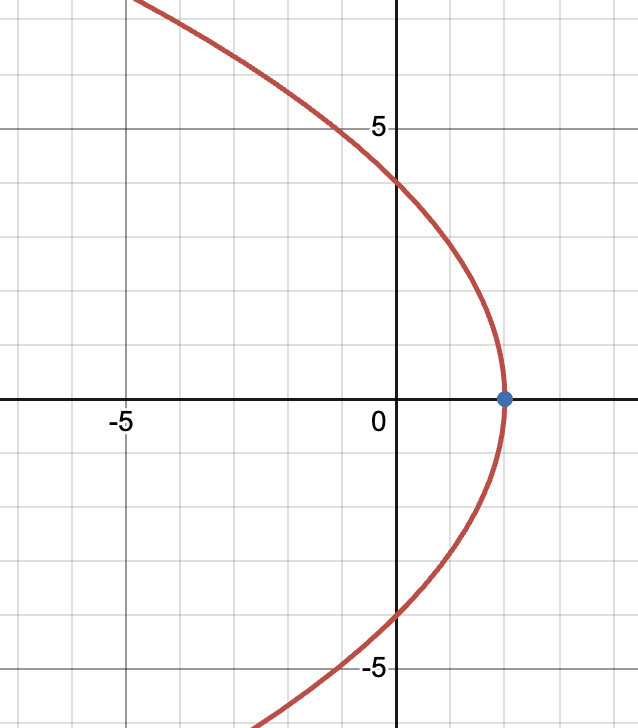
You can view the transcript for “Graphing Conic Sections Using Polar Equations – Part 1” here (opens in new window).
Choose a Calculator
Conics Defined by a Focus and Directrix
The Main Idea
All conic sections—parabolas, ellipses, and hyperbolas—can be defined in terms of a focus (a fixed point) and a directrix (a fixed line). A conic is the set of all points [latex]P[/latex] in the plane such that the ratio of the distance from [latex]P[/latex] to the focus and the distance from [latex]P[/latex] to the directrix is a constant [latex]e[/latex], called the eccentricity.
-
If [latex]e=1[/latex], the conic is a parabola.
-
If [latex]e<1[/latex], the conic is an ellipse.
-
If [latex]e>1[/latex], the conic is a hyperbola.
This definition unifies all the conics under one geometric property.
Quick Tips: Understanding Focus-Directrix Definition
-
General Definition
-
A conic is all points [latex]P[/latex] such that [latex]e=\dfrac{\text{distance from P to focus}}{\text{distance from P to directrix}}[/latex].
-
-
Special Cases by Eccentricity
-
Parabola: Distance to focus = distance to directrix ([latex]e=1[/latex]).
-
Ellipse: Distance to focus < distance to directrix ([latex]e<1[/latex]).
-
Hyperbola: Distance to focus > distance to directrix ([latex]e>1[/latex]).
-
A conic has its focus at the origin and directrix [latex]x = 4[/latex]. A point on the conic is twice as far from the directrix as it is from the focus. Find the eccentricity and identify the conic.