- Find the common difference for an arithmetic sequence.
- Write the formula for an arithmetic sequence.
- Use arithmetic sequences to solve realistic scenarios
Terms of an Arithmetic Sequence
Companies often make large purchases, such as computers and vehicles, for business use. The book-value of these supplies decreases each year for tax purposes. This decrease in value is called depreciation. One method of calculating depreciation is straight-line depreciation, in which the value of the asset decreases by the same amount each year.
[latex]\\[/latex]
The loss in value of the truck will therefore be [latex]$17,000[/latex], which is [latex]$3,400[/latex] per year for five years.
[latex]\\[/latex]
The truck will be worth [latex]$21,600[/latex] after the first year; [latex]$18,200[/latex] after two years; [latex]$14,800[/latex] after three years; [latex]$11,400[/latex] after four years; and [latex]$8,000[/latex] at the end of five years.
The values of the truck in the example form an arithmetic sequence because they change by a constant amount each year. Each term increases or decreases by the same constant value called the common difference of the sequence. For this sequence the common difference is [latex]–3,400[/latex]. You can choose any term of the sequence, and subtract [latex]3,400[/latex] to find the subsequent term.

arithmetic sequence
An arithmetic sequence is a sequence where the difference between consecutive terms is always the same.
[latex]\left\{{a}_{n}\right\}=\left\{{a}_{1},{a}_{1}+d,{a}_{1}+2d,{a}_{1}+3d,...\right\}[/latex]
The difference between consecutive terms, [latex]d[/latex], and is called the common difference, for [latex]n[/latex] greater than or equal to two.

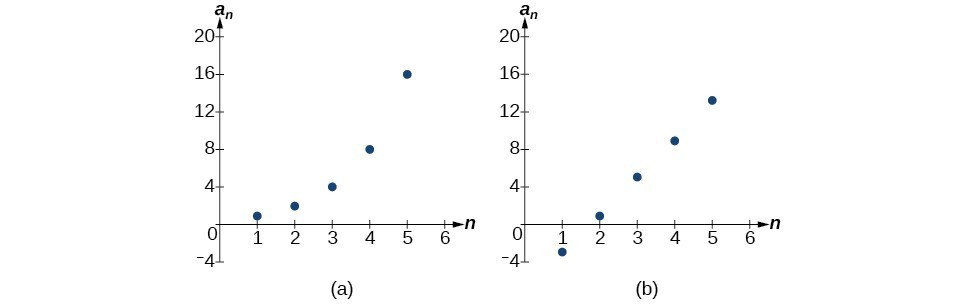
- [latex]\left\{1,2,4,8,16,...\right\}[/latex]
- [latex]\left\{-3,1,5,9,13,...\right\}[/latex]