- Use the Law of Cosines to solve oblique triangles.
- Solve applied problems using the Law of Cosines.
- Use Heron’s formula to find the area of a triangle.
Solving Oblique Triangles with the Law of Cosines
The Main Idea
The Law of Cosines extends the Pythagorean Theorem to all triangles, making it possible to solve oblique (non-right) triangles when the Law of Sines is not convenient. It is especially useful for SAS (two sides and the included angle) and SSS (all three sides) cases. With it, we can find unknown sides or angles even when no right angle is present.
The Law of Cosines:
-
[latex]a^{2} = b^{2} + c^{2} - 2bc\cos A[/latex]
-
[latex]b^{2} = a^{2} + c^{2} - 2ac\cos B[/latex]
-
[latex]c^{2} = a^{2} + b^{2} - 2ab\cos C[/latex]
Quick Tips: Using the Law of Cosines
-
Know When to Use It
-
SAS: when two sides and the included angle are given, use the formula to find the third side.
-
SSS: when all three sides are given, use the formula to find an angle.
-
-
Solving for a Side
-
Plug in known sides and the included angle.
-
-
Solving for an Angle
-
Rearrange the formula:
[latex]\cos A = \dfrac{b^{2} + c^{2} - a^{2}}{2bc}[/latex]. - Plug in the known sides
-
-
Combine with the Law of Sines
-
After using the Law of Cosines to find one side or angle, switch to the Law of Sines for quicker calculations of the remaining parts.
-
-
Check for Validity
-
Angles must add up to [latex]180^\circ[/latex] (or [latex]\pi[/latex]).
-
Side lengths must satisfy the triangle inequality.
-
In triangle ABC, [latex]b = 12[/latex], [latex]c = 15[/latex], and [latex]A = 65°[/latex]. Find side [latex]a[/latex].
Applied Problems with the Law of Cosines
The Main Idea
The Law of Cosines is especially useful for real-world problems where no right triangle is present. It allows us to calculate unknown distances, heights, or angles when two sides and the included angle (SAS) or all three sides (SSS) are known. This makes it a powerful tool in navigation, surveying, construction, and physics, where many situations naturally form oblique triangles.
The Law of Cosines:
-
[latex]a^{2} = b^{2} + c^{2} - 2bc\cos A[/latex]
-
[latex]b^{2} = a^{2} + c^{2} - 2ac\cos B[/latex]
-
[latex]c^{2} = a^{2} + b^{2} - 2ab\cos C[/latex]
Quick Tips: Solving Applied Problems
-
Translate the Problem into a Triangle
-
Draw a diagram of the situation (survey lines, navigation paths, etc.).
-
Label sides and angles with the given information.
-
-
Use SAS or SSS Information
-
SAS: two sides and the included angle → use the formula directly to find the third side.
-
SSS: all three sides → rearrange the formula to solve for an angle.
-
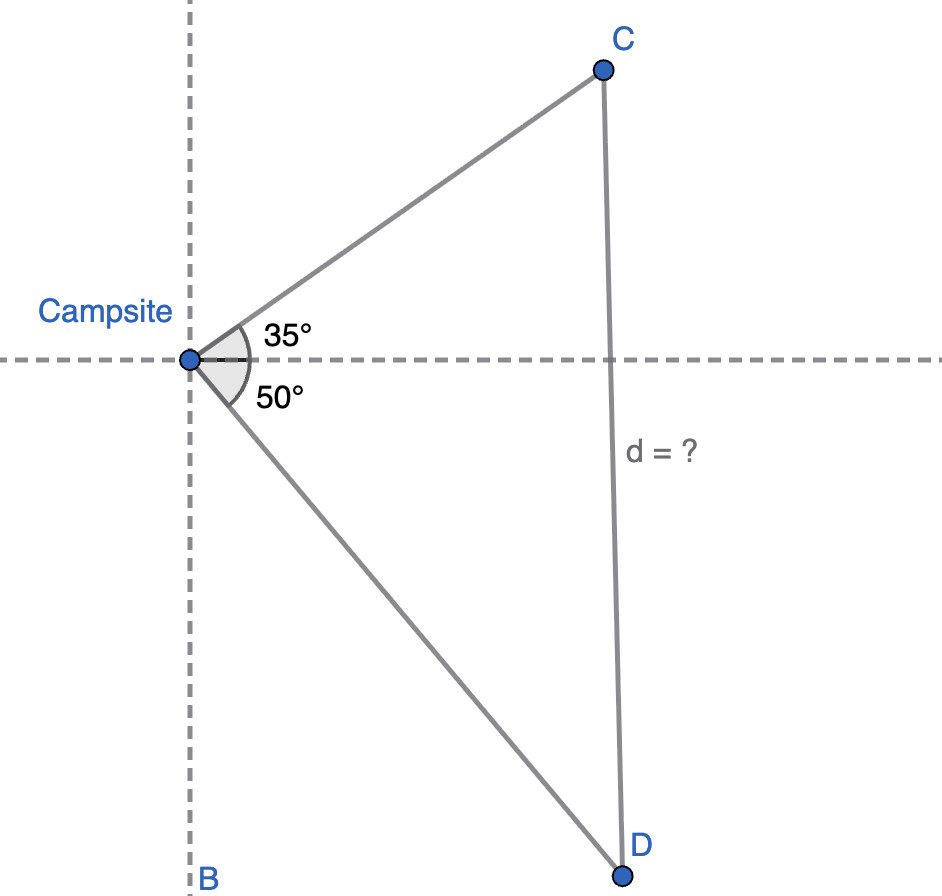
Two hikers leave a campsite at the same time. One hikes 6 miles in a direction [latex]35°[/latex] north of east. The other hikes 8 miles in a direction [latex]50°[/latex] south of east. How far apart are the hikers?
You can view the transcript for “Bearing Word Problem Find Distance and Angle Using Law of Sines and Law of Cosines” here (opens in new window).
Area of a Triangle with Heron’s Formula
The Main Idea
Heron’s Formula is a method for finding the area of a triangle when all three sides are known. Unlike the sine-based formula, it doesn’t require knowing or calculating any angles. This makes it especially useful in surveying, geometry, or applied problems where side lengths are given directly.
Heron’s Formula:
-
First compute the semiperimeter:
[latex]s = \dfrac{a+b+c}{2}[/latex] -
Then the area is:
[latex]\text{Area} = \sqrt{s(s-a)(s-b)(s-c)}[/latex]
Quick Tips: Using Heron’s Formula
-
Check That the Triangle is Valid
-
The sum of any two sides must be greater than the third.
-
-
Calculate the Semiperimeter
-
Add all three sides and divide by 2.
-
-
Apply the Formula
-
Plug [latex]s[/latex] and each side into [latex]\sqrt{s(s-a)(s-b)(s-c)}[/latex].
-