- Determine amplitude, period, phase shift, and vertical shift of a sine or cosine graph from its equation.
- Graph transformations of y=cos x and y=sin x .
- Determine a function formula that would have a given sinusoidal graph.
- Determine functions that model circular and periodic motion.
Sine and Cosine Graph Features
The Main Idea
The graphs of sine and cosine can be stretched, compressed, shifted, or moved up and down by changing parts of their equations. In general, the form is
[latex]y = a \sin(bx)[/latex]
[latex]y = a \cos(bx)[/latex].
Each letter tells you something about the graph:
-
a controls the amplitude (how tall the wave is).
-
b affects the period (how long it takes for the wave to repeat).
Quick Tips: Reading Transformations from the Equation
- Amplitude
-
Formula: [latex]\text{Amplitude} = |a|[/latex].
-
Example: [latex]y = 3\sin(x)[/latex] → amplitude = 3.
-
- Period
-
Formula: [latex]\text{Period} = \dfrac{2\pi}{b}[/latex].
-
Example: [latex]y = \cos(2x)[/latex] → period = [latex]\dfrac{2\pi}{2} = \pi[/latex].
-
You can view the transcript for “Animation: Graphing the Sine Function Using The Unit Circle” here (opens in new window).
Sine and Cosine Graph Transformations
The Main Idea
The graphs of [latex]y=\sin x[/latex] and [latex]y=\cos x[/latex] form smooth, repeating waves. Transformations let us reshape these waves by stretching them taller or shorter, squeezing them to fit more cycles, sliding them left or right, or lifting and lowering the whole curve. These changes don’t alter the wave’s basic pattern—it still oscillates smoothly—but they make the graph flexible enough to model real-world cycles like sound waves, tides, or seasonal patterns. Recognizing transformations helps us quickly sketch graphs and understand how the wave has been shifted from its standard position.
Quick Tips: Transforming Sine and Cosine Graphs
-
Amplitude: [latex]|a|[/latex] is the max distance from the midline. Bigger [latex]|a|[/latex] = taller wave.
-
Period: [latex]\dfrac{2\pi}{b}[/latex] is the length of one cycle. Larger [latex]b[/latex] compresses the wave, smaller [latex]b[/latex] stretches it.
-
Phase Shift: [latex]\dfrac{c}{b}[/latex]. If [latex]c > 0[/latex] → shift right, if [latex]c < 0[/latex] → shift left.
-
Vertical Shift: [latex]d[/latex]. Positive → up, Negative → down.
-
Start Points:
-
For sine: normally starts at (0,0); apply shifts to move the starting point.
-
For cosine: normally starts at (0,1); apply shifts to move it.
-
-
Graph in Steps: Midline first, mark amplitude, then adjust cycle length and shifts.
You can view the transcript for “Exploring Transformations of Sine and Cosine: y=Asin(Bx-C)+D with Desmos” here (opens in new window).
Formulas of Sinusoidal Graphs
The Main Idea
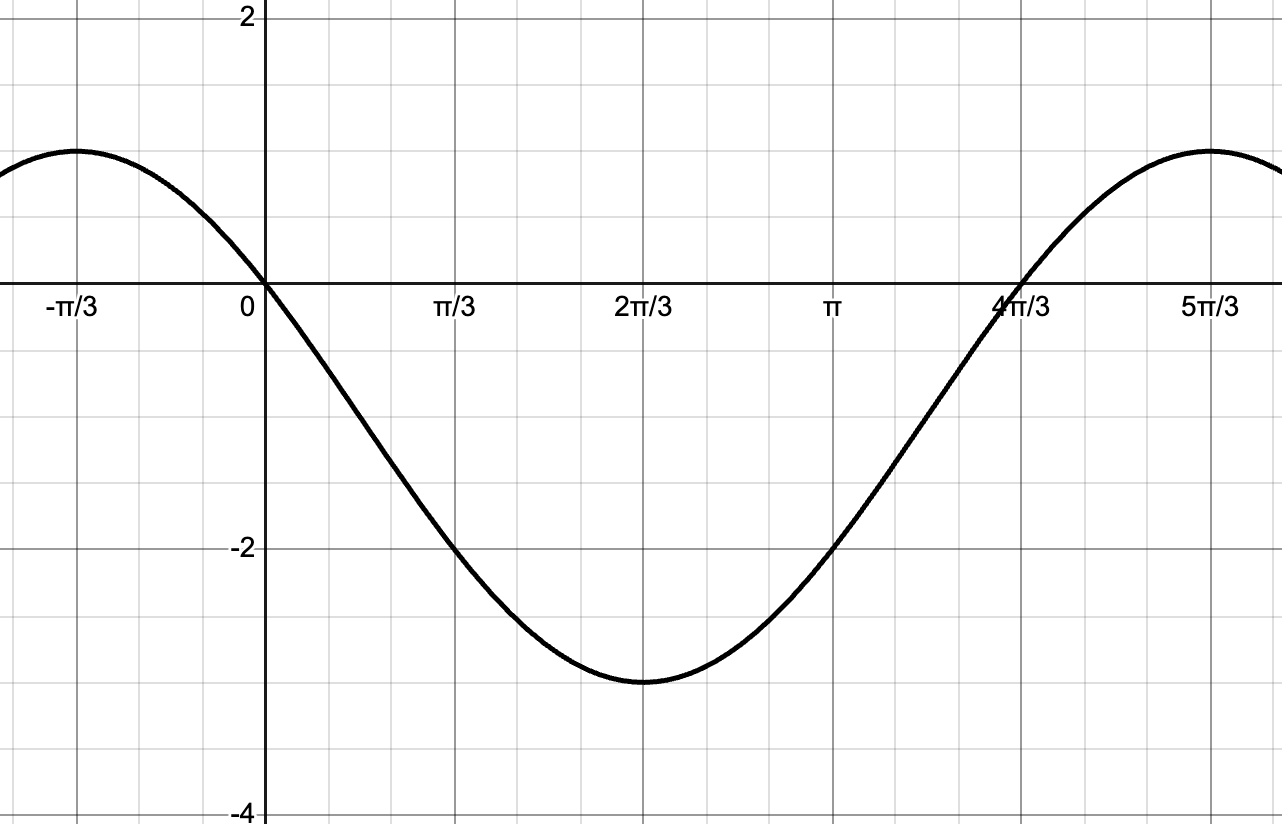
A sinusoidal graph is a shifted, stretched, and possibly reflected version of [latex]y=\sin x[/latex] or [latex]y=\cos x[/latex]. To build its formula, read the graph’s midline (vertical shift), amplitude (height of peaks above the midline), period (cycle length), and phase shift (horizontal shift). Then choose sine or cosine to match a convenient key point (like a peak or a midline crossing) and write:
[latex]y = a\sin\big(b(x-h)\big)+d \quad \text{or} \quad y = a\cos\big(b(x-h)\big)+d[/latex].
Quick Tips: Transforming Sine and Cosine Graphs
-
Midline & Vertical Shift
-
Midline = average of max and min values.
-
[latex]d = \dfrac{\text{max}+\text{min}}{2}[/latex].
-
-
Amplitude
-
Distance from midline to a peak or valley.
-
[latex]|a| = \dfrac{\text{max}-\text{min}}{2}[/latex].
-
If the graph starts by going down from a midline crossing or has peaks where cosine would normally have troughs, let [latex]a<0[/latex] (reflection).
-
-
Period → [latex]b[/latex]
-
Period [latex]P[/latex] = horizontal distance of one full cycle (peak-to-peak, trough-to-trough, or midline-up to next same).
-
[latex]b = \dfrac{2\pi}{P}[/latex].
-
-
Phase Shift [latex]h[/latex]
-
Pick an anchor point:
-
Cosine form → use a peak at [latex]x=h[/latex].
-
Sine form → use an upward midline crossing at [latex]x=h[/latex].
-
-
-
Choose Sine vs. Cosine
-
Starts at a peak → cosine is natural.
-
Starts at a midline going up → sine is natural.
-
Both work with the right [latex]h[/latex]; pick the simpler one.
-
-
Final Formula
-
Keep values exact in terms of [latex]\pi[/latex].
-
[latex]y = a\sin\big(b(x-h)\big)+d \quad \text{or} \quad y = a\cos\big(b(x-h)\big)+d[/latex].
-
You can view the transcript for “Determining the Equation of a Sine and Cosine Graph” here (opens in new window).
Modeling Circular and Periodic Motion
The Main Idea
Circular and periodic motion can be modeled using sine and cosine because these functions naturally repeat in cycles. When an object moves around a circle or follows a repeating up-and-down pattern, its position over time can be described with sinusoidal functions. The general form is
[latex]y = a\sin(bx - c) + d \quad \text{or} \quad y = a\cos(bx - c) + d[/latex].
Here, [latex]a[/latex] represents the maximum displacement (amplitude), [latex]b[/latex] sets how quickly the cycle repeats (related to period or frequency), [latex]c[/latex] shifts the motion left or right in time (phase shift), and [latex]d[/latex] raises or lowers the entire path (vertical shift). These formulas allow us to model phenomena such as a Ferris wheel, a pendulum, tides, or seasonal temperature changes.
Quick Tips: Transforming Sine and Cosine Graphs
-
Amplitude [latex]a[/latex]
-
Distance from midline to peak.
-
Represents the maximum displacement of the motion.
-
-
Period and [latex]b[/latex]
-
Period [latex]P = \dfrac{2\pi}{b}[/latex].
-
Shorter period = faster cycle; longer period = slower cycle.
-
-
Phase Shift [latex]\dfrac{c}{b}[/latex]
-
Determines where the motion starts.
-
Positive [latex]c[/latex] → shift right; Negative [latex]c[/latex] → shift left.
-
-
Vertical Shift [latex]d[/latex]
-
Moves the midline of the motion up or down.
-
Useful for modeling motions above the ground (e.g., a Ferris wheel that never dips below 10 ft).
-
-
Choose Sine vs. Cosine
-
Use cosine if the motion begins at a maximum or minimum.
-
Use sine if the motion begins at the midline going up or down.
-
-
Real-World Connection
-
Ferris wheel: height as a function of time.
-
Tides: water level rising and falling each day.
-
Springs/Pendulums: back-and-forth oscillation.
-
You can view the transcript for “Sine & Cosine Graphs Word Problems (Writing the Equation)” here (opens in new window).