- Evaluate exponential functions.
- Find the equation of an exponential function.
- Use compound interest formulas.
Defining Exponential Functions
The Main Idea
- Exponential Growth and Decay:
- Exponential growth: Increase based on a constant multiplicative rate over equal time increments
- Exponential decay: Decrease based on a constant multiplicative rate over equal time increments
- Contrast with Linear Growth:
- Exponential: Changes by the same percentage over equal increments
- Linear: Changes by the same amount over equal increments
- General Form of Exponential Function:
- [latex]f(x) = ab^x[/latex]
- [latex]a[/latex] is any nonzero number
- [latex]b[/latex] is a positive real number, [latex]b \neq 1[/latex]
- If [latex]b > 1[/latex]: function grows
- If [latex]0 < b < 1[/latex]: function decays
- Evaluating Exponential Functions:
- Substitute the given value for [latex]x[/latex]
- Follow the order of operations carefully
Which of the following equations represent exponential functions?
- [latex]f(x) = 2x^2 - 3x + 1[/latex]
- [latex]g(x) = 0.875^x[/latex]
- [latex]h(x) = 1.75x + 2[/latex]
- [latex]j(x) = 1095.6^{2x}[/latex]
You can view the transcript for “Introduction to Exponential Functions – Nerdstudy” here (opens in new window).
Exponential Growth and Decay
The Main Idea
- Exponential Growth:
- Output increases by a constant factor over equal intervals
- General form: [latex]f(x) = ab^x[/latex], where [latex]b > 1[/latex]
- Example: [latex]f(x) = 2^x[/latex]
- Exponential Decay:
- Output decreases by a constant factor over equal intervals
- General form: [latex]f(x) = ab^x[/latex], where [latex]0 < b < 1[/latex]
- Example: [latex]g(x) = (\frac{1}{2})^x[/latex]
- Key Characteristics of Exponential Functions:
- Domain: [latex](-\infty, \infty)[/latex]
- Range: [latex](0, \infty)[/latex]
- Horizontal asymptote: [latex]y = 0[/latex]
- [latex]y[/latex]-intercept: [latex](0, 1)[/latex] for [latex]f(x) = b^x[/latex]
- No [latex]x[/latex]-intercept
You can view the transcript for “Exponential growth and decay word problems | Algebra II | Khan Academy” here (opens in new window).
Finding Equations of Exponential Functions
The Main Idea
- General Form of Exponential Functions:
- [latex]f(x) = ab^x[/latex]
- [latex]a[/latex]: initial value
- [latex]b[/latex]: growth factor (if [latex]b > 1[/latex]) or decay factor (if [latex]0 < b < 1[/latex])
- Methods for Finding Equations:
- Using two points
- Using a graph
- Key Principle:
- Every point on the graph satisfies the equation of the function
Problem-Solving Strategies
- When Given Two Points:
- If one point is [latex](0, a)[/latex], use it as the initial value
- If no [latex](0, a)[/latex] point, set up a system of equations
- When Given a Graph:
- Choose the [latex]y[/latex]-intercept as one point if possible
- Select a second point with integer coordinates
- Use points far apart to minimize rounding errors
- General Steps:
- Identify or calculate the initial value [latex]a[/latex]
- Use the second point to solve for [latex]b[/latex]
- Write the equation in the form [latex]f(x) = ab^x[/latex]
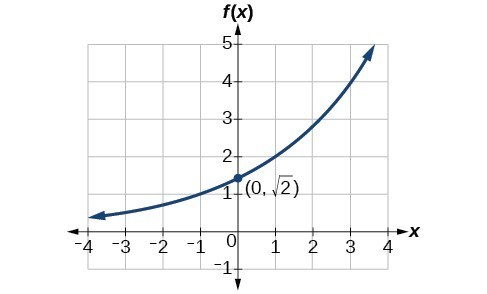
You can view the transcript for “Ex: Find an Exponential Function Given Two Points – Initial Value Not Given” here (opens in new window).
You can view the transcript for “Writing Exponential Functions from a Graph” here (opens in new window).