- Graph exponential functions
- Graph exponential functions using transformations
Graphing Exponential Functions
The Main Idea
- Parent Function: [latex]f(x) = b^x[/latex], where [latex]b > 0[/latex] and [latex]b \neq 1[/latex]
- Key Characteristics:
- Domain: All real numbers [latex](-\infty, \infty)[/latex]
- Range: All positive real numbers [latex](0, \infty)[/latex]
- Horizontal asymptote: [latex]y = 0[/latex]
- y-intercept: [latex](0, 1)[/latex]
- No x-intercept
- Growth vs. Decay:
- If [latex]b > 1[/latex]: Exponential growth (increasing function)
- If [latex]0 < b < 1[/latex]: Exponential decay (decreasing function)
Graphing Strategy
- Create a table of points:
- Include negative and positive [latex]x[/latex]-values
- Always include the [latex]y[/latex]-intercept [latex](0, 1)[/latex]
- Plot at least [latex]3[/latex] points, including the y-intercept
- Draw a smooth curve through the points
- Indicate the horizontal asymptote at [latex]y = 0[/latex]

Watch the following video for another example of graphing an exponential function. The base of the exponential term is between [latex]0[/latex] and [latex]1[/latex], so this graph will represent decay.
You can view the transcript for “Graph a Basic Exponential Function Using a Table of Values” here (opens in new window).
The next video example includes graphing an exponential growth function and defining the domain and range of the function.
You can view the transcript for “Graph an Exponential Function Using a Table of Values” here (opens in new window).
Horizontal and Vertical Translations of Exponential Functions
The Main Idea
- Parent Function: [latex]f(x) = b^x[/latex], where [latex]b > 0[/latex] and [latex]b \neq 1[/latex]
- General Transformed Function: [latex]f(x) = ab^{x-h} + k[/latex]
- [latex]a[/latex]: Vertical stretch/compression
- [latex]h[/latex]: Horizontal shift
- [latex]k[/latex]: Vertical shift
- Key Transformations:
- Vertical Shift: [latex]f(x) = b^x + d[/latex]
- Horizontal Shift: [latex]f(x) = b^{x-c}[/latex]
Transformation Effects
- Vertical Shift ([latex]+d[/latex]):
- Moves graph up [latex]d[/latex] units if [latex]d > 0[/latex], down if [latex]d < 0[/latex]
- Changes [latex]y[/latex]-intercept to [latex](0, 1+d)[/latex]
- Shifts asymptote to [latex]y = d[/latex]
- New range: [latex](d, \infty)[/latex]
- Horizontal Shift ([latex]-c[/latex]):
- Moves graph right [latex]c[/latex] units if [latex]c > 0[/latex], left if [latex]c < 0[/latex]
- Changes [latex]y[/latex]-intercept to [latex](0, b^c)[/latex]
- Asymptote remains at [latex]y = 0[/latex]
- Domain and range unchanged
- Combined Transformations:
- Apply horizontal shift first, then vertical shift
- New [latex]y[/latex]-intercept: [latex](0, b^c + d)[/latex]
- New asymptote: [latex]y = d[/latex]
- New range: [latex](d, \infty)[/latex]
Graphing Strategy
- Identify [latex]b[/latex], [latex]c[/latex], and [latex]d[/latex] in [latex]f(x) = b^{x-c} + d[/latex]
- Draw the horizontal asymptote [latex]y = d[/latex]
- Plot the [latex]y[/latex]-intercept [latex](0, b^c + d)[/latex]
- Sketch the graph, shifting horizontally by [latex]c[/latex] and vertically by [latex]d[/latex]
- State the domain [latex](-\infty, \infty)[/latex], range [latex](d, \infty)[/latex], and asymptote [latex]y = d[/latex]
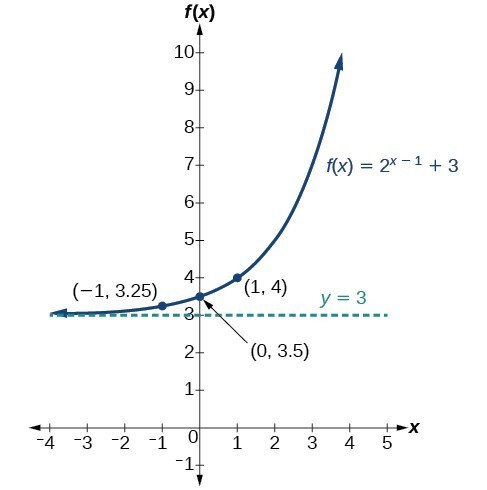
Watch the following video for more examples of the difference between horizontal and vertical shifts of exponential functions and the resulting graphs and equations.
You can view the transcript for “Ex: Match the Graphs of Translated Exponential Function to Equations” here (opens in new window).
Stretching, Compressing, or Reflecting an Exponential Function
The Main Idea
- General Transformed Function: [latex]f(x) = ab^{x-h} + k[/latex]
- [latex]a[/latex]: Vertical stretch/compression and reflection
- [latex]b[/latex]: Base of exponential ([latex]b > 0, b \neq 1[/latex])
- [latex]h[/latex]: Horizontal shift
- [latex]k[/latex]: Vertical shift
- Vertical Stretch/Compression:
- [latex]f(x) = ab^x[/latex], where [latex]a \neq 0[/latex]
- Stretch if [latex]|a| > 1[/latex]
- Compress if [latex]0 < |a| < 1[/latex]
- Reflections:
- About [latex]x[/latex]-axis: [latex]f(x) = -b^x[/latex]
- About [latex]y[/latex]-axis: [latex]f(x) = b^{-x}[/latex]
Transformation Effects
- Vertical Stretch/Compression ([latex]a[/latex]):
- Multiplies all [latex]y[/latex]-values by [latex]|a|[/latex]
- New [latex]y[/latex]-intercept: [latex](0, a)[/latex]
- Domain and horizontal asymptote unchanged
- Reflection about [latex]x[/latex]-axis ([latex]-b^x[/latex]):
- Flips graph upside down
- New range: [latex](-\infty, 0)[/latex] if [latex]b > 1[/latex], [latex](0, -\infty)[/latex] if [latex]0 < b < 1[/latex]
- New [latex]y[/latex]-intercept: [latex](0, -1)[/latex]
- Reflection about [latex]y[/latex]-axis ([latex]b^{-x}[/latex]):
- Reverses left-right orientation
- Domain, range, and [latex]y[/latex]-intercept unchanged
- Growth becomes decay (and vice versa)
Graphing Strategy
- Identify [latex]a[/latex], [latex]b[/latex], [latex]h[/latex], and [latex]k[/latex] in [latex]f(x) = ab^{x-h} + k[/latex]
- Apply transformations in this order:
- Horizontal shift
- Reflection about [latex]y[/latex]-axis (if applicable)
- Vertical stretch/compression
- Reflection about [latex]x[/latex]-axis (if applicable)
- Vertical shift
- Plot key points: [latex]y[/latex]-intercept and a few others
- Sketch the curve and asymptote
- State domain, range, and asymptote


- [latex]f\left(x\right)={e}^{x}[/latex] is compressed vertically by a factor of [latex]\frac{1}{3}[/latex], reflected across the [latex]x[/latex]-axis, and then shifted down [latex]2[/latex] units.
You can view the transcript for “Graphing exponential functions with horizontal and vertical transformations” here (opens in new window).
You can view the transcript for “How to Graph Exponential Functions with Transformations (3 Examples)” here (opens in new window).
You can view the transcript for “Ex: Equations of a Transformed Exponential Function” here (opens in new window).