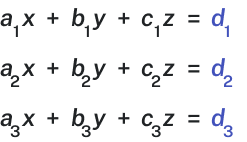
Using Cramer’s Rule to Solve a System of Three Equations in Three Variables
Now that we can find the determinant of a 3 × 3 matrix, we can apply Cramer’s Rule to solve a system of three equations in three variables. Cramer’s Rule is straightforward, following a pattern consistent with Cramer’s Rule for 2 × 2 matrices. As the order of the matrix increases to 3 × 3, however, there are many more calculations required.
When we calculate the determinant to be zero, Cramer’s Rule gives no indication as to whether the system has no solution or an infinite number of solutions. To find out, we have to perform elimination on the system.
If we are writing the determinant [latex]{D}_{x}[/latex], we replace the [latex]x[/latex] column with the constant column. If we are writing the determinant [latex]{D}_{y}[/latex], we replace the [latex]y[/latex] column with the constant column. If we are writing the determinant [latex]{D}_{z}[/latex], we replace the [latex]z[/latex] column with the constant column. Always check the answer.
Find the solution to the given 3 × 3 system using Cramer’s Rule.
Obtaining an answer of [latex]0=0[/latex], a statement that is always true, means that the system has an infinite number of solutions. Graphing the system, we can see that two of the planes are the same and they both intersect the third plane on a line.