Systems of Nonlinear Equations and Inequalities: Learn It 1
Solve a system of nonlinear equations.
Graph a system of nonlinear inequalities.
Solving a System of Nonlinear Equations Using Substitution
A system of nonlinear equations is a system of two or more equations in two or more variables containing at least one equation that is not linear. Recall that a linear equation can take the form [latex]Ax+By+C = 0[/latex]. Any equation that cannot be written in this form in nonlinear.
The substitution method we used for linear systems is the same method we will use for nonlinear systems. We solve one equation for one variable and then substitute the result into the second equation to solve for another variable, and so on. There is, however, a variation in the possible outcomes.
Intersection of a Parabola and a Line
There are three possible types of solutions for a system of nonlinear equations involving a parabola and a line.
possible types of solutions for points of intersection of a parabola and a line
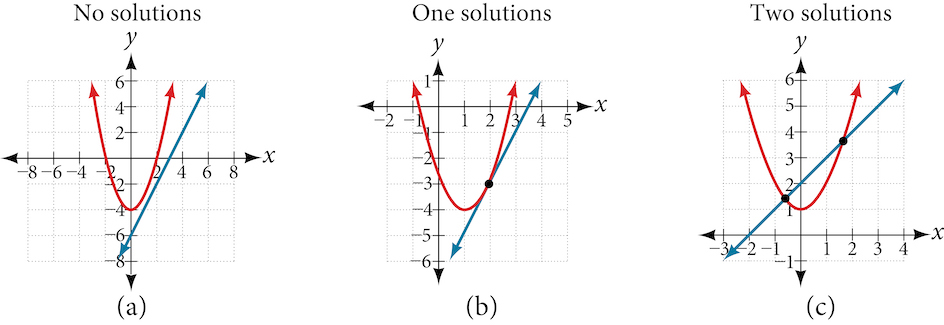
The graphs below illustrate possible solution sets for a system of equations involving a parabola (quadratic function) and a line (linear function).
No solution. The line will never intersect the parabola.
One solution. The line is tangent to the parabola and intersects the parabola at exactly one point.
Two solutions. The line crosses on the inside of the parabola and intersects the parabola at two points.
Given a system of equations containing a line and a parabola, find the solution.
Solve the linear equation for one of the variables.
Substitute the expression obtained in step one into the parabola equation.
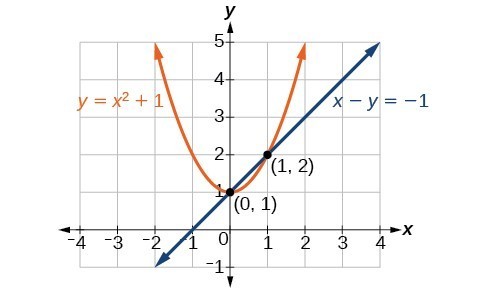
Solving for [latex]y[/latex] gives [latex]y=2[/latex] and [latex]y=1[/latex].
[latex]\\[/latex]
Next, substitute each value for [latex]y[/latex] into the first equation to solve for [latex]x[/latex]. Always substitute the value into the linear equation to check for extraneous solutions.
The solutions are [latex]\left(1,2\right)[/latex] and [latex]\left(0,1\right),\text{}[/latex], which can be verified by substituting these [latex]\left(x,y\right)[/latex] values into both of the original equations.
Could we have substituted values for [latex]y[/latex] into the second equation to solve for [latex]x[/latex]?
Yes, but because [latex]x[/latex] is squared in the second equation this could give us extraneous solutions for [latex]x[/latex].
Notice that [latex]-1[/latex] is an extraneous solution.
Use an online graphing calculator to graph the parabola [latex]y\ =\ x^2+2x-3[/latex]. Now graph the line [latex]ax+by+c\ =\ 0[/latex] and adjust the values of [latex]a[/latex], [latex]b[/latex], and [latex]c[/latex] to find equations for lines that produce systems with the following types of solutions: