Horizontal and Slant Asymptotes
While vertical asymptotes describe the behavior of a graph as the output gets very large or very small, horizontal asymptotes help describe the behavior of a graph as the input gets very large or very small. Recall that a polynomial’s end behavior will mirror that of the leading term. Likewise, a rational function’s end behavior will mirror that of the ratio of the leading terms of the numerator and denominator functions.
[latex]\\[/latex]
If the leading term is positive or negative, and has even or odd degree, it will tell us the toolkit function’s graph behavior it will mimic: [latex]f(x)=x^2, \quad f(x)=-x^2,\quad f(x)=x^3,\quad[/latex] or [latex]\quad f(x)=-x^3[/latex].
[latex]\\[/latex]
The same idea applies to the ratio of leading terms of a rational function.
There are three distinct outcomes when checking for horizontal asymptotes:
- Case 1: If the degree of the denominator [latex]>[/latex] degree of the numerator, there is a horizontal asymptote at [latex]y=0[/latex].
Example: [latex]f\left(x\right)=\dfrac{4x+2}{{x}^{2}+4x - 5}[/latex]
In this case the end behavior is [latex]f\left(x\right)\approx \frac{4x}{{x}^{2}}=\frac{4}{x}[/latex]. This tells us that, as the inputs increase or decrease without bound, this function will behave similarly to the function [latex]g\left(x\right)=\frac{4}{x}[/latex], and the outputs will approach zero, resulting in a horizontal asymptote at [latex]y=0[/latex]. Note that this graph crosses the horizontal asymptote.
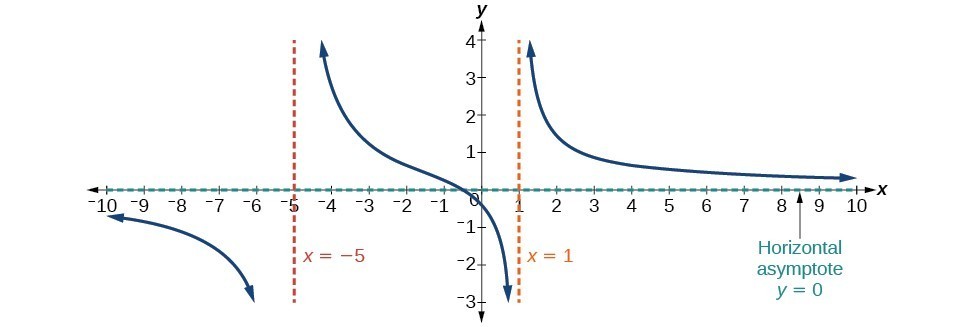
Horizontal Asymptote [latex]y=0[/latex] when [latex]f\left(x\right)=\dfrac{p\left(x\right)}{q\left(x\right)},q\left(x\right)\ne{0}\text{ where degree of }p<\text{degree of q}[/latex]. - Case 2: If the degree of the denominator [latex]<[/latex] degree of the numerator by one, we get a slant asymptote.
Example: [latex]f\left(x\right)=\dfrac{3{x}^{2}-2x+1}{x - 1}[/latex]
In this case the end behavior is [latex]f\left(x\right)\approx \frac{3{x}^{2}}{x}=3x[/latex]. This tells us that as the inputs increase or decrease without bound, this function will behave similarly to the function [latex]g\left(x\right)=3x[/latex]. As the inputs grow large, the outputs will grow and not level off, so this graph has no horizontal asymptote. However, the graph of [latex]g\left(x\right)=3x[/latex] looks like a diagonal line, and since [latex]f[/latex] will behave similarly to [latex]g[/latex], it will approach a line close to [latex]y=3x[/latex]. This line is a slant asymptote (NOTE: the graph of the function itself is just a “sketch” within the parameters of the asymptotes).
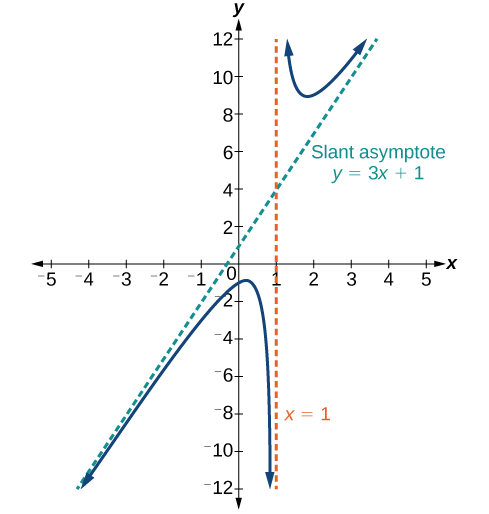
Slant Asymptote when [latex]f\left(x\right)=\dfrac{p\left(x\right)}{q\left(x\right)},q\left(x\right)\ne 0[/latex] where degree of [latex]p>\text{ degree of }q\text{ by }1[/latex]. To find the equation of the slant asymptote, we’ll need to divide the rational expression. The asymptote is the quotient (or result of the division without the remainder). - Case 3: If the degree of the denominator [latex]=[/latex] degree of the numerator, there is a horizontal asymptote at [latex]y=\frac{{a}_{n}}{{b}_{n}}[/latex], where [latex]{a}_{n}[/latex] and [latex]{b}_{n}[/latex] are the leading coefficients of [latex]p\left(x\right)[/latex] and [latex]q\left(x\right)[/latex] for [latex]f\left(x\right)=\frac{p\left(x\right)}{q\left(x\right)},q\left(x\right)\ne 0[/latex].
Example: [latex]f\left(x\right)=\dfrac{3{x}^{2}+2}{{x}^{2}+4x - 5}[/latex]
In this case the end behavior is [latex]f\left(x\right)\approx \frac{3{x}^{2}}{{x}^{2}}=3[/latex]. This tells us that as the inputs grow large, this function will behave like the function [latex]g\left(x\right)=3[/latex], which is a horizontal line. As [latex]x\to \pm \infty ,f\left(x\right)\to 3[/latex], resulting in a horizontal asymptote at [latex]y=3[/latex]. Note that this graph crosses the horizontal asymptote.
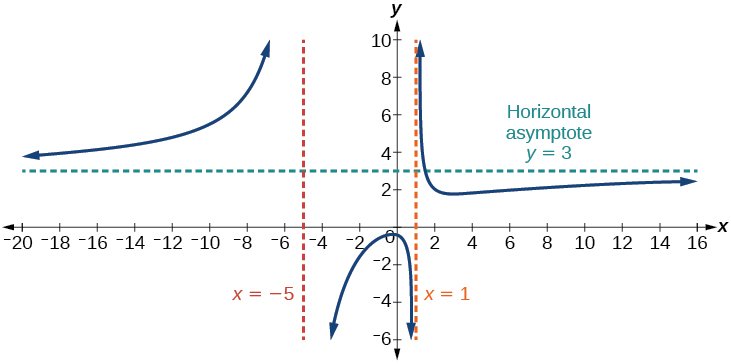
Horizontal Asymptote when [latex]f\left(x\right)=\frac{p\left(x\right)}{q\left(x\right)},q\left(x\right)\ne 0\text{ where degree of }p=\text{degree of }q[/latex].
horizontal asymptotes of rational functions
The horizontal asymptote of a rational function can be determined by looking at the degrees of the numerator and denominator.
- Case 1: Degree of numerator is less than degree of denominator: horizontal asymptote at [latex]y=0[/latex]
- Case 2: Degree of numerator is greater than degree of denominator by one: no horizontal asymptote; slant asymptote.
- If the degree of the numerator is greater than the degree of the denominator by more than one, the end behavior of the function’s graph will mimic that of the graph of the reduced ratio of leading terms.
- Case 3: Degree of numerator is equal to degree of denominator: horizontal asymptote at ratio of leading coefficients.
It should be noted that, if the degree of the numerator is larger than the degree of the denominator by more than one, the end behavior of the graph will mimic the behavior of the reduced end behavior fraction.
- Find values of [latex]a[/latex] and [latex]b[/latex] that will give a graph with a slant asymptote.
- Find values of [latex]a[/latex] and [latex]b[/latex] that will give a graph with a horizontal asymptote at [latex]y = 0[/latex]
- Find values of [latex]a[/latex] and [latex]b[/latex] that will give a graph with a horizontal asymptote that is the ratio of the leading coefficients of [latex]f(x)[/latex].
- [latex]g\left(x\right)=\dfrac{6{x}^{3}-10x}{2{x}^{3}+5{x}^{2}}[/latex]
- [latex]h\left(x\right)=\dfrac{{x}^{2}-4x+1}{x+2}[/latex]
- [latex]k\left(x\right)=\dfrac{{x}^{2}+4x}{{x}^{3}-8}[/latex]

[latex]f\left(x\right)=\dfrac{\left(x - 2\right)\left(x+3\right)}{\left(x - 1\right)\left(x+2\right)\left(x - 5\right)}[/latex]
