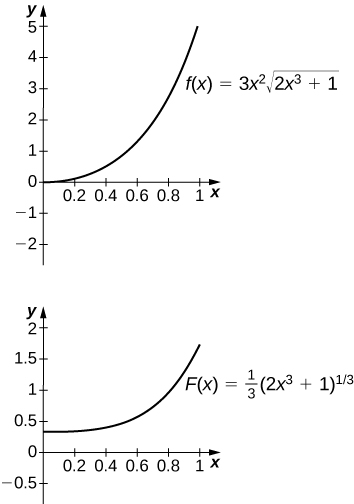
The antiderivative is [latex]y= \sin (\text{ln}(2x)).[/latex] Since the antiderivative is not continuous at [latex]x=0,[/latex] one cannot find a value of C that would make [latex]y= \sin (\text{ln}(2x))-C[/latex] work as a definite integral.
The antiderivative is [latex]y=\frac{1}{2}\phantom{\rule{0.05em}{0ex}}{ \sec }^{2}x.[/latex] You should take [latex]C=-2[/latex] so that [latex]F(-\frac{\pi }{3})=0.[/latex]
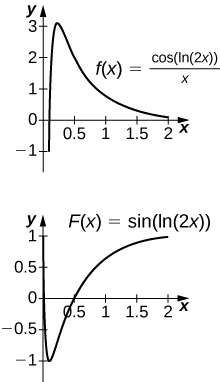
The antiderivative is [latex]y=\frac{1}{3}{(2{x}^{3}+1)}^{3\text{/}2}.[/latex] One should take [latex]C=-\frac{1}{3}.[/latex]
No, because the integrand is discontinuous at [latex]x=1.[/latex]
[latex]u= \sin ({t}^{2});[/latex] the integral becomes [latex]\frac{1}{2}{\displaystyle\int }_{0}^{0}udu.[/latex]
[latex]u=(1+{(t-\frac{1}{2})}^{2});[/latex] the integral becomes [latex]\text{−}{\displaystyle\int }_{5\text{/}4}^{5\text{/}4}\frac{1}{u}du.[/latex]
[latex]u=1-t;[/latex] the integral becomes[latex]\begin{array}{l}{\displaystyle\int }_{1}^{-1}u \cos (\pi (1-u))du\hfill \\ ={\displaystyle\int }_{1}^{-1}u\left[ \cos \pi \cos u- \sin \pi \sin u\right]du\hfill \\ =\text{−}{\displaystyle\int }_{1}^{-1}u \cos udu\hfill \\ ={\displaystyle\int }_{-1}^{1}u \cos udu=0\hfill \end{array}[/latex]
since the integrand is odd.
Setting [latex]u=cx[/latex] and [latex]du=cdx[/latex] gets you [latex]\frac{1}{\frac{b}{c}-\frac{a}{c}}{\displaystyle\int }_{a\text{/}c}^{b\text{/}c}f(cx)dx=\frac{c}{b-a}{\displaystyle\int }_{u=a}^{u=b}f(u)\frac{du}{c}=\frac{1}{b-a}{\displaystyle\int }_{a}^{b}f(u)du.[/latex]
[latex]{\displaystyle\int }_{0}^{x}g(t)dt=\frac{1}{2}{\displaystyle\int }_{u=1-{x}^{2}}^{1}\frac{du}{{u}^{a}}=\frac{1}{2(1-a)}{u}^{1-a}{|}_{u=1-{x}^{2}}^{1}=\frac{1}{2(1-a)}(1-{(1-{x}^{2})}^{1-a}).[/latex] As [latex]x\to 1[/latex] the limit is [latex]\frac{1}{2(1-a)}[/latex] if [latex]a<1,[/latex] and the limit diverges to +∞ if [latex]a>1.[/latex]
Exact solution: [latex]\frac{e-1}{e},{R}_{50}=0.6258.[/latex] Since [latex]f[/latex] is decreasing, the right endpoint estimate underestimates the area.
Exact solution: [latex]\frac{2\text{ln}(3)-\text{ln}(6)}{2},{R}_{50}=0.2033.[/latex] Since [latex]f[/latex] is increasing, the right endpoint estimate overestimates the area.
Exact solution: [latex]-\frac{1}{\text{ln}(4)},{R}_{50}=-0.7164.[/latex] Since [latex]f[/latex] is increasing, the right endpoint estimate overestimates the area (the actual area is a larger negative number).
![Two graphs. The first is the function f(x) = sin(x) / cos(x)^3 over [-5pi/16, 5pi/16]. It is an increasing concave down function for values less than zero and an increasing concave up function for values greater than zero. The second is the fuction f(x) = ½ sec(x)^2 over the same interval. It is a wide, concave up curve which decreases for values less than zero and increases for values greater than zero.](https://s3-us-west-2.amazonaws.com/courses-images/wp-content/uploads/sites/2332/2018/01/11204239/CNX_Calc_Figure_05_05_206.jpg)