Power Series and Applications: Get Stronger Answer Key
Introduction to Power Series
True. If a series converges then its terms tend to zero.
False. It would imply that [latex]{a}{n}{x}^{n}\to 0[/latex] for [latex]|x|
It must converge on [latex]\left(0,6\right][/latex] and hence at: a. [latex]x=1[/latex]; b. [latex]x=2[/latex]; c. [latex]x=3[/latex]; d. [latex]x=0[/latex]; e. [latex]x=5.99[/latex]; and f. [latex]x=0.000001[/latex].
[latex]|\dfrac{{a}{n+1}{2}^{n+1}{x}^{n+1}}{{a}{n}{2}^{n}{x}^{n}}|=2|x||\dfrac{{a}{n+1}}{{a}{n}}|\to 2|x|[/latex] so [latex]R=\dfrac{1}{2}[/latex]
[latex]|\dfrac{{a}{n+1}{\left(\dfrac{\pi }{e}\right)}^{n+1}{x}^{n+1}}{{a}{n}{\left(\dfrac{\pi }{e}\right)}^{n}{x}^{n}}|=\dfrac{\pi |x|}{e}|\dfrac{{a}{n+1}}{{a}{n}}|\to \dfrac{\pi |x|}{e}[/latex] so [latex]R=\dfrac{e}{\pi }[/latex]
[latex]|\dfrac{{a}{n+1}{\left(-1\right)}^{n+1}{x}^{2n+2}}{{a}{n}{\left(-1\right)}^{n}{x}^{2n}}|=|{x}^{2}||\dfrac{{a}{n+1}}{{a}{n}}|\to |{x}^{2}|[/latex] so [latex]R=1[/latex]
[latex]{a}{n}=\dfrac{{2}^{n}}{n}[/latex] so [latex]\dfrac{{a}{n+1}x}{{a}_{n}}\to 2x[/latex]. so [latex]R=\dfrac{1}{2}[/latex]. When [latex]x=\dfrac{1}{2}[/latex] the series is harmonic and diverges. When [latex]x=-\dfrac{1}{2}[/latex] the series is alternating harmonic and converges. The interval of convergence is [latex]I=\left[-\dfrac{1}{2},\dfrac{1}{2}\right)[/latex].
[latex]{a}{n}=\dfrac{n}{{2}^{n}}[/latex] so [latex]\dfrac{{a}{n+1}x}{{a}_{n}}\to \dfrac{x}{2}[/latex] so [latex]R=2[/latex]. When [latex]x=\pm2[/latex] the series diverges by the divergence test. The interval of convergence is [latex]I=\left(-2,2\right)[/latex].
[latex]{a}_{n}=\dfrac{{n}^{2}}{{2}^{n}}[/latex] so [latex]R=2[/latex]. When [latex]x=\pm[/latex] the series diverges by the divergence test. The interval of convergence is [latex]I=\left(-2,2\right)[/latex].
[latex]{a}_{k}=\dfrac{{\pi }^{k}}{{k}^{\pi }}[/latex] so [latex]R=\dfrac{1}{\pi }[/latex]. When [latex]x=\pm\dfrac{1}{\pi }[/latex] the series is an absolutely convergent p-series. The interval of convergence is [latex]I=\left[-\dfrac{1}{\pi },\dfrac{1}{\pi }\right][/latex].
[latex]{a}{n}=\dfrac{{10}^{n}}{n\text{!}},\dfrac{{a}{n+1}x}{{a}_{n}}=\dfrac{10x}{n+1}\to 0<1[/latex] so the series converges for all x by the ratio test and [latex]I=\left(\text{-}\infty ,\infty \right)[/latex].
[latex]{a}{k}=\dfrac{{\left(k\text{!}\right)}^{2}}{\left(2k\right)\text{!}}[/latex] so [latex]\dfrac{{a}{k+1}}{{a}_{k}}=\dfrac{{\left(k+1\right)}^{2}}{\left(2k+2\right)\left(2k+1\right)}\to \dfrac{1}{4}[/latex] so [latex]R=4[/latex]
[latex]{a}{k}=\dfrac{k\text{!}}{1\cdot 3\cdot 5\cdots\left(2k - 1\right)}[/latex] so [latex]\dfrac{{a}{k+1}}{{a}_{k}}=\dfrac{k+1}{2k+1}\to \dfrac{1}{2}[/latex] so [latex]R=2[/latex]
[latex]{a}{n}=\dfrac{1}{\left(\begin{array}{c}2n\ n\end{array}\right)}[/latex] so [latex]\dfrac{{a}{n+1}}{{a}_{n}}=\dfrac{{\left(\left(n+1\right)\text{!}\right)}^{2}}{\left(2n+2\right)\text{!}}\dfrac{2n\text{!}}{{\left(n\text{!}\right)}^{2}}=\dfrac{{\left(n+1\right)}^{2}}{\left(2n+2\right)\left(2n+1\right)}\to \dfrac{1}{4}[/latex] so [latex]R=4[/latex]
[latex]\dfrac{{a}{n+1}}{{a}{n}}=\dfrac{{\left(n+1\right)}^{3}}{\left(3n+3\right)\left(3n+2\right)\left(3n+1\right)}\to \dfrac{1}{27}[/latex] so [latex]R=27[/latex]
[latex]{a}{n}=\dfrac{n\text{!}}{{n}^{n}}[/latex] so [latex]\dfrac{{a}{n+1}}{{a}_{n}}=\dfrac{\left(n+1\right)\text{!}}{n\text{!}}\dfrac{{n}^{n}}{{\left(n+1\right)}^{n+1}}={\left(\dfrac{n}{n+1}\right)}^{n}\to \dfrac{1}{e}[/latex] so [latex]R=e[/latex]
[latex]f\left(x\right)=\displaystyle\sum _{n=0}^{\infty }{\left(1-x\right)}^{n}[/latex] on [latex]I=\left(0,2\right)[/latex]
[latex]\displaystyle\sum _{n=0}^{\infty }{x}^{2n+1}[/latex] on [latex]I=\left(-1,1\right)[/latex]
[latex]\displaystyle\sum _{n=0}^{\infty }{\left(-1\right)}^{n}{x}^{2n+2}[/latex] on [latex]I=\left(-1,1\right)[/latex]
[latex]\displaystyle\sum _{n=0}^{\infty }{2}^{n}{x}^{n}[/latex] on [latex]\left(-\dfrac{1}{2},\dfrac{1}{2}\right)[/latex]
[latex]\displaystyle\sum _{n=0}^{\infty }{4}^{n}{x}^{2n+2}[/latex] on [latex]\left(-\dfrac{1}{2},\dfrac{1}{2}\right)[/latex]
Converges on [latex]\left(-1,1\right)[/latex] by the ratio test
Consider the series [latex]\displaystyle\sum {b}{k}{x}^{k}[/latex] where [latex]{b}{k}={a}{k}[/latex] if [latex]k={n}^{2}[/latex] and [latex]{b}{k}=0[/latex] otherwise. Then [latex]{b}{k}\le {a}{k}[/latex] and so the series converges on [latex]\left(-1,1\right)[/latex] by the comparison test.
The approximation is more accurate near [latex]x=-1[/latex]. The partial sums follow [latex]\dfrac{1}{1-x}[/latex] more closely as N increases but are never accurate near [latex]x=1[/latex] since the series diverges there.
The approximation appears to stabilize quickly near both [latex]x=\pm 1[/latex].
Operations with Power Series
[latex]\dfrac{1}{2}\left(f\left(x\right)+g\left(x\right)\right)=\displaystyle\sum _{n=0}^{\infty }\dfrac{{x}^{2n}}{\left(2n\right)\text{!}}[/latex] and [latex]\dfrac{1}{2}\left(f\left(x\right)-g\left(x\right)\right)=\displaystyle\sum _{n=0}^{\infty }\dfrac{{x}^{2n+1}}{\left(2n+1\right)\text{!}}[/latex].
[latex]P={P}{1}+\cdots+{P}{20}[/latex] where [latex]{P}_{k}=10,000\dfrac{1}{{\left(1+r\right)}^{k}}[/latex]. Then [latex]P=10,000\displaystyle\sum _{k=1}^{20}\dfrac{1}{{\left(1+r\right)}^{k}}=10,000\dfrac{1-{\left(1+r\right)}^{-20}}{r}[/latex]. When [latex]r=0.03,P\approx 10,000\times 14.8775=148,775[/latex]. When [latex]r=0.05,P\approx 10,000\times 12.4622=124,622[/latex]. When [latex]r=0.07,P\approx 105,940[/latex].
In general, [latex]P=\dfrac{C\left(1-{\left(1+r\right)}^{\text{-}N}\right)}{r}[/latex] for N years of payouts, or [latex]C=\dfrac{Pr}{1-{\left(1+r\right)}^{\text{-}N}}[/latex]. For [latex]N=20[/latex] and [latex]P=100,000[/latex], one has [latex]C=6721.57[/latex] when [latex]r=0.03;C=8024.26[/latex] when [latex]r=0.05[/latex]; and [latex]C\approx 9439.29[/latex] when [latex]r=0.07[/latex].
In general, [latex]P=\dfrac{C}{r}[/latex]. Thus, [latex]r=\dfrac{C}{P}=5\times \dfrac{{10}^{4}}{{10}^{6}}=0.05[/latex].
[latex]{a}{n}=2,{b}{n}=n[/latex] so [latex]{c}{n}=\displaystyle\sum {k=0}^{n}{b}{k}{a}{n-k}=2\displaystyle\sum _{k=0}^{n}k=\left(n\right)\left(n+1\right)[/latex] and [latex]f\left(x\right)g\left(x\right)=\displaystyle\sum _{n=1}^{\infty }n\left(n+1\right){x}^{n}[/latex]
[latex]{a}{n}={b}{n}={2}^{\text{-}n}[/latex] so [latex]{c}{n}=\displaystyle\sum {k=1}^{n}{b}{k}{a}{n-k}={2}^{\text{-}n}\displaystyle\sum _{k=1}^{n}1=\dfrac{n}{{2}^{n}}[/latex] and [latex]f\left(x\right)g\left(x\right)=\displaystyle\sum _{n=1}^{\infty }n{\left(\dfrac{x}{2}\right)}^{n}[/latex]
The derivative of [latex]f[/latex] is [latex]-\dfrac{1}{{\left(1+x\right)}^{2}}=\text{-}\displaystyle\sum _{n=0}^{\infty }{\left(-1\right)}^{n}\left(n+1\right){x}^{n}[/latex].
The indefinite integral of [latex]f[/latex] is [latex]\dfrac{1}{1+{x}^{2}}=\displaystyle\sum _{n=0}^{\infty }{\left(-1\right)}^{n}{x}^{2n}[/latex].
[latex]\displaystyle\sum _{k=1}^{\infty }\dfrac{{x}^{k}}{k}=\text{-}\text{ln}\left(1-x\right)[/latex] so [latex]\displaystyle\sum _{k=1}^{\infty }\dfrac{{x}^{3k}}{6k}=-\dfrac{1}{6}\text{ln}\left(1-{x}^{3}\right)[/latex]. The radius of convergence is equal to 1 by the ratio test.
If [latex]y={2}^{\text{-}x}[/latex], then [latex]\displaystyle\sum {k=1}^{\infty }{y}^{k}=\dfrac{y}{1-y}=\dfrac{{2}^{\text{-}x}}{1-{2}^{\text{-}x}}=\dfrac{1}{{2}^{x}-1}[/latex]. If [latex]{a}{k}={2}^{\text{-}kx}[/latex], then [latex]\dfrac{{a}{k+1}}{{a}{k}}={2}^{\text{-}x}<1[/latex] when [latex]x>0[/latex]. So the series converges for all [latex]x>0[/latex].
Answers will vary.
The solid curve is [latex]{S}{5}[/latex]. The dashed curve is [latex]{S}{2}[/latex], dotted is [latex]{S}{3}[/latex], and dash-dotted is [latex]{S}{4}[/latex]
When [latex]x=-\dfrac{1}{2},\text{-}\text{ln}\left(2\right)=\text{ln}\left(\dfrac{1}{2}\right)=\text{-}\displaystyle\sum _{n=1}^{\infty }\dfrac{1}{n{2}^{n}}[/latex]. Since [latex]\displaystyle\sum _{n=11}^{\infty }\dfrac{1}{n{2}^{n}}<\displaystyle\sum _{n=11}^{\infty }\dfrac{1}{{2}^{n}}=\dfrac{1}{{2}^{10}}[/latex], one has [latex]\displaystyle\sum _{n=1}^{10}\dfrac{1}{n{2}^{n}}=0.69306\ldots[/latex] whereas [latex]\text{ln}\left(2\right)=0.69314\ldots[/latex]; therefore, [latex]N=10[/latex].
[latex]6{S}{N}\left(\dfrac{1}{\sqrt{3}}\right)=2\sqrt{3}\displaystyle\sum {n=0}^{N}{\left(-1\right)}^{n}\dfrac{1}{{3}^{n}\left(2n+1\right)}[/latex]. One has [latex]\pi -6{S}{4}\left(\dfrac{1}{\sqrt{3}}\right)=0.00101\ldots[/latex] and [latex]\pi -6{S}{5}\left(\dfrac{1}{\sqrt{3}}\right)=0.00028\ldots[/latex] so [latex]N=5[/latex] is the smallest partial sum with accuracy to within 0.001. Also, [latex]\pi -6{S}{7}\left(\dfrac{1}{\sqrt{3}}\right)=0.00002\ldots[/latex] while [latex]\pi -6{S}{8}\left(\dfrac{1}{\sqrt{3}}\right)=-0.000007\ldots[/latex] so [latex]N=8[/latex] is the smallest N to give accuracy to within 0.00001.
[latex]\dfrac{{d}^{2}}{d{x}^{2}}{x}^{\dfrac{1}{3}}=-\dfrac{2}{9{x}^{\dfrac{5}{3}}}\ge -0.00092\ldots[/latex] when [latex]x\ge 28[/latex] so the remainder estimate applies to the linear approximation [latex]{x}^{\dfrac{1}{3}}\approx {p}_{1}\left(27\right)=3+\dfrac{x - 27}{27}[/latex], which gives [latex]{\left(28\right)}^{\dfrac{1}{3}}\approx 3+\dfrac{1}{27}=3.\overline{037}[/latex], while [latex]{\left(28\right)}^{\dfrac{1}{3}}\approx 3.03658[/latex].
Using the estimate [latex]\dfrac{{2}^{10}}{10\text{!}}<0.000283[/latex] we can use the Taylor expansion of order 9 to estimate [latex]e^{x}[/latex] at [latex]x=2[/latex]. as [latex]{e}^{2}\approx {p}_{9}\left(2\right)=1+2+\dfrac{{2}^{2}}{2}+\dfrac{{2}^{3}}{6}+\cdots+\dfrac{{2}^{9}}{9\text{!}}=7.3887\ldots[/latex] whereas [latex]{e}^{2}\approx 7.3891[/latex].
Since [latex]\dfrac{{d}^{n}}{d{x}^{n}}\left(\text{ln}x\right)={\left(-1\right)}^{n - 1}\dfrac{\left(n - 1\right)\text{!}}{{x}^{n}},{R}{1000}\approx \dfrac{1}{1001}[/latex]. One has [latex]{p}{1000}\left(1\right)=\displaystyle\sum _{n=1}^{1000}\dfrac{{\left(-1\right)}^{n - 1}}{n}\approx 0.6936[/latex] whereas [latex]\text{ln}\left(2\right)\approx 0.6931\cdots[/latex].
Since [latex]{f}^{\left(n+1\right)}\left(z\right)[/latex] is [latex]\sin{z}[/latex] or [latex]\cos{z}[/latex], we have [latex]M=1[/latex]. Since [latex]|x - 0|\le \dfrac{\pi }{2}[/latex], we seek the smallest n such that [latex]\dfrac{{\pi }^{n+1}}{{2}^{n+1}\left(n+1\right)\text{!}}\le 0.001[/latex]. The smallest such value is [latex]n=7[/latex]. The remainder estimate is [latex]{R}_{7}\le 0.00092[/latex].
Since [latex]{f}^{\left(n+1\right)}\left(z\right)=\pm{e}^{\text{-}z}[/latex] one has [latex]M={e}^{3}[/latex]. Since [latex]|x - 0|\le 3[/latex], one seeks the smallest n such that [latex]\dfrac{{3}^{n+1}{e}^{3}}{\left(n+1\right)\text{!}}\le 0.001[/latex]. The smallest such value is [latex]n=14[/latex]. The remainder estimate is [latex]{R}_{14}\le 0.000220[/latex].
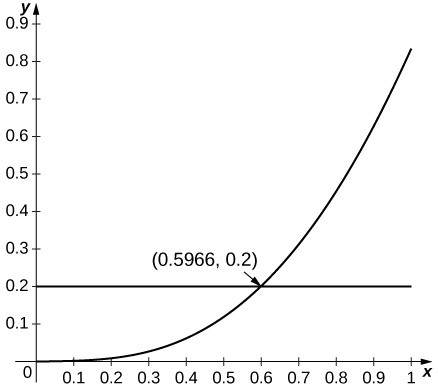
Since [latex]\sin{x}[/latex] is increasing for small x and since [latex]\mathrm{si}n\text{''}x=\text{-}\sin{x}[/latex], the estimate applies whenever [latex]{R}^{2}\sin\left(R\right)\le 0.2[/latex], which applies up to [latex]R=0.596[/latex].
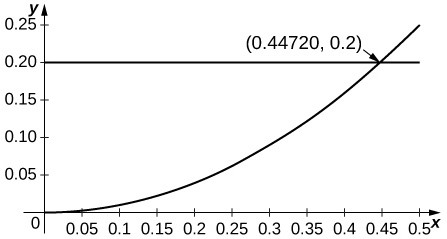
Since the second derivative of [latex]\cos{x}[/latex] is [latex]\text{-}\cos{x}[/latex] and since [latex]\cos{x}[/latex] is decreasing away from [latex]x=0[/latex], the estimate applies when [latex]{R}^{2}\cos{R}\le 0.2[/latex] or [latex]R\le 0.447[/latex].
Values of derivatives are the same as for [latex]x=0[/latex] so [latex]\cos{x}={\displaystyle\sum _{n=0}^{\infty }\left(-1\right)}^{n}\dfrac{{\left(x - 2\pi \right)}^{2n}}{\left(2n\right)\text{!}}[/latex]
[latex]\cos\left(\dfrac{\pi }{2}\right)=0,\text{-}\sin\left(\dfrac{\pi }{2}\right)=-1[/latex] so [latex]\cos{x}=\displaystyle\sum _{n=0}^{\infty }{\left(-1\right)}^{n+1}\dfrac{{\left(x-\dfrac{\pi }{2}\right)}^{2n+1}}{\left(2n+1\right)\text{!}}[/latex], which is also [latex]\text{-}\cos\left(x-\dfrac{\pi }{2}\right)[/latex].
The derivatives are [latex]{f}^{\left(n\right)}\left(1\right)=e[/latex] so [latex]{e}^{x}=e\displaystyle\sum _{n=0}^{\infty }\dfrac{{\left(x - 1\right)}^{n}}{n\text{!}}[/latex].
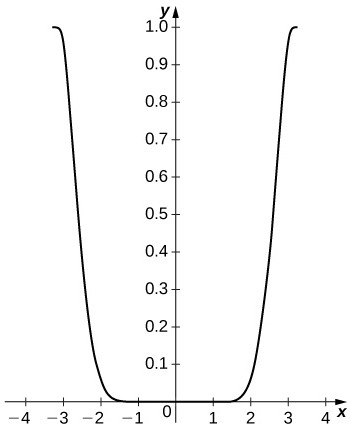
The difference is small on the interior of the interval but approaches [latex]1[/latex] near the endpoints. The remainder estimate is [latex]|{R}_{4}|=\dfrac{{\pi }^{5}}{120}\approx 2.552[/latex].
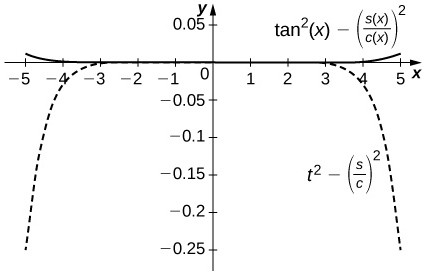
The difference is on the order of [latex]{10}^{-4}[/latex] on [latex]\left[-1,1\right][/latex] while the Taylor approximation error is around [latex]0.1[/latex] near [latex]\pm 1[/latex]. The top curve is a plot of [latex]{\tan}^{2}x-{\left(\dfrac{{S}{5}\left(x\right)}{{C}{4}\left(x\right)}\right)}^{2}[/latex] and the lower dashed plot shows [latex]{t}^{2}-{\left(\dfrac{{S}{5}}{{C}{4}}\right)}^{2}[/latex].
Using the expansion for [latex]\tan{x}[/latex] gives [latex]1+\dfrac{x}{3}+\dfrac{2{x}^{2}}{15}[/latex].
[latex]\dfrac{1}{1+{x}^{2}}=\displaystyle\sum _{n=0}^{\infty }{\left(-1\right)}^{n}{x}^{2n}[/latex] so [latex]R=1[/latex] by the ratio test.
[latex]\text{ln}\left(1+{x}^{2}\right)=\displaystyle\sum _{n=1}^{\infty }\dfrac{{\left(-1\right)}^{n - 1}}{n}{x}^{2n}[/latex] so [latex]R=1[/latex] by the ratio test.