Skip to content
Systems of Equations and Inequalities: Get Stronger Answer Key
Systems of Linear Equations: Two Variables
- Yes
- Yes
- [latex](-1,2)[/latex]
- [latex](-3,1)[/latex]
- [latex](-\dfrac{3}{5},0)[/latex]
- No solutions exist.
- [latex](\dfrac{72}{5},\dfrac{132}{5})[/latex]
- [latex](6,-6)[/latex]
- [latex](-\dfrac{1}{2},\dfrac{1}{10})[/latex]
- No solutions exist.
- [latex](-\dfrac{1}{5},\dfrac{2}{3})[/latex]
- [latex](x,\dfrac{x+3}{2})[/latex]
- [latex](-4,4)[/latex]
- [latex](\dfrac{1}{2},\dfrac{1}{8})[/latex]
- [latex](\dfrac{1}{6},0)[/latex]
- [latex](x,2(7x-6))[/latex]
- [latex](-\dfrac{5}{6},\dfrac{4}{3})[/latex]
- Consistent with one solution
- Consistent with one solution
- Dependent with infinitely many solutions
- They never turn a profit.
- [latex](1,250,100,000)[/latex]
- The numbers are [latex]7.5[/latex] and [latex]20.5[/latex].
- [latex]24,000[/latex]
- [latex]790[/latex] second-year students, [latex]805[/latex] first-year students
- [latex]56[/latex] men, [latex]74[/latex] women
- [latex]10[/latex] gallons of [latex]10 \%[/latex] solution, [latex]15[/latex] gallons of [latex]60 \%[/latex] solution
Systems of Linear Equations: Three Variables
- No
- Yes
- [latex](-1,4,2)[/latex]
- [latex](-\dfrac{85}{107},\dfrac{312}{107},\dfrac{191}{107})[/latex]
- [latex](1,\dfrac{1}{2},0)[/latex]
- [latex](4,-6,1)[/latex]
- [latex](x,\dfrac{1}{27}(65-16x),\dfrac{x+28}{27})[/latex]
- [latex](-\dfrac{45}{13},\dfrac{17}{13},-2)[/latex]
- No solutions exist[/latex]
- [latex](0,0,0)[/latex]
- [latex](\dfrac{4}{7},-\dfrac{1}{7},-\dfrac{3}{7})[/latex]
- [latex]24[/latex], [latex]36[/latex], [latex]48[/latex]
- [latex]70[/latex] grandparents, [latex]140[/latex] parents, [latex]190[/latex] children
- Your share was [latex]$19.95[/latex], Shani’s share was [latex]$40[/latex], and your other roommate’s share was [latex]$22.05[/latex].
- There are infinitely many solutions; we need more information
- [latex]500[/latex] students, [latex]225[/latex] children, and [latex]450[/latex] adults
- The BMW was [latex]$49,636[/latex], the Jeep was [latex]$42,636[/latex], and the Toyota was [latex]$47,727[/latex].
Systems of Nonlinear Equations and Inequalities
- [latex](0,-3), (3,0)[/latex]
- [latex](-\dfrac{3\sqrt{2}}{2},\dfrac{3\sqrt{2}}{2}), (\dfrac{3\sqrt{2}}{2},-\dfrac{3\sqrt{2}}{2})[/latex]
- [latex](-3,0), (3,0)[/latex]
- [latex](\dfrac{1}{4},-\dfrac{\sqrt{62}}{8}), (\dfrac{1}{4},\dfrac{\sqrt{62}}{8})[/latex]
- [latex](-\dfrac{\sqrt{398}}{4},-\dfrac{199}{4}), (\dfrac{\sqrt{398}}{4},-\dfrac{199}{4})[/latex]
- [latex](0,2), (1,3)[/latex]
- [latex](-\sqrt{\dfrac{1}{2}}(\sqrt{5}-1),\dfrac{1}{2}(1-\sqrt{5})), (\sqrt{\dfrac{1}{2}}(\sqrt{5}-1),\dfrac{1}{2}(1-\sqrt{5}))[/latex]
- [latex](5,0)[/latex]
- [latex](0,0)[/latex]
- [latex](3,0)[/latex]
- No Solutions Exist
- No Solutions Exist
- [latex](-\dfrac{\sqrt{2}}{2},-\dfrac{\sqrt{2}}{2}), (-\dfrac{\sqrt{2}}{2},\dfrac{\sqrt{2}}{2}), (\dfrac{\sqrt{2}}{2},-\dfrac{\sqrt{2}}{2}), (\dfrac{\sqrt{2}}{2},\dfrac{\sqrt{2}}{2})[/latex]
- [latex](2,0)[/latex]

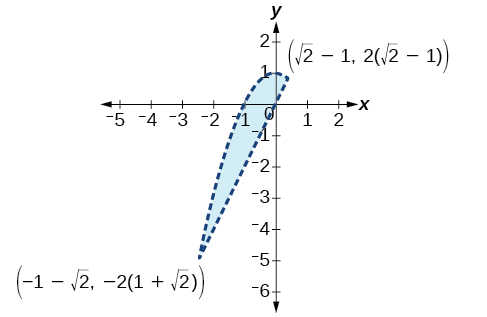
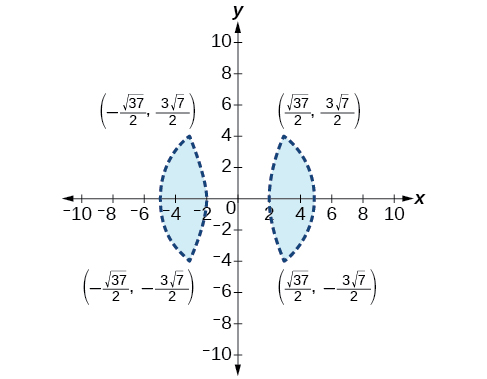
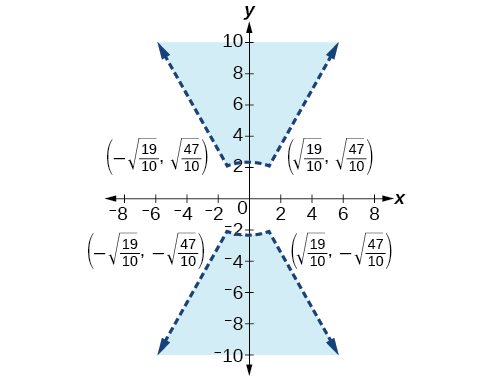
- [latex]12, 288[/latex]
- [latex]2–20[/latex] computers
Partial Fraction Decomposition
- [latex]\dfrac{8}{x+3}-\dfrac{5}{x-8}[/latex]
- [latex]\dfrac{1}{x+5}+\dfrac{9}{x+2}[/latex]
- [latex]\dfrac{3}{5x-2}+\dfrac{4}{4x-1}[/latex]
- [latex]\dfrac{5}{2(x+3)}+\dfrac{5}{2(x-3)}[/latex]
- [latex]\dfrac{1}{x-2}+\dfrac{2}{(x-2)^2}[/latex]
- [latex]-\dfrac{6}{4x+5}+\dfrac{3}{(4x+5)^2}[/latex]
- [latex]-\dfrac{1}{x-7}+\dfrac{2}{(x-7)^2}[/latex]
- [latex]\dfrac{4}{x}-\dfrac{3}{2(x+1)}+\dfrac{7}{2(x+1)^2}[/latex]
- [latex]\dfrac{x+1}{x^2+x+3}+\dfrac{3}{x+2}[/latex]
- [latex]\dfrac{4-3x}{x^2+3x+8}+\dfrac{1}{x-1}[/latex]
- [latex]\dfrac{2x-1}{x^2+6x+1}+\dfrac{2}{x+3}[/latex]
- [latex]\dfrac{1}{x^2+x+1}+\dfrac{4}{x-1}[/latex]
- [latex]\dfrac{x+6}{x^2+1}+\dfrac{4x+3}{(x^2+1)^2}[/latex]
- [latex]\dfrac{x+1}{x+2}+\dfrac{2x+3}{(x+2)^2}[/latex]
- [latex]\dfrac{1}{x^2+3x+25}+\dfrac{3x}{(x^2+3x+25)^2}[/latex]
- [latex]\dfrac{1}{8x}-\dfrac{x}{8(x^2+4)}+\dfrac{10-x}{2(x^2+4)^2}[/latex]