- Calculate the probability of an event in a chance experiment.
- Recognize the differences between theoretical and empirical probability.
What are the Chances?
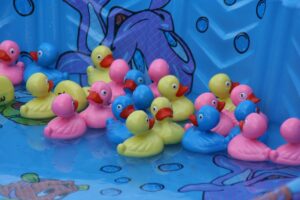
Organizers of a school carnival created a duck pond game consisting of [latex]20[/latex] rubber ducks floating in a small, artificial pond. Six of the ducks are designated as winners with a large dot on the bottom of each winning duck. To play the duck pond game, participants choose a duck and turn it over to discover if they chose a winning duck and win a prize.
Every carnival attendee is allowed to play the game once for free. Of the [latex]20[/latex] ducks in the pond, two ducks are [latex]\$10[/latex] winners, four ducks are [latex]\$5[/latex] winners, and the rest of the ducks are not winners ([latex]\$0[/latex]).