Experimental Design: Learn It 3

Experimental and Control Groups

An important aspect of all experiments is a comparison between one or more groups or levels of the factor of interest. These comparisons are called treatments. In a simple experimental design, one group receives the researcher’s treatment and the other group(s) does not.

  • The group that receives the treatment is commonly called the experimental group.
  • The group that does not receive the treatment is usually called the control group.

The control group is usually kept under conditions that are considered typical or common for a given situation.
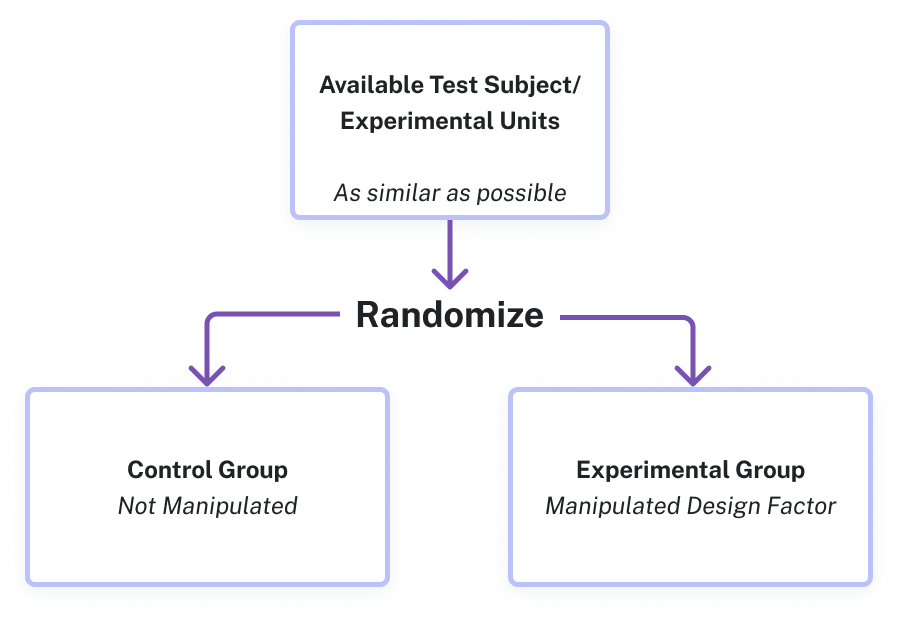
Diagram showing that the available test subjects are randomly split into two groups: control group and experimental group
Figure 1. Random assignment helps ensure that the only difference between the control and experimental groups is the treatment being tested.

It is important to remember that the only difference between the experimental and control groups is the researcher’s manipulation of the factor of interest.

The primary goal of an experiment is to provide evidence for a cause-and-effect relationship between two variables. In contrast, an observational study observes individuals and measures variables of interest. We conduct observational studies to investigate questions about a population or an association between two variables. However, an observational study alone does not provide convincing evidence of a cause-and-effect relationship.