- Calculate a confidence interval for the difference in proportions of two groups.
- Make conclusions based on a confidence interval.
Analyzing voting behavior
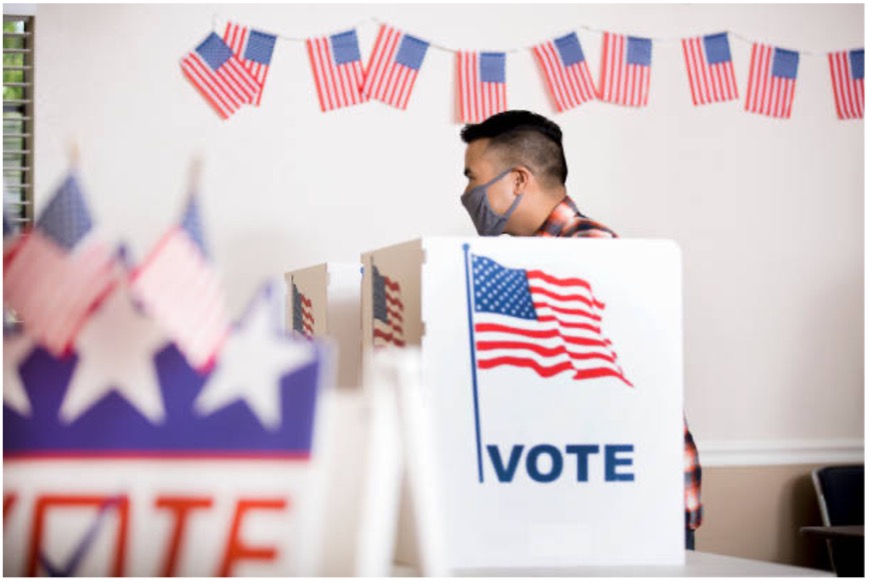
One of the most important rights of American citizens is the franchise—the right to vote.[1] The American electoral system is called a two-party system. That means that two parties dominate the political field. They are the Republican Party and the Democratic Party.[2]
Let’s investigate if there are differences in voting behaviors between eligible voters who affiliate with one of the two major political parties in the United States (Democrats and Republicans) and those who do not. Specifically, we will look at the difference in the proportions of “regular voters” between the two groups. In these data, a “regular voter” is a person who indicated that they voted in “all or all-but-one of the elections they were eligible for” in the survey.
The authors in the FiveThirtyEight article “Why Many Americans Don’t Vote”[3] limited their analysis to only include survey responses from voters who were eligible for at least four election cycles. For this activity, we will also limit our data to this group.
The data come from the data journalism website FiveThirtyEight. The data were originally collected as part of an online survey conducted by Ipsos, where respondents answered demographic questions along with questions about political party affiliation and voting behavior.
The data contain information for [latex]3,594[/latex] respondents who said they identify with a major party (Republican or Democrat) and [latex]2,242[/latex] respondents who said they do not have a major party affiliation. All the respondents had been eligible to vote for at least four election cycles at the time of the survey. The primary variables of interest are:
- party_id: Republican, Democrat, or Other
- major_party: Yes if the respondent identified as Republican or Democrat; no otherwise
- regular_voter: Yes if the respondent voted in all or all-but-one of the elections they were eligible for; no otherwise
Of the [latex]3,594[/latex] respondents with a major party affiliation, [latex]1,255[/latex] were regular voters. Of the [latex]2,242[/latex] respondents with no major party affiliation, [latex]556[/latex] were regular voters.
- https://www.whitehouse.gov/about-the-white-house/our-government/elections-and-voting/ ↵
- https://en.wikipedia.org/wiki/Political_parties_in_the_United_States ↵
- Thomson-DeVeaux, A., Mithani, J., & Bronner, L. (2020, October 26). Why many Americans don’t vote. FiveThirtyEight. https://projects.fivethirtyeight.com/non-voters-poll-2020-election/ ↵