- Calculate a confidence interval and explain what it means.
- Recognize common misinterpretations of confidence intervals.
The purpose of a confidence interval is to estimate a population parameter on the basis of a sample statistic. Sample statistics vary, so there are always errors in our estimates, but we never know how much. We therefore use the standard error, which is the average error in our sample estimates, to create a margin of error. The margin of error is related to our confidence that the interval contains the population parameter.
[1]Here we add these ideas to the Big Picture to show how probability connects to inference.
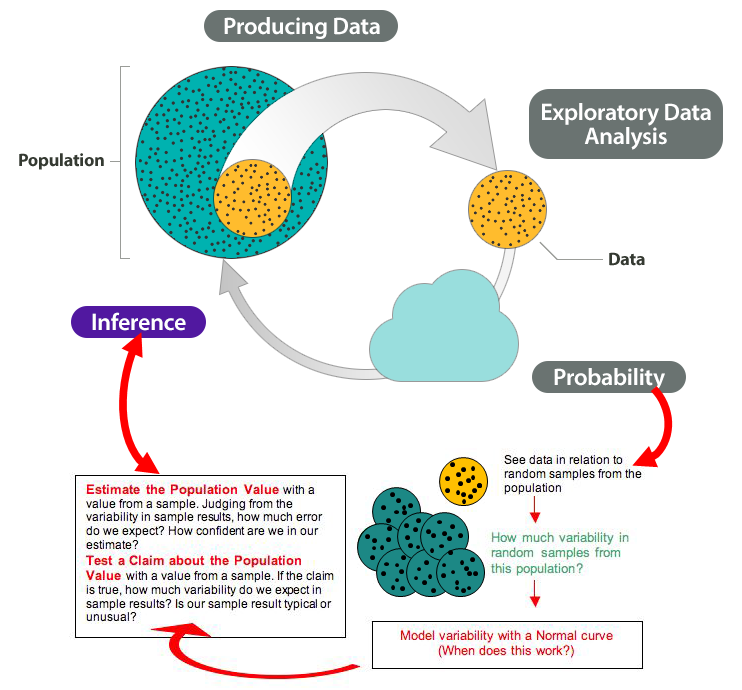
[Trouble viewing? Click to open in a new tab.]
- Using a 95% confidence level, compute and interpret a confidence interval estimate for the true proportion of people who own tablets.
- Using a 99% confidence level, compute and interpret a confidence interval estimate for the true proportion of people who own tablets.
Is yawning contagious?
In one experiment, [latex]34[/latex] participants saw a person near them yawn. The experimenters recorded whether or not the participants yawned. [latex]10[/latex] participants did yawn (“Yes”) and [latex]24[/latex] participants didn’t yawn (“No”).
- https://courses.lumenlearning.com/introstatscorequisite/chapter/why-it-matters-confidence-intervals/ ↵