- Check the assumptions for a two-sample [latex]t[/latex] confidence interval for population mean.
- Calculate and explain a confidence interval for the difference between two population means.
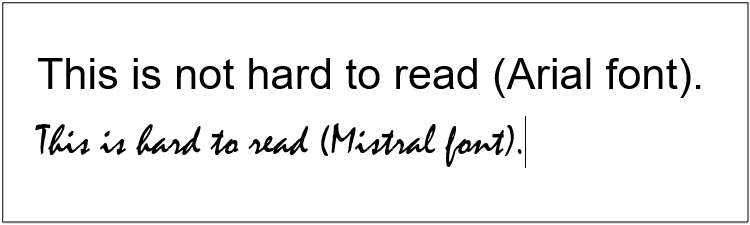
If it’s hard to read, it’s hard to do!
There are a few assumptions/conditions that you should check before using the two-sample [latex]t[/latex] confidence interval. These were introduced in the preview assignment and are included here as a reminder:
- The samples are independent.
- Each sample is a random sample from the corresponding population of interest, or it is reasonable to regard the sample as if it were a random sample. It is reasonable to regard the sample as a random sample if it was selected in a way that should result in the sample being representative of the population. If the data are from an experiment, you just need to check that there was random assignment to experimental groups—this substitutes for the random sample condition and also results in independent samples.
- For each population, the distribution of the variable that was measured is approximately normal, or the sample size for the sample from that population is large. Usually, a sample of size [latex]30[/latex] or more is considered to be “large.” If a sample size is less than [latex]30[/latex], you should look at a plot of the data from that sample (a dotplot, a boxplot, or, if the sample size isn’t really small, a histogram) to make sure that the distribution looks approximately symmetric and that there are no outliers.
As we learned previously, the [latex]t[/latex]-distribution depends on the degrees of freedom ([latex]df[/latex]). In the one-sample cases, [latex]df = n – 1[/latex]. For the two-sample [latex]t[/latex] confidence interval, determining the correct [latex]df[/latex] is based on a complicated formula that we do not cover in this course. We will either give the [latex]df[/latex] or use technology to find the [latex]df[/latex] and the [latex]t[/latex]-critical value.
[Trouble viewing? Click to open in a new tab.]