- Interpret statements of inequality
Inequalities and Probabilities
Let’s consider probability questions where each trial of an experiment has exactly two outcomes (which we call “success” and “failure”), and we want to count how many of the trials result in successes.
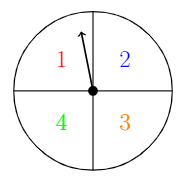 Suppose that we have a spinner with [latex]4[/latex] sections, each of equal size, and the sections are labeled [latex]1, 2, 3, \text{and} 4[/latex]. We might want to count how many times the spinner lands on the [latex]1[/latex] section if we spin the spinner [latex]10[/latex] times. We will also consider questions like, “What is the probability that in at least [latex]6[/latex] out of [latex]10[/latex] spin attempts, the arrow lands on the [latex]1[/latex] section?” For these types of questions, we will need inequality expressions.
Inequality Review
There are four inequality symbols:
- [latex]<[/latex] (less than): [latex]a \lt b[/latex] means that “a is less than b.” For example, we write [latex]2 \lt 5[/latex] because [latex]2[/latex] is less than [latex]5[/latex].
- [latex]\leq[/latex] (less than or equal to): [latex]a \leq b[/latex] means that “a is less than or equal to b.” For example, we can write [latex]2 \leq 5[/latex] and [latex]5 \leq 5[/latex] because the symbol indicates that there are two possibilities: the number on the left is either less than [latex]5[/latex] or the number on the left equals [latex]5[/latex].
- [latex]>[/latex] (greater than): [latex]a>b[/latex] means that “a is greater than b.” For example, we write [latex]5 > 2[/latex] because [latex]5[/latex] is greater than [latex]2[/latex].
- [latex]\geq[/latex] (greater than or equal to): [latex]a \geq b[/latex] means that “a is greater than or equal to b.” For example, we can write [latex]5 \geq 2[/latex] and [latex]5 \geq 5[/latex] because the symbol indicates that there are two possibilities: the number on the left is either greater than [latex]5[/latex] or the number on the left equals [latex]5[/latex].
One way to help remember how these symbols work is that the pointy end (the smaller side) of the symbol always points to the smaller number, while the open side (the bigger side) of the symbol always opens to the bigger number. (A fun way to remember it is to think of the symbol as a mouth that wants to eat the biggest number!)
An important part of answering probability questions is translating the question into a mathematical expression so that you know what probability you’re trying to find.
Let’s imagine we are spinning a spinner with [latex]4[/latex] equally-sized sections [latex]10[/latex] times.Let the random variable [latex]X[/latex] be the number of times that we land on the [latex]1[/latex] in our [latex]10[/latex] spin attempts.Describe [latex]P(X > 5)[/latex].
Interpretation of Inequality
Sometimes, a description of an inequality can be a little trickier to interpret. Translating intervals in context to notation is an important steps in answering a statistic question. This is necessary for calculating purposes. It is also important to feel comfortable with identifying values that would be located within an interval.
- “At least [latex]x[/latex]” means [latex]x[/latex] or more. For example: “at least [latex]3[/latex]” means [latex]3[/latex] or more.
- “Up to [latex]x[/latex]” means less than or equal to [latex]x[/latex]. For example: “up to [latex]2[/latex]” means [latex]2[/latex] or less.
- “At most [latex]x[/latex]” means less than or equal to [latex]x[/latex]. For example: “at most [latex]2[/latex]” means [latex]2[/latex] or less.
- “No more than [latex]x[/latex]” means less than or equal to [latex]x[/latex]. For example: “no more than [latex]2[/latex]” means [latex]2[/latex] or less.