- Complete a one-way ANOVA hypothesis test
- Write the conclusion of a one-way ANOVA hypothesis test in context of the problem
steps for one-way ANOVA
- Set up the null and alternative hypotheses.
- Check the conditions/assumptions for the ANOVA hypothesis test.
- The right types of data—factor of interest should be categorical, and the response variable should be numeric and continuous
- Similar levels of variability
- Randomly assigned, independent groups
- Calculate the [latex]F[/latex]-statistic.
- Calculate the P-value.
- Compare the P-value to the significance level, [latex]\alpha[/latex], to make a decision.
- Write a conclusion in context (e.g., we do/do not have convincing evidence…).
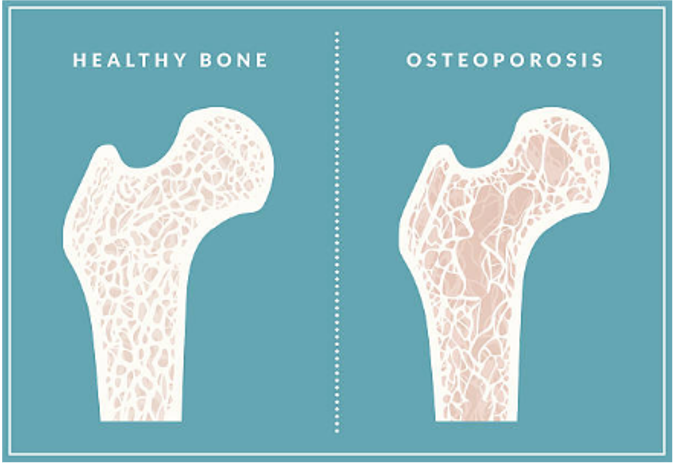 A 1995 study used a one-way ANOVA to compare different osteoporosis prevention strategies on the bone density of older women.[1] The women were randomly assigned to receive either a placebo treatment, milk powder containing calcium, calcium pills, or calcium pills with an exercise program.
In order to compare the groups, the researchers measured the densities of the thigh bones for each of the treatment groups after a period of two years. Results were recorded as percentage changes in bone density from the beginning of the study. There were 168 participants in the study (42 in each group).
Let’s conduct the one-way ANOVA hypothesis test for this scenario. The data set for this scenario is uploaded into the ANOVA statistical tool under “Osteoporosis.”
[Trouble viewing? Click to open in a new tab.]
In an ANOVA hypothesis test, it is very tempting to make assumptions based on the obvious differences in the group means, but further testing is needed to confirm and provide statistical evidence of our conclusions.
- Prince, R., Devine, A., Dick, I., Criddle, A., Kerr, D., Kent, N., Randell, A. & Price, R. (1995). The effects of calcium supplementation (milk powder or tablets) and exercise on bone density in postmenopausal women. Journal of Bone and Mineral Research, 10(7), 1068–1075. ↵