Ethics in Experimental Design
The Salk vaccine experiment was one of the largest health experiments ever conducted. It was an experiment because subjects were given treatments, but ethical issues, cost, time, and other considerations sometimes prohibit the use of an experiment. For example, we would never want to conduct a texting-while-driving experiment in which we ask subjects to text while driving. Why? Some of them could die! It would be far better to observe past crash results to understand the effects of texting while driving.
The large-scale experiment designed to test the effectiveness of the Salk vaccine in preventing polio used a completely randomized design in that the experimental units (or subjects) were randomly assigned to one of the treatments. However, in a well-designed experiment, we want to know what effect the factor of interest has on the response variable.
Nuisance Factors
Sometimes, a nuisance factor may also affect the response factor, even though we are not interested in this factor (e.g., the specific operator who prepared the treatment, the time of day the experiment was run, the room temperature). All experiments have nuisance factors, so the experimenter will typically need to spend some time deciding which nuisance factors are important enough to keep track of or control.
Randomized Block Design
Sometimes, the nuisance factors can be directly controlled in the experiment using a completely randomized block design. This design is used when the experimental units are divided into homogeneous groups called blocks.
block
A block is a group of subjects that are similar, but blocks differ in ways that might affect the outcome of the experiment. For example, if your nuisance factor is known and controllable, it can be added to your experimental design.
We use the term blocking to describe the grouping together of homogeneous (similar) experimental units, followed by the random assignment of the experimental units within each group to a treatment.
The diagram below illustrates the completely randomized block design for an experiment testing a new fertilizer:
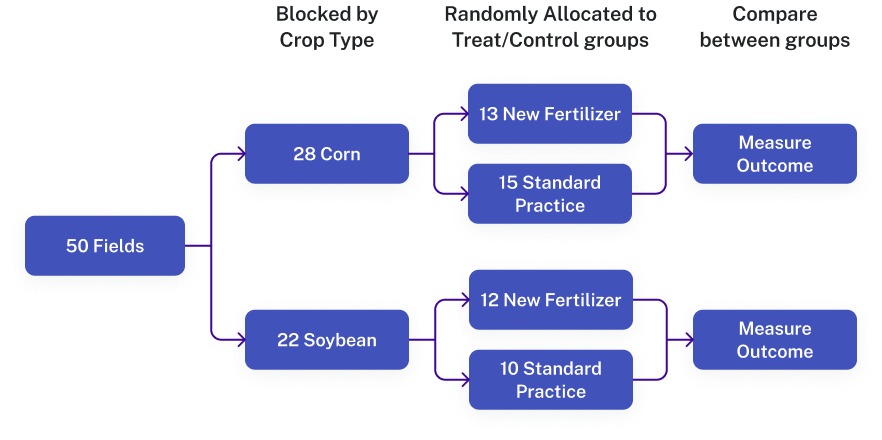
In a completely randomized block design, we do not wish to determine whether the differences between blocks result in any difference in the value of the response variable. Our goal is to remove any variability in the response variable that may be attributable to the block. Therefore, the advantage of this design is that blocking will help to minimize the effects of nuisance factors.
The basic principles of the completely randomized block design are blocking and randomization. The general rule is to “block what you can and randomize what you cannot.” So, blocking is used to remove the effects of a few of the most important nuisance factors. Randomization is then used to create comparable groups to reduce the contaminating effects from the removal of the nuisance factors.