- Describe and find conditional probabilities.
- Understand the concept of independent events.
Conditional Probability
A conditional probability is calculated based on the assumption that one event has already occurred. Conditional probabilities restrict the total. The new total is indicated after the word “given” in the question.
conditional probability
The conditional probability of [latex]A[/latex] given [latex]B[/latex] is written [latex]P(A\text{ given }B)[/latex] or [latex]P(A|B)[/latex].
[latex]P(A\text{ given }B)[/latex] is the probability that event [latex]A[/latex] will occur given that the event [latex]B[/latex] has already occurred.
[latex]P(A|B)=\frac{P(A \text{ and }B)}{P(B)}[/latex]
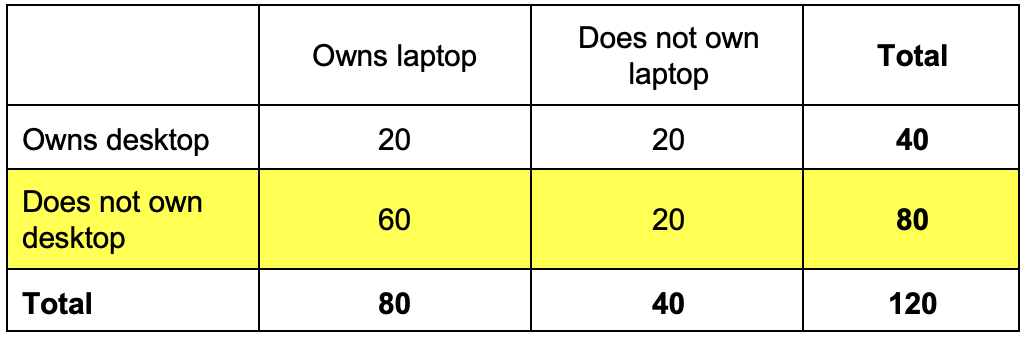
A researcher conducts a survey of 120 randomly selected college students to try to answer the questions: If someone has a laptop, are they likely to own a desktop computer? If someone has a desktop computer, are they likely to own a laptop? The results of the survey are displayed in the following contingency table.
| Owns laptop | Does not own laptop | Total | |
| Owns desktop | 20 | 20 | 40 |
| Does not own a desktop | 60 | 20 | 80 |
| Total | 80 | 40 | 120 |
If someone does not own a desktop, what is the probability that they don’t own a laptop computer either?