Population and Parameter vs. Sample and Statistics
One primary use of statistics is to make inferences about a population based on data collected on a sample from that population. From the sample data, we can calculate a statistic.
statistic
A statistic is a numerical summary measure of a sample.
For example, if we consider one math course to be a sample of the population of all math courses, then the average number of points earned by students in that one math course at the end of the term is an example of a statistic.
The statistic is an estimate of a population parameter. A parameter is a numerical characteristic of the whole population that can be estimated by a statistic. Since we considered all math courses to be the population, the average number of points earned per student over all the math courses is an example of a parameter. We are interested in both the sample statistic and the population parameter in inferential statistics.
parameter
A parameter is a numerical measure that summarizes a population.
In other words, In other words, we use statistics to learn about large groups by studying smaller portions of them. When we calculate a number from our smaller group (called a statistic), we use it to estimate what that same number would be for the entire large group (called a parameter). For example, if we find the average test score for 30 students in one class (statistic), we can use that to estimate the average test score for all students taking that type of class (parameter).
statistical inference
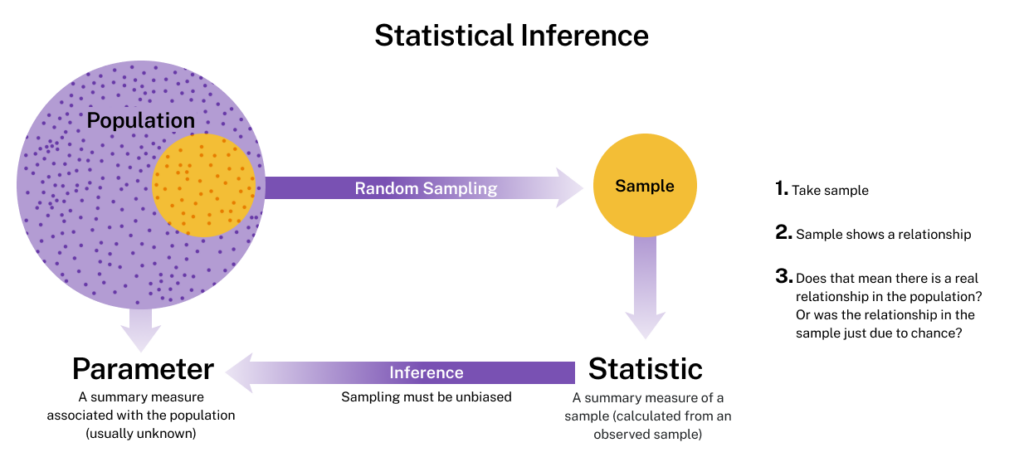
The process of taking a statistic from a sample and determining a parameter for a population is called statistical inference.
- Population: 200 students at the college.
- Variable: Eligibility for financial aid is a categorical variable, so we use a proportion as a summary.
- Parameter: Population proportion of 60% or 0.6 of the population is eligible for financial aid.
Note: Populations are usually much larger than 200 people. Also, in real situations, we typically do not know the population proportion.