- Create questions that can be answered with statistics
- Name and classify variables by type
Statistical Questions
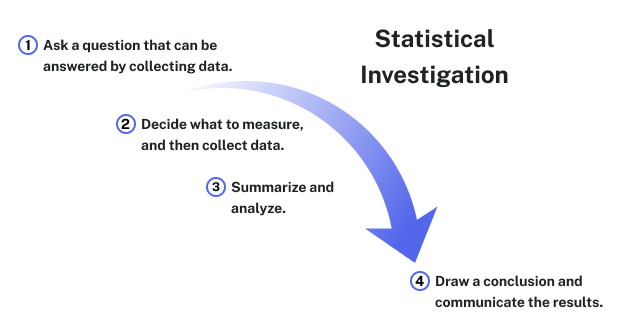
The first step in any statistical investigation is to identify statistical investigative questions and anticipate the responses to survey questions. For example, “Is there a relationship between students’ phone use in class and their grades?” To answer this question, you would need to survey a group of students and ask them about their phone use and their grades. You would then analyze the data using appropriate graphical displays and summary statistics and interpret the results.
At its heart, statistics is an investigative process that can allow us to answer questions about our world. We need to consider what makes a good statistical question and how we can match appropriate data with those statistical questions.
statistical investigative question
A statistical investigative question is a question that can be used as the starting point for an investigation that involves data collection and data analysis.
Statistical investigative questions always anticipate variability.
Data and Statistical Questions
Anticipating variability is key in a good statistical question; in other words, a good statistical question anticipates that there will be variability in the data collected to answer the question. That means that the variables (or characteristics) we measure about our observational units are expected to have different values among the different observational units. Understanding which kinds of questions anticipate variability can help us understand what kind of variables can be used to explore a statistical question.
variation vs. definitive answer
You cannot conduct a statistical study on a question that has no variability. If you can simply answer the question, ask for a single response, or look up the answer, it has no variability anticipated, and therefore, there’s no statistical question to create a study around.
Let’s consider what types of investigative questions can be answered through statistics. If a question has a definitive answer, statistics are not needed. If a question only needs a sample of one to be solved, statistics are not needed.
- Can Bill tie his own shoes? To find out, we just need to ask or observe Bill.
- Does five plus five equal ten? There is no population to pull a sample from.
- What is the average size TV in a New York City apartment? Now that is a great statistical question!