- Understand the concept of set theory and how it relates to probability
- Create and interpret Venn diagrams to visually represent sets and their intersections
- Understand how to use Venn diagrams to solve problems related to probability, including union, intersection, and complement of events
One of the advantages of Venn diagrams is their ability to visualize the probability of events. This is particularly helpful when we want to visualize the probability rules of AND, OR, and NOT.
Let’s start with NOT.
complement of an event
The complement of event [latex]A[/latex] is denoted [latex]A'[/latex] (read “A prime”) or [latex]A^c[/latex] (read “A complement”).
The complement of an event [latex]A[/latex] consist of all outcomes that are NOT in [latex]A[/latex].
More generally, for any event [latex]A[/latex], we can think of the probability of complements as having the following relationship:
[latex]P[/latex]([latex]A[/latex]) + [latex]P[/latex](not [latex]A[/latex]) = [latex]1[/latex]
or
[latex]P[/latex]([latex]A[/latex]) + [latex]P[/latex]([latex]A'[/latex]) = [latex]1[/latex]
Suppose the sample space is [latex]S =[/latex] all whole numbers from [latex]1[/latex] to [latex]9[/latex].
If [latex]A = \{1,2,4\}[/latex], then [latex]A' = \{3,5,6,7,8,9\}[/latex].
Using the Venn diagram, we can represent the complement of the event [latex]A[/latex] as the shaded region outside the circle representing the event. It’s important to note that these two regions together represent the entire sample space.
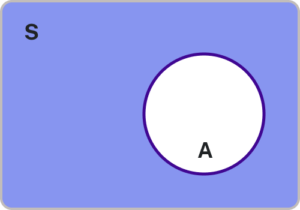
(a) Suppose we had a sample of 100 adults, how would we create a Venn diagram representing the event B = “has a bachelor’s degree” and its complement using the numbers given?
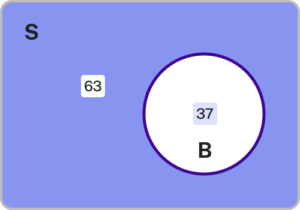
(b) What is the probability that an adult 25 years or older in the United States does not have a bachelor’s degree?