- Complete pair-wise comparisons for ANOVA
- Calculate a confidence interval and p-value for pair-wise comparisons and explain what it means
Pair-wise Comparisons for ANOVA
Recall the study done by the National Survey of Student Engagement, which found that, on average, college students spend 17 hours per week preparing and studying for their classes.[1][2]
Previously, we conducted a one-way ANOVA to determine if there are any statistically significant differences between the means of the following majors:
- Arts and Humanities
- STEM
- Education
- Business
Using a 5% level of significance, we rejected the null hypothesis that the means are equal and accepted the alternative hypothesis that at least two means are different.
Question! Which means are different? To answer this question, we need to make multiple pair-wise comparisons.
We could begin by comparing business and education. This is an example of a pair-wise comparison. However, there are more!
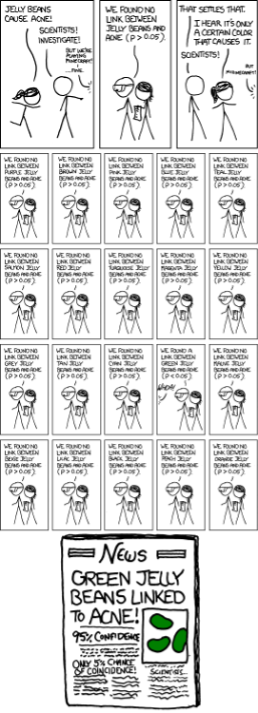
Notice the following key concepts:
- “Did the original test reveal that at least one of the colors is linked to acne?”
- “How many tests did the stick researchers conduct?”
- “What is the probability of committing a type I error (saying a color is significant when it is actually not) in each test?”
- “How do we know the significance level?”
- “Is the conclusion adjusted for multiple comparisons?”