- Complete pair-wise comparisons for ANOVA
- Calculate a confidence interval and p-value for pair-wise comparisons and explain what it means
What is the best treatment?
 [1] The CDC states that people with osteoporosis are more likely to break bones, most often in the hip, forearm, wrist, and spine. There are steps you can take to improve your bone health and strengthen weak bones.
Previously, we looked at a 1995 study that used a one-way ANOVA to compare different osteoporosis prevention strategies on the bone density of older women.[2] The women were randomly assigned to receive either a placebo treatment, milk powder containing calcium, calcium pills, or calcium pills with an exercise program. In order to compare the groups, the researchers measured the densities of the thigh bones for each of the treatment groups after a period of two years.
Through a one-way ANOVA, we found that there is a difference between the means of two or more of these treatments. At least one of the preventative strategies was more or less effective than the other options.
Now the question is: “What treatment works best to prevent osteoporosis?”
It is tempting to use the following boxplot to determine the answer, so we need to be careful. This method does not provide statistical EVIDENCE to support your conclusion.
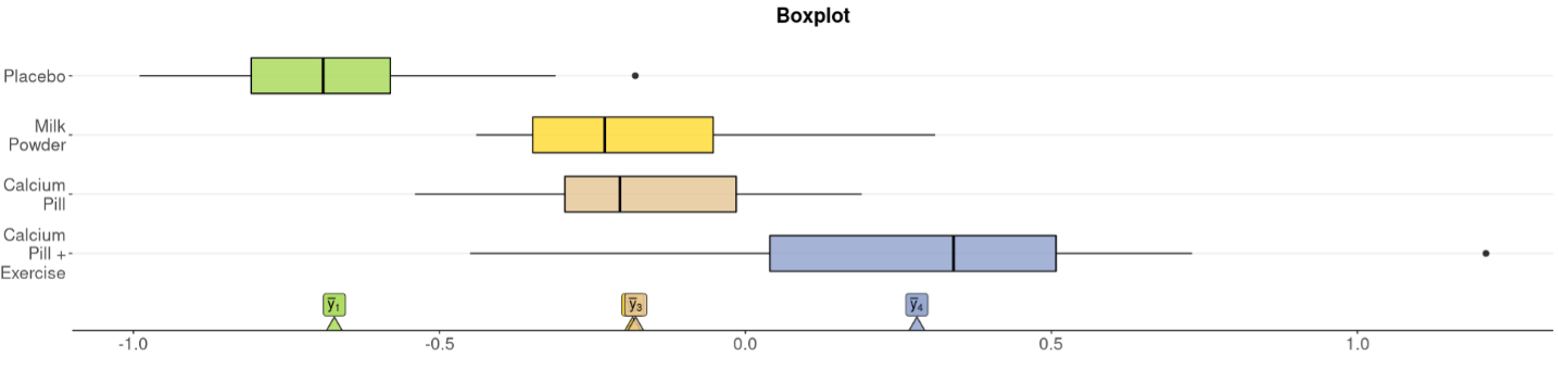
It is also tempting to only show the comparisons you want to show based on the boxplot. For example, only looking at comparisons including Calcium Pill Plus Exercise. This is called data snooping or data fishing. You cannot look at your results and then determine the comparisons that you want to make.
So, let’s investigate the difference in the treatment options for all pair-wise comparisons at the family-wise [latex]5\%[/latex] significance level.
Step 2: Select the option to perform “Pairwise Comparisons and Confidence Intervals.”
Step 3: Select a confidence level of 95%.
[Trouble viewing? Click to open in a new tab.]
- https://www.cdc.gov/genomics/disease/osteoporosis.htm ↵
- Prince, R., Devine, A., Dick, I., Criddle, A., Kerr, D., Kent, N., Randell, A. & Price, R. (1995). The effects of calcium supplementation (milk powder or tablets) and exercise on bone density in postmenopausal women. Journal of Bone and Mineral Research, 10(7), 1068–1075. ↵