- Complete pair-wise comparisons for ANOVA
- Calculate a confidence interval and p-value for pair-wise comparisons and explain what it means
Tukey method
One method for controlling for a family-wise error rate is the Tukey method for all pair-wise comparisons (formally Tukey-Kramer method).
This method adjusts the length of the confidence interval (to ensure an overall level of confidence) and the P-value (to ensure an overall significance level for all pair-wise comparisons).
Let’s look at our study about studying the efficacy of new statistics teaching methods. Recall that you randomly assign [latex]20[/latex] students to each of the four different methods: [latex]A[/latex], [latex]B[/latex], [latex]C[/latex], and [latex]D[/latex]. You test their knowledge on the midterm to compare the differences between the teaching methods.
- Table A presents the P-values and confidence intervals that are unadjusted for multiple comparisons.
- Table B presents the adjusted confidence intervals using the Tukey method.
Table A: Unadjusted for multiple comparisons*
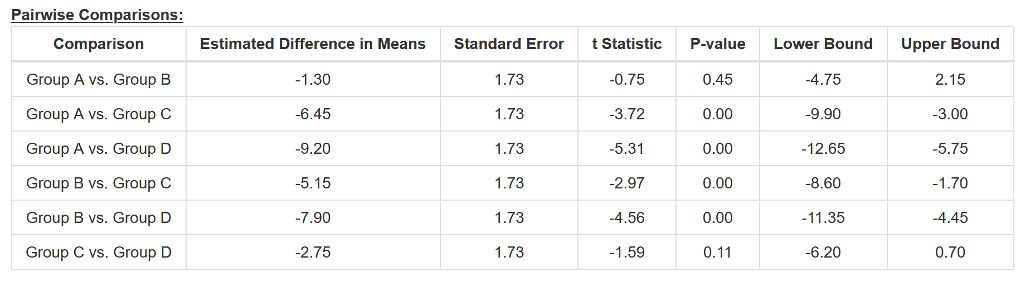
*Note: These P-values and confidence intervals are slightly different than those derived from conducting separate two-sample t-tests.
Table B: Tukey method used to adjust for multiple comparisons
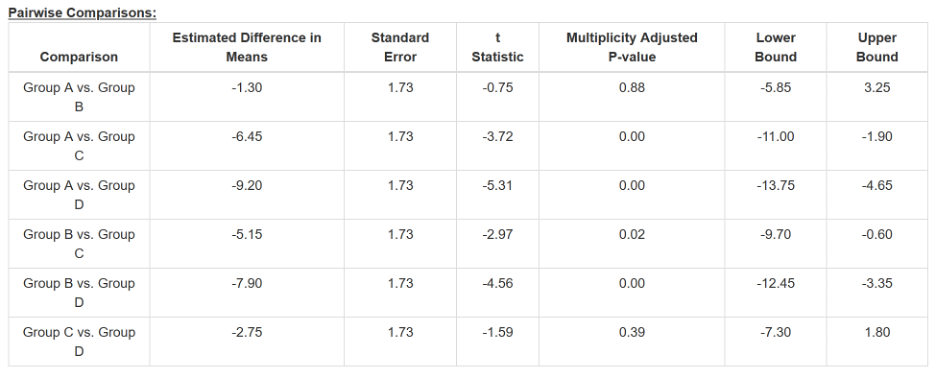
Note that the difference between the methods for Group [latex]C[/latex] and Group [latex]B[/latex] [latex](\mu_C-\mu_B)[/latex] is not considered because it would provide the same information. Similarly, [latex]\mu_C-\mu_A[/latex],etc. are not needed.