- Write a null and alternative hypothesis for a one-way ANOVA hypothesis test
- Discuss the error sum of squares and group sum of squares
The purpose of a one-way ANOVA test is to determine the existence of a statistically significant difference among several group means. The test actually uses variances to help determine if the means are equal or not.
The null hypothesis is simply that all the group population means are the same. The alternative hypothesis is that at least one pair of means is different.
hypotheses
The null hypothesis for a one-way ANOVA states that all the group/population means are the same. This can be written as:
[latex]H_0: \mu_1 = \mu_2 = ... = \mu_k[/latex]
where [latex]k[/latex] is the number of independent groups or samples.
The alternative hypothesis for a one-way ANOVA should be written as:
[latex]H_{A}:[/latex] At least two of the group means are different.
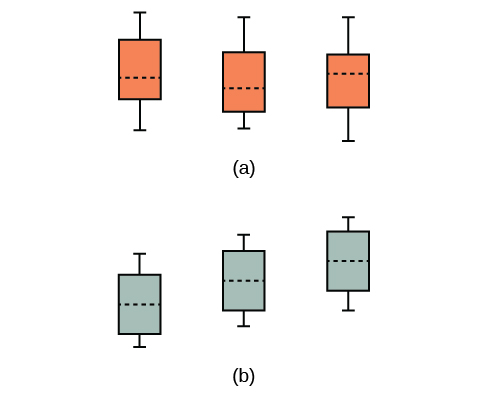
(a) [latex]H_0[/latex] is true. All means are the same; the differences are due to random variation. (b) [latex]H_0[/latex] is not true. All means are not the same; the differences are too large to be due to random variation.
But what does it mean when we reject the null hypothesis? Remember that an ANOVA only tells us that there is a difference, not which group(s) are different. Let’s use colors to understand it better.