- Identify and interpret the difference between sample proportions.
Proportions
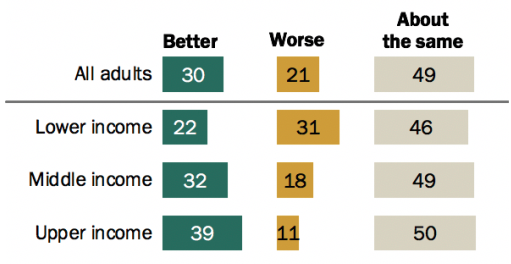
A Pew Research Center survey conducted in January 2021 about American adults’ perceptions of the financial impact of the COVID-19 pandemic.[1] Note: The survey was conducted in January 2021; the COVID-19 pandemic began in March 2020.
The survey randomly selected [latex]10,334[/latex] U.S. adult respondents. The graphic below shows the percentages of respondents saying that, compared with one year earlier, their financial situations (and that of their families) were better, worse, or about the same.
An inequality is a mathematical statement that compares two expressions using the ideas of greater than or less than. Special symbols are used in these statements. When you read an inequality, read it from left to right—just like reading text on a page.
- Horowitz, J. M., Brown, A., & Minkin, R. (2021, March 5). A year into the pandemic, long-term financial impact weighs heavily on many Americans. Pew Research Center. https://www.pewresearch.org/social-trends/2021/03/05/a-year-into-the-pandemic-long-term-financial-impact-weighs-heavily-on-many-americans/ ↵