- Use technology to create a sampling distribution of a sample proportion given [latex]n[/latex] and [latex]p[/latex].
- Calculate the mean and standard deviation for a sampling distribution of a sample proportion.
- Recognize the difference between the standard deviation and the standard error of a sample proportion.
Sampling Variability in Unemployment Rates
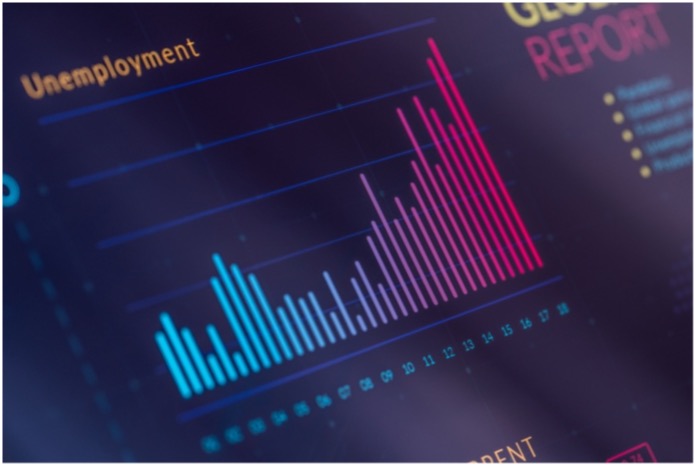
Each month, the U.S. Bureau of Labor Statistics releases a report on the employment situation in the United States.
Included in the report is an estimate of the nationwide unemployment rate: The number of unemployed people as a percentage of the labor force. This is defined as the total number of employed individuals plus unemployed individuals who are actively looking for work.[1]
For example: The U.S. Bureau of Labor Statistics stated that at the start of the COVID-19 pandemic in the United States, the unemployment rate jumped from [latex]3.5\%[/latex] in February 2020 to [latex]14.8\%[/latex] in April 2020.[3]
Note: Though the BLS presents unemployment rates as if they are a known parameter, these rates are actually estimated through two labor force surveys: the Current Population Survey (CPS) and the Current Employment Statistics Survey (CES), for a total sample size of about [latex]60,000[/latex] households from the CPS and [latex]400,000[/latex] individual employees from the CES.[4]
Let’s use the Sampling Distribution of the Sample Proportion tool to explore sampling variability of sample proportions.
- U.S. Bureau of Labor Statistics. (n.d.). Concepts and definitions. https://www.bls.gov/cps/definitions.htm ↵
- U.S. Bureau of Labor Statistics. (n.d.). Concepts and definitions. https://www.bls.gov/cps/definitions.htm ↵
- U.S. Bureau of Labor Statistics. (n.d.). Graphics for economic news releases. https://www.bls.gov/charts/employment-situation/civilian-unemployment-rate.htm ↵
- Lumen Learning. (n.d.). Measuring unemployment. https://courses.lumenlearning.com/boundless-economics/chapter/measuring-unemployment/ ↵