- Explain latent learning and cognitive maps
- Explain observational learning and the steps in the modeling process
- Describe Albert Bandura’s bobo doll experiment and its implications
Latent Learning and Cognitive Maps
Early behaviorists such as Watson and Skinner believed psychology should only study observable behavior—not thoughts, plans, or expectations. Skinner went so far as to describe the mind as a “black box”—something unknowable and irrelevant to scientific study. But psychologist Edward C. Tolman challenged this view.
Tolman’s research with rats showed that learning can occur even without reinforcement, revealing that internal mental processes matter more than strict behaviorism allowed.
latent learning
Latent learning is a form of learning that is not immediately expressed in an overt response. It is not readily apparent to the researcher because it is not shown behaviorally until there is sufficient motivation. This type of learning broke the constraints of behaviorism, which stated that processes must be directly observable and that learning was the direct consequence of conditioning to stimuli.
In his classic studies (Tolman & Honzik, 1930; Tolman, Ritchie, & Kalish, 1946), Tolman placed hungry rats in a maze. Some received food at the end; others wandered through the maze with no reward at all. Surprisingly, the unrewarded rats gradually learned the maze layout anyway—they formed a cognitive map, or a mental representation of the maze.
After 10 days, Tolman added food to the end of the maze for the previously unrewarded rats. Immediately, they began navigating the maze just as quickly as the rats that had been rewarded all along. The learning had been there the whole time—it simply had not been shown until the rats had a reason to reveal it.
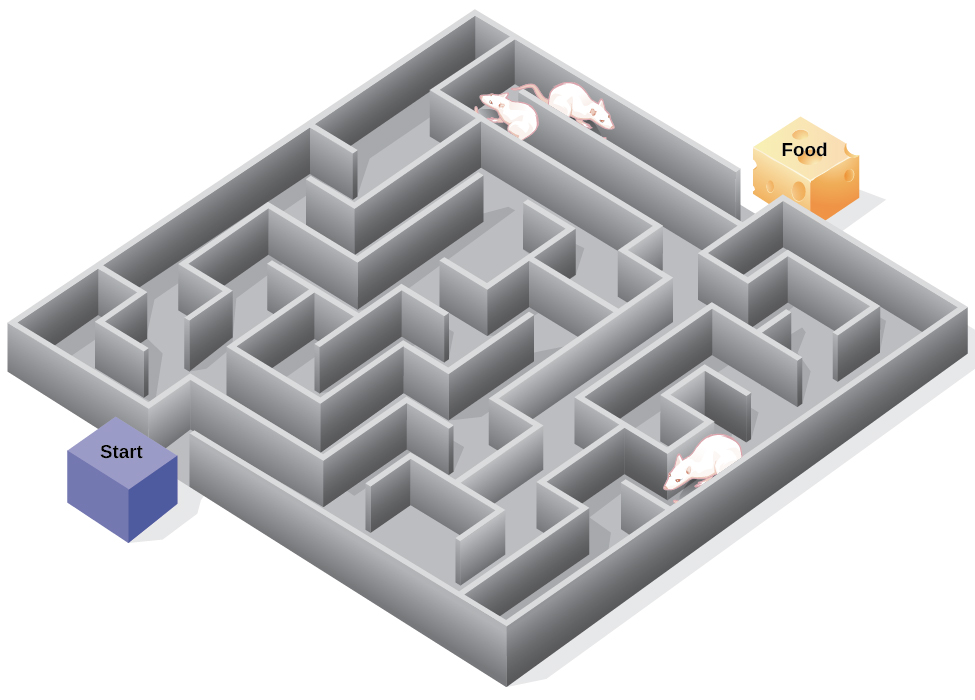
Latent learning also occurs in humans. Children may learn by watching the actions of their parents but only demonstrate it at a later date, when the learned material is needed.
For example, suppose that Ravi’s dad drives him to school every day. In this way, Ravi learns the route from his house to his school, but he’s never driven there himself, so he has not had a chance to demonstrate that he’s learned the way. One morning Ravi’s dad has to leave early for a meeting, so he can’t drive Ravi to school. Instead, Ravi follows the same route on his bike that his dad would have taken in the car. This demonstrates latent learning. Ravi had learned the route to school, but had no need to demonstrate this knowledge earlier.
Cognitive Maps in Everyday Life
Cognitive maps aren’t just for rats—everyone uses mental maps to navigate complex environments such as hospitals, shopping malls, airports, and college campuses.
Psychologist Laura Carlson (2010) explains that people build more accurate maps when they pay attention to distinctive cues, such as:
- A large painting or sculpture
- A particular set of windows
- A fountain or atrium
- Changes in floor color or pattern
These anchors help us find our way later, especially in buildings with repetitive hallways or confusing layouts.