- Describe various personality tests
- Understand the development of personality tests
- Understand how validity is measured and why it’s important
Igor, Sophie, and Lukas are friends with different career aspirations. Igor is reserved and often lacks self-confidence, usually following the lead of others. Sophie is outgoing and tends to take charge, though she can be impulsive at times. Lukas is well-liked for his trustworthiness but occasionally faces difficulty making quick decisions.
In the context of career choices, who do you think would excel at managing a hotel? What personality traits and qualities should be considered when evaluating their suitability for such a profession? The hospitality industry, like many others, including retail, law enforcement, transportation, military, and healthcare, requires specific traits and skills from its professionals and sometimes uses personality tests to screen applicants for employment and job training. Personality tests are also used in criminal cases and custody battles, and to assess psychological disorders. This section explores the best-known among the many different types of personality tests.
Self-Report Inventories
Self-report inventories are a kind of objective test used to assess personality. They typically use multiple-choice items or numbered scales, which represent a range from 1 (strongly disagree) to 5 (strongly agree). They often are called Likert scales after their developer, Rensis Likert (1932).
Self-report inventories are efficient and cost-effective, but they have a major limitation: people don’t always answer accurately. Responses can be influenced by self-awareness, mood, misunderstanding an item, or impression management (trying to look good—especially in hiring situations).

One of the best-known self-report inventories is the Minnesota Multiphasic Personality Inventory (MMPI). It has undergone several revisions since its original 1943 publication.
| Version | Year | Items | Key Changes |
|---|---|---|---|
| MMPI | 1943 | 504 true/false | Original; limited sample (Minnesota farmers, psychiatric patients) |
| MMPI-2 | 1989 | 567 | More representative national sample; better standardization |
| MMPI-2-RF | 2008 | 338 | Streamlined; takes half the time to complete |
| MMPI-3 | 2020 | 335 | Updated norms; modernized item content; improved scales for contemporary clinical use |
The MMPI-3, released in 2020, represents the most current version. It features updated normative data, revised item content to reflect contemporary language and clinical presentations, and refined scales. The test continues to be used for clinical diagnosis of psychological disorders as well as occupational screening in fields like law enforcement, and in college, career, and marital counseling (Ben-Porath & Tellegen, 2008; Ben-Porath & Tellegen, 2020).
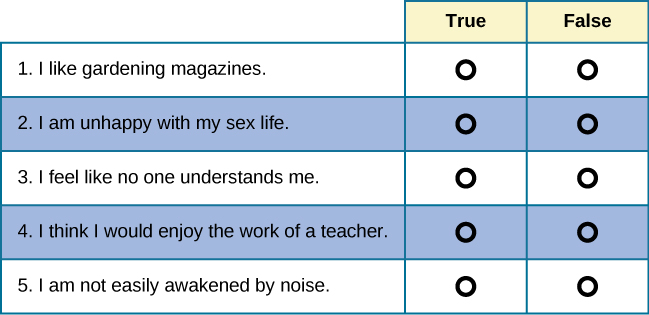
Beyond clinical scales, the MMPI includes validity and reliability scales to ensure accurate interpretation.
- Validity Scales detect response patterns that might compromise test accuracy. For example, the Lie Scale (L Scale) includes 15 items to identify respondents who are “faking good”—underreporting problems to appear healthier. Someone answering “yes” to unrealistically positive statements like “I have never told a lie” may be attempting to present an overly favorable self-image.
- Reliability Scales test the instrument’s consistency over time. If you take the MMPI today and again in five years, your scores should be similar.
A longitudinal study by Beutler, Nussbaum, and Meredith (1988) demonstrated this reliability while also revealing occupational effects on personality. Police officers were tested at recruitment, then again at two and four years on the job. Over time, their responses indicated increased vulnerability to alcoholism, somatic symptoms (vague physical complaints), and anxiety—suggesting that job stress can measurably impact psychological functioning.
- How objective do you think you can be about yourself in answering questions on self-report personality assessment measures? What implications might this have for the validity of the personality test?