Types of Prejudice and Discrimination
When we meet strangers we automatically process three pieces of information about them: their race, gender, and age (Ito & Urland, 2003). Why are these aspects of an unfamiliar person so important? Why don’t we instead notice whether their eyes are friendly, whether they are smiling, their height, the type of clothes they are wearing? Although these secondary characteristics are important in forming a first impression of a stranger, the social categories of race, gender, and age provide a wealth of information about an individual. This information, however, often is based on stereotypes.
We may have different expectations of strangers depending on their race, gender, and age. These stereotypes might inform how intelligent, friendly, aggressive, or honest, among a range of other characteristics, we expect a person to be. What stereotypes and prejudices do you hold about people who are from a race, gender, and age group different from your own? What stereotypes are you familiar with that are targeted at your own demographic group or groups?
racism
Racism is prejudice and discrimination against an individual based solely on one’s membership in a specific racial group (such as toward African Americans, Asian Americans, Latinos, Native Americans, European Americans). It is often linked to harmful racial stereotypes.
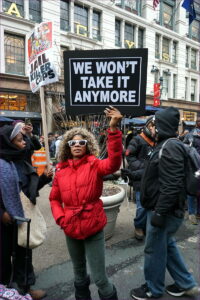
Racism continues to affect many racial and ethnic groups in the United States. Research consistently shows racial disparities in areas such as policing and criminal justice. For example:
- Black individuals are more likely than White individuals to be stopped, searched, and arrested during police encounters, particularly in predominantly White neighborhoods (Rojek et al., 2012; Kochel et al., 2011).
- Deaths due to police violence are significantly higher among Black Americans compared to non-Hispanic White Americans (GBD 2019 Police Violence US Subnational Collaborators, 2021).
These disparities are shaped by multiple factors, including the historical role of policing in enforcing racially discriminatory laws, unequal policy decisions, and the influence of implicit bias on individual behavior. Following the killing of George Floyd in 2020, the Black Lives Matter movement drew renewed attention to systemic racism in law enforcement and called for institutional reform.
Latino communities also experience racism and discrimination. Studies show that Latino shoppers are more likely than White shoppers to be asked for identification when paying by check (Dovidio et al., 2010), and research indicates increased risk for discriminatory policing (Weitzer, 2013). In some cases, undocumented immigrants are especially vulnerable to abuse because fear of deportation discourages reporting mistreatment.
Racism also affects Native Americans, Asian Americans, Arab Americans, Jewish Americans, and other racial and ethnic groups—often in different ways, depending on historical context and current events. Awareness of racism includes recognizing both overt acts and subtle, everyday forms of bias.
Explicit and Implicit Bias
One reason modern racism and prejudice can be difficult to identify is that people often hold dual attitudes (Wilson et al., 2000):
- Explicit attitudes are conscious, deliberate, and easier to control.
- Implicit attitudes are unconscious and automatic.
Because egalitarian beliefs are socially valued, many people express little prejudice at an explicit level. However, research using measures of implicit bias often reveals automatic associations that favor certain groups over others—even among people who strongly reject prejudice (Devine, 1989; Greenwald et al., 1998).
Understanding this distinction helps explain how discrimination can occur even when individuals believe they are being fair.
sexism
Sexism is prejudice and discrimination toward individuals based on their sex. Typically, sexism takes the form of men holding biases against women, but either sex can show sexism toward their own or another sex.
Like racism, sexism may be subtle and difficult to detect. Common forms of sexism in modern society include gender role expectations, such as expecting women to be the caretakers of the household. Sexism also includes people’s expectations for how members of a gender group should behave. For example, women are expected to be friendly, passive, and nurturing, and when women behave in an unfriendly, assertive, or neglectful manner they often are disliked for violating their gender role (Rudman, 1998).
Research by Laurie Rudman (1998) finds that when female job applicants self-promote, they are likely to be viewed as competent, but they may be disliked and are less likely to be hired because they violated gender expectations for modesty.
Sexism can exist on a societal level such as in hiring, employment opportunities, and education. Women are less likely to be hired or promoted in male-dominated professions such as engineering, aviation, and construction (Figure 2) (Blau, Ferber, & Winkler, 2010; Ceci & Williams, 2011).

Racism and sexism are not only individual attitudes; they are reinforced by social norms, institutions, and everyday interactions. Because biases can be implicit as well as explicit, people may unintentionally contribute to unequal treatment even when they value fairness.
Consider the following questions:
- How do social structures and personal experiences shape prejudice and discrimination?
- Have you observed situations where bias influenced decisions or treatment?
- How might awareness of implicit bias change the way people interact with others?
Recognizing these patterns is a critical step toward reducing prejudice and promoting more equitable social relationships.