Defense Mechanisms
Freud believed that feelings of anxiety result from the ego’s inability to mediate the conflict between the id and superego. When this happens, Freud believed that the ego seeks to restore balance through various protective measures.
defense mechanisms
Defense mechanisms are unconscious strategies the mind uses to reduce anxiety and protect self-esteem. They often work by distorting or shifting reality in some way—so they can feel soothing in the moment, even if they don’t solve the underlying problem.
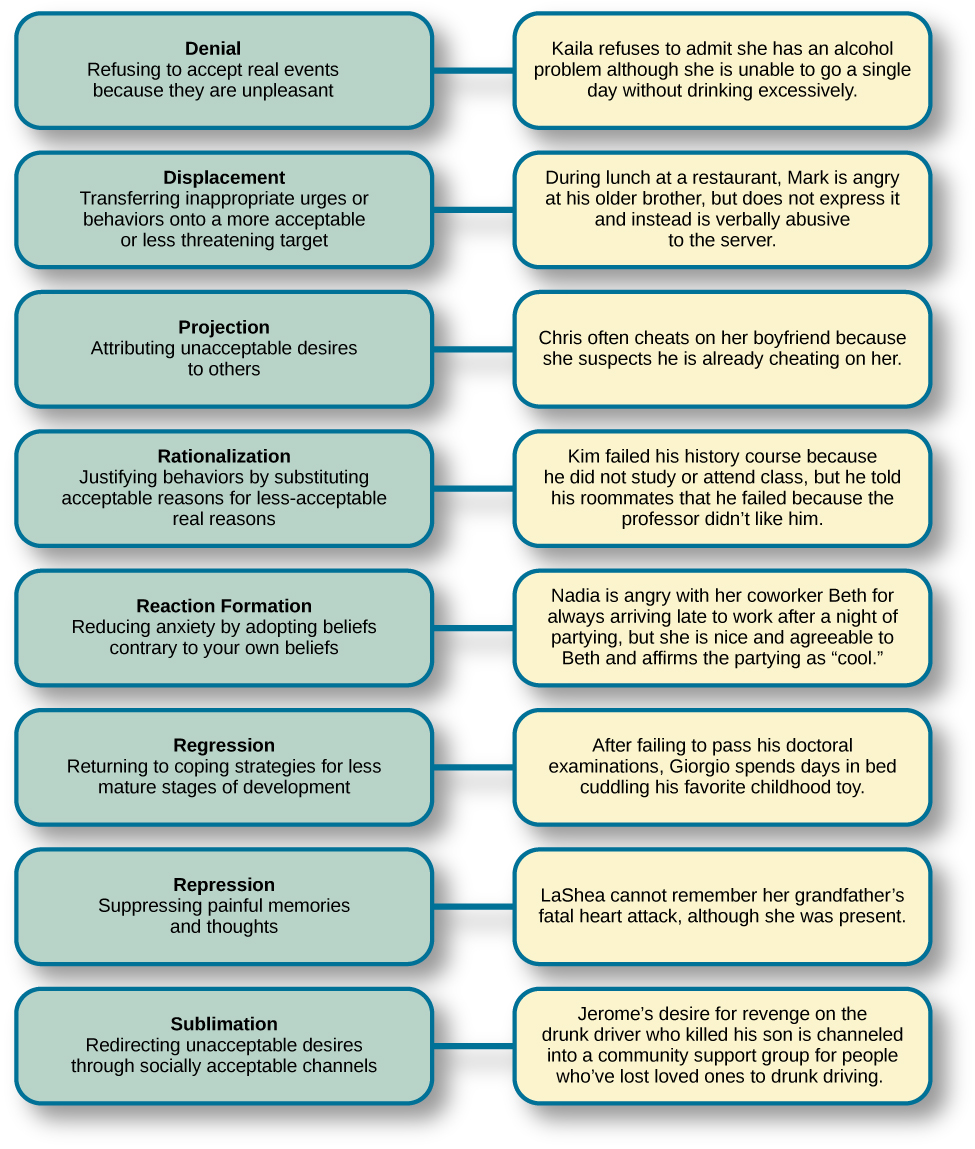
Below are several defenses Freud described. You’ll probably recognize these in everyday life.
- Repression: pushing distressing thoughts or memories out of conscious awareness.
- Analogy: if your car makes a worrying noise, you might turn up the radio and “forget” about it for a while. Similarly, if a memory feels overwhelming, a person might keep it out of awareness—though it can still affect emotions and behavior indirectly.
- Regression: responding to stress by acting in a younger, less mature way.
- Example: a child who feels threatened by a new sibling starts using baby talk or wanting a bottle again.
- Projection: refusing to acknowledge your own feelings and instead attributing them to someone else.
- Example: someone who feels jealous insists that everyone else is jealous of them.
Other classic defenses include:
- Rationalization: creating a “reasonable-sounding” explanation for something driven by discomfort or emotion.
- Displacement: redirecting emotions from the real source to a safer target (snapping at a roommate after a rough day with a boss).
- Sublimation: channeling unacceptable impulses into socially acceptable outlets (turning anger into intense training or art).
When defense mechanisms become a problem
Freud argued that everyone uses defenses—and modern research agrees that defenses can be common and automatic. The issue is overuse or relying on the same defense so often that it blocks insight, damages relationships, or keeps problems from being addressed.
For example, a person who feels insecure and fears rejection might act overly confident—bragging, dismissing others, or performing superiority. On the surface they look self-assured, but the behavior functions as armor against vulnerability. This is reaction formation: expressing feelings or behaviors that are the opposite of what someone is struggling with underneath.
Researchers studying defenses today often describe a range—from less adaptive defenses (that can intensify distress over time) to more adaptive defenses (that can help people cope and function). Patterns of less adaptive defenses are linked, on average, with higher depression/anxiety symptoms, while more adaptive defenses tend to relate to better functioning.
Defense Mechanisms Today
Many therapists and clinical psychologists still find the concept of defense mechanisms useful because it describes something people often do under stress: we protect ourselves from painful feelings automatically, sometimes without realizing it.
Research also suggests that people tend to have habitual patterns—meaning one person might often cope by minimizing problems (“It’s fine, it doesn’t matter”), while another might cope by blaming others, and another might cope by using humor or putting feelings into words. You can think of this as a person’s defense style: the set of defenses they most commonly fall back on.
Importantly, defenses aren’t “good” or “bad” all the time. They’re often about fit:
-
Some defenses are usually more adaptive because they reduce distress and still help you deal with reality (for example, using humor carefully, reframing a setback, or channeling emotions into something constructive).
-
Other defenses can be less adaptive when they repeatedly avoid the problem or distort reality in ways that create new issues (for example, denying a serious problem, constantly blaming others, or acting opposite to your real feelings).
A big part of what matters is flexibility. If someone can shift strategies depending on the situation, defenses may help them cope. If they use the same defense rigidly in lots of situations—even when it clearly isn’t working—it can interfere with relationships, self-understanding, and mental health.
- Can you think of an example of defense mechanisms that you have used yourself or have witnessed others using within in the past few weeks?