Observational Learning
observational learning
Observational learning occurs when we learn by watching others and then imitating, or modeling, their behavior. If you’ve ever pulled up a YouTube video to learn how to change a tire, braid hair, or solve a math problem, you’ve learned through observation. The people demonstrating the behavior are called models.
Research suggests that this kind of imitative learning may involve mirror neurons—brain cells that activate both when we perform an action and when we watch someone else perform the same action (Hickok, 2010; Rizzolatti et al., 2002, 2006).
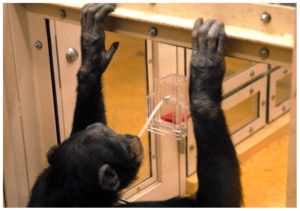
Observational Learning in Animals
Humans and animals alike are capable of observational learning. For example, in a study of social learning in chimpanzees, researchers gave juice boxes with straws to two groups of captive chimpanzees:
-
“Dippers” dipped the straw in and licked off small bits of juice.
-
“Suckers” drank through the straw, which was far more efficient.
When the “dippers” watched the “suckers,” they immediately switched strategies. Simply seeing a more effective technique was enough to change their behavior (Yamamoto, Humle, & Tanaka, 2013).
This demonstrates that observational learning is widespread—even beyond humans.
Social Learning Theory
Like Tolman, whose experiments with rats suggested a cognitive component to learning, psychologist Albert Bandura’s ideas about learning were different from those of strict behaviorists who thought all behaviors were conditioned.
Bandura and other researchers proposed a brand of behaviorism called social learning theory, which took cognitive processes into account. According to Bandura, pure behaviorism could not explain why learning can take place in the absence of external reinforcement. He felt that internal mental states must also have a role in learning and that observational learning involves much more than imitation. In imitation, a person simply copies what the model does. Observational learning is much more complex.
According to Lefrançois (2012), there are a few steps in how observational learning can occur:
- You learn a new response. For example, after watching your coworker get chewed out by your boss for coming in late, you start leaving home 10 minutes earlier so that you won’t be late.
- You choose whether or not to imitate the model depending on what you saw happen to the model.
- You learn a general rule that you can apply to other situations.
observational models
Bandura identified three kinds of models: live, verbal, and symbolic:
- A live model demonstrates a behavior in person, like when one person gets up on a surfboard, another can observe how it was done.
- A verbal instructional model does not perform the behavior, but instead explains or describes the behavior, as when a soccer coach tells his young players to kick the ball with the inside of the foot, not with the toe.
- A symbolic model can be fictional characters or real people who demonstrate behaviors in books, movies, television shows, video games, or Internet sources (Figure 2).

Marketing and advertising use this constantly. When a celebrity appears in a car commercial, the advertisers rely on observational learning: viewers may associate their success, confidence, or likability with the product. By watching a well-known model use or endorse something, consumers may be more likely to imitate the choice.