Integrating Expressions Involving [latex]\sqrt{{x}^{2}-{a}^{2}}[/latex]
The third type of expression requires yet another approach. Let’s see why [latex]\sqrt{{x}^{2}-{a}^{2}}[/latex] is different from the previous two cases.
The expression [latex]\sqrt{{x}^{2}-{a}^{2}}[/latex] has a restricted domain: [latex](-\infty, -a] \cup [a, +\infty)[/latex]. This means either [latex]x \leq -a[/latex] or [latex]x \geq a[/latex], which gives us [latex]\frac{x}{a} \leq -1[/latex] or [latex]\frac{x}{a} \geq 1[/latex]. The range of [latex]\sec\theta[/latex] on [latex][0, \frac{\pi}{2}) \cup (\frac{\pi}{2}, \pi][/latex] is exactly [latex](-\infty, -1] \cup [1, +\infty)[/latex]—this perfectly matches what we need!
So we use the substitution [latex]x = a\sec\theta[/latex] where [latex]0 \leq \theta < \frac{\pi}{2}[/latex] or [latex]\frac{\pi}{2} < \theta \leq \pi[/latex], with [latex]dx = a\sec\theta \tan\theta , d\theta[/latex].
Why This Substitution Works
When you substitute [latex]x = a\sec\theta[/latex]:
[latex]\sqrt{{x}^{2}-{a}^{2}} = \sqrt{(a\sec\theta)^{2}-{a}^{2}} = \sqrt{{a}^{2}({\sec}^{2}\theta-1)} = \sqrt{{a}^{2}{\tan}^{2}\theta} = |a\tan\theta|[/latex]

Sign Matters Here! Unlike the previous cases, the sign of [latex]|a\tan\theta|[/latex] depends on which part of the domain you’re in:
- For [latex]x \geq a[/latex]: [latex]|a\tan\theta| = a\tan\theta[/latex]
- For [latex]x \leq -a[/latex]: [latex]|a\tan\theta| = -a\tan\theta[/latex]
This is why you need two reference triangles for this case!
Since [latex]\sec\theta = \frac{x}{a}[/latex], you need different triangles depending on the sign of [latex]x[/latex]:
For [latex]x \geq a[/latex]:
- Hypotenuse: [latex]x[/latex]
- Adjacent side: [latex]a[/latex]
- Opposite side: [latex]\sqrt{x^2-a^2}[/latex]
For [latex]x \leq -a[/latex]:
- The triangle setup changes because [latex]\tan\theta[/latex] will be negative
- You’ll need to be careful about signs when converting back to [latex]x[/latex]

- Check first: Can this integral be solved more easily another way? If so, we may wish to consider applying an alternative technique.
- Substitute: [latex]x = a\sec\theta[/latex] and [latex]dx = a\sec\theta \tan\theta , d\theta[/latex].
- Simplify: Use [latex]\sqrt{{x}^{2}-{a}^{2}} = |a\tan\theta|[/latex] (watch the sign!)
- Integrate: Use trigonometric integration techniques
- Convert back: Use the appropriate reference triangle and [latex]\theta = \sec^{-1}\left(\frac{x}{a}\right)[/latex]. (Note: We need both reference triangles, since the values of some of the trigonometric ratios are different depending on whether [latex]x\ge a[/latex] or [latex]x\le \text{-}a.[/latex])
For the next example, it is worthwhile to review the technique of how to precisely evaluate a trigonometric function whose input is an inverse trigonometric function.
[latex]\begin{align} &\sin^{2}\theta+\cos^{2}\theta=1 && \text{Use our known value for cosine.} \\ &\sin^{2}\theta+\left(\frac{4}{5}\right)^{2}=1 && \text{Solve for sine.} \\ &\sin^{2}\theta=1−\frac{16}{25} \\ &\sin\theta=\pm\sqrt{\frac{9}{25}}=\pm\frac{3}{5} \end{align}[/latex]
Since [latex]\theta=\cos^{−1}(\frac{4}{5})[/latex] is in quadrant I, [latex]\sin{\theta}[/latex] must be positive, so the solution is [latex]\frac{3}{5}[/latex]. See Figure A below.
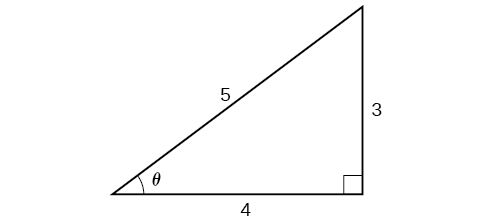
Figure A. Right triangle illustrating that if [latex]\cos\theta=\frac{4}{5}[/latex], then [latex]\sin\theta=\frac{3}{5}[/latex]
We know that the inverse cosine always gives an angle on the interval [0, π], so we know that the sine of that angle must be positive; therefore [latex]\sin\left(\cos^{−1}\left(\frac{4}{5}\right)\right)=\sin\theta=\frac{3}{5}[/latex].
Find the area of the region between the graph of [latex]f\left(x\right)=\sqrt{{x}^{2}-9}[/latex] and the [latex]x[/latex]-axis over the interval [latex]\left[3,5\right][/latex].
