Sequences and Series Foundations: Background You’ll Need 2
Use factorial notation
Factorial Notation
Factorial notation is an important mathematical concept used in various contexts, including sequences, combinatorics, and probability. Factorial notation, represented by an exclamation point ([latex]![/latex]), is a way to express the product of all positive integers up to a given number. For instance, [latex]4![/latex] equals [latex]4 \times 3 \times 2 \times 1 = 24[/latex], and [latex]5![/latex] equals [latex]5 \times 4 \times 3 \times 2 \times 1 = 120[/latex].
factorial
[latex]n[/latex] factorial is a mathematical operation that can be defined using a recursive formula.
The factorial of [latex]n[/latex], denoted [latex]n![/latex], is defined for a positive integer [latex]n[/latex] as:
The special case [latex]0![/latex] is defined as [latex]0!=1[/latex].
Factorials often appear in sequence-related problems. An example of formula containing a factorial is [latex]{a}_{n}=\left(n+1\right)![/latex]. The sixth term of the sequence can be found by substituting 6 for [latex]n[/latex].
The factorial of any whole number [latex]n[/latex] is [latex]n\left(n - 1\right)![/latex] We can therefore also think of [latex]5![/latex] as [latex]5\cdot 4!\text{.}[/latex]Write the first five terms of the sequence defined by the explicit formula [latex]{a}_{n}=\dfrac{5n}{\left(n+2\right)!}[/latex].
Substitute [latex]n=1,n=2[/latex], and so on in the formula.
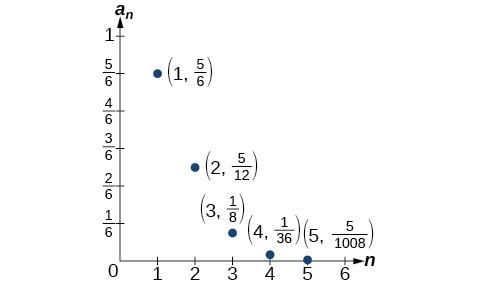
The first five terms are [latex]\left\{\dfrac{5}{6},\dfrac{5}{12},\dfrac{1}{8},\dfrac{1}{36},\dfrac{5}{1,008}\right\}[/latex].
Analysis
The figure below shows the graph of the sequence. Notice that, since factorials grow very quickly, the presence of the factorial term in the denominator results in the denominator becoming much larger than the numerator as [latex]n[/latex] increases. This means the quotient gets smaller and, as the plot of the terms shows, the terms are decreasing and nearing zero.