Parametric Curves and Their Applications: Background You’ll Need 2
Type your Learning Goals text here
Arc Lengths of Curves
Arc Length of the Curve [latex]y[/latex] = [latex]f[/latex]([latex]x[/latex])
In previous applications of integration, we required the function [latex]f(x)[/latex] to be integrable, or at most continuous. However, for calculating arc length we have a more stringent requirement for [latex]f(x).[/latex] Here, we require [latex]f(x)[/latex] to be differentiable, and furthermore we require its derivative, [latex]{f}^{\prime }(x),[/latex] to be continuous. Functions like this, which have continuous derivatives, are called smooth.
Let [latex]f(x)[/latex] be a smooth function defined over [latex]\left[a,b\right].[/latex] We want to calculate the length of the curve from the point [latex](a,f(a))[/latex] to the point [latex](b,f(b)).[/latex]
We start by using line segments to approximate the length of the curve.
For [latex]i=0,1,2\text{,…},n,[/latex] let [latex]P=\left\{{x}_{i}\right\}[/latex] be a regular partition of [latex]\left[a,b\right].[/latex]
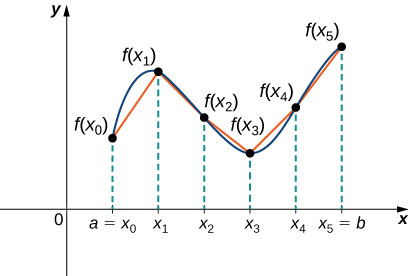
Then, for [latex]i=1,2\text{,…},n,[/latex] construct a line segment from the point [latex]({x}_{i-1},f({x}_{i-1}))[/latex] to the point [latex]({x}_{i},f({x}_{i})).[/latex] Although it might seem logical to use either horizontal or vertical line segments, we want our line segments to approximate the curve as closely as possible. The figure below depicts this construct for [latex]n=5.[/latex]
Figure 1. We can approximate the length of a curve by adding line segments.
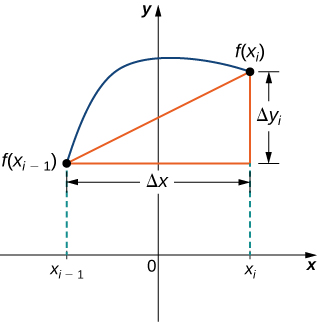
To help us find the length of each line segment, we look at the change in vertical distance as well as the change in horizontal distance over each interval.
Because we have used a regular partition, the change in horizontal distance over each interval is given by [latex]\text{Δ}x.[/latex] The change in vertical distance varies from interval to interval, though, so we use [latex]\text{Δ}{y}_{i}=f({x}_{i})-f({x}_{i-1})[/latex] to represent the change in vertical distance over the interval [latex]\left[{x}_{i-1},{x}_{i}\right],[/latex] as shown below Note that some (or all) [latex]\text{Δ}{y}_{i}[/latex] may be negative.
Figure 2. A representative line segment approximates the curve over the interval [latex]\left[{x}_{i-1},{x}_{i}\right].[/latex]
By the Pythagorean theorem, the length of the line segment is:
Now, by the Mean Value Theorem, there is a point [latex]{x}_{i}^{*}\in \left[{x}_{i-1},{x}_{i}\right][/latex] such that [latex]{f}^{\prime }({x}_{i}^{*})=(\text{Δ}{y}_{i})\text{/}(\text{Δ}x).[/latex]
We summarize these findings in the following theorem.
arc length for [latex]y[/latex] = [latex]f[/latex]([latex]x[/latex])
Let [latex]f(x)[/latex] be a smooth function over the interval [latex]\left[a,b\right].[/latex] Then the arc length of the portion of the graph of [latex]f(x)[/latex] from the point [latex](a,f(a))[/latex] to the point [latex](b,f(b))[/latex] is given by:
Note that we are integrating an expression involving [latex]{f}^{\prime }(x),[/latex] so we need to be sure [latex]{f}^{\prime }(x)[/latex] is integrable. This is why we require [latex]f(x)[/latex] to be smooth. The following example shows how to apply the theorem.
Let [latex]f(x)=2{x}^{3\text{/}2}.[/latex] Calculate the arc length of the graph of [latex]f(x)[/latex] over the interval [latex]\left[0,1\right].[/latex] Round the answer to three decimal places.
We have [latex]{f}^{\prime }(x)=3{x}^{1\text{/}2},[/latex] so [latex]{\left[{f}^{\prime }(x)\right]}^{2}=9x.[/latex] Then, the arc length is
Substitute [latex]u=1+9x.[/latex] Then, [latex]du=9dx.[/latex] When [latex]x=0,[/latex] then [latex]u=1,[/latex] and when [latex]x=1,[/latex] then [latex]u=10.[/latex] Thus,
Although it is nice to have a formula for calculating arc length, this particular theorem can generate expressions that are difficult to integrate. In some cases, we may have to use a computer or calculator to approximate the value of the integral.
Let [latex]f(x)={x}^{2}.[/latex] Calculate the arc length of the graph of [latex]f(x)[/latex] over the interval [latex]\left[1,3\right].[/latex]
We have [latex]{f}^{\prime }(x)=2x,[/latex] so [latex]{\left[{f}^{\prime }(x)\right]}^{2}=4{x}^{2}.[/latex] Then the arc length is given by
Arc Length of the Curve [latex]x[/latex] = [latex]g[/latex]([latex]y[/latex])
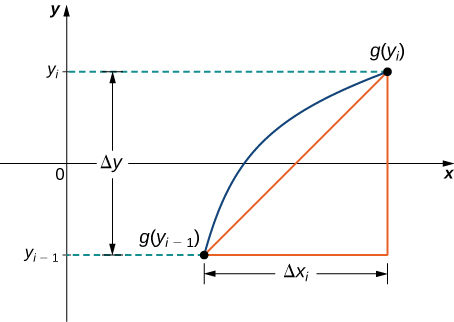
We have just seen how to approximate the length of a curve with line segments. If we want to find the arc length of the graph of a function of [latex]y,[/latex] we can repeat the same process, except we partition the [latex]y\text{-axis}[/latex] instead of the [latex]x\text{-axis}.[/latex]
The figure below shows a representative line segment.
Figure 3. A representative line segment over the interval [latex]\left[{y}_{i-1},{y}_{i}\right].[/latex]
The length of the line segment is [latex]\sqrt{{(\text{Δ}y)}^{2}+{(\text{Δ}{x}_{i})}^{2}},[/latex] which can also be written as [latex]\text{Δ}y\sqrt{1+{((\text{Δ}{x}_{i})\text{/}(\text{Δ}y))}^{2}}.[/latex] If we now follow the same development we did earlier, we get a formula for arc length of a function [latex]x=g(y).[/latex]
arc length for [latex]x[/latex] = [latex]g[/latex]([latex]y[/latex])
Let [latex]g(y)[/latex] be a smooth function over an interval [latex]\left[c,d\right].[/latex] Then, the arc length of the graph of [latex]g(y)[/latex] from the point [latex](c,g(c))[/latex] to the point [latex](d,g(d))[/latex] is given by:
Let [latex]g(y)=\frac{1}{y}.[/latex] Calculate the arc length of the graph of [latex]g(y)[/latex] over the interval [latex]\left[1,4\right].[/latex] Use a computer or calculator to approximate the value of the integral.
[latex]\text{Arc Length}=3.15018[/latex]
Area of a Surface of Revolution
The concepts used to find the arc length of a curve can be extended to find the surface area of a surface of revolution. Surface area is the total area of the outer layer of an object. For objects such as cubes or bricks, the surface area of the object is the sum of the areas of all its faces. For curved surfaces, the situation is a little more complex.
As with arc length, we can conduct a similar development for functions of [latex]y[/latex] to get a formula for the surface area of surfaces of revolution about the [latex]y\text{-axis}.[/latex] These findings are summarized in the following theorem.
surface area of a surface of revolution
Let [latex]f(x)[/latex] be a nonnegative smooth function over the interval [latex]\left[a,b\right].[/latex] Then, the surface area of the surface of revolution formed by revolving the graph of [latex]f(x)[/latex] around the [latex]x[/latex]-axis is given by:
Similarly, let [latex]g(y)[/latex] be a nonnegative smooth function over the interval [latex]\left[c,d\right].[/latex] Then, the surface area of the surface of revolution formed by revolving the graph of [latex]g(y)[/latex] around the [latex]y\text{-axis}[/latex] is given by:
Let [latex]f(x)=\sqrt{x}[/latex] over the interval [latex]\left[1,4\right].[/latex] Find the surface area of the surface generated by revolving the graph of [latex]f(x)[/latex] around the [latex]x\text{-axis}.[/latex] Round the answer to three decimal places.
The graph of [latex]f(x)[/latex] and the surface of rotation are shown in the following figure.
Figure 10. (a) The graph of [latex]f(x).[/latex] (b) The surface of revolution.
We have [latex]f(x)=\sqrt{x}.[/latex] Then, [latex]{f}^{\prime }(x)=\frac{1}{(2\sqrt{x})}[/latex] and [latex]{({f}^{\prime }(x))}^{2}=\frac{1}{(4x)}.[/latex] Then,
Let [latex]u=x+\frac{1}{4}.[/latex] Then, [latex]du=dx.[/latex] When [latex]x=1,[/latex] [latex]u=\frac{5}{4},[/latex] and when [latex]x=4,[/latex] [latex]u=\frac{17}{4}.[/latex] This gives us:
Let [latex]f(x)=y=\sqrt[3]{3x}.[/latex] Consider the portion of the curve where [latex]0\le y\le 2.[/latex] Find the surface area of the surface generated by revolving the graph of [latex]f(x)[/latex] around the [latex]y\text{-axis}.[/latex]
Notice that we are revolving the curve around the [latex]y\text{-axis},[/latex] and the interval is in terms of [latex]y,[/latex] so we want to rewrite the function as a function of [latex]y[/latex]. We get [latex]x=g(y)=\left(\frac{1}{3}\right){y}^{3}.[/latex] The graph of [latex]g(y)[/latex] and the surface of rotation are shown in the following figure.
Figure 11. (a) The graph of [latex]g(y).[/latex] (b) The surface of revolution.
We have [latex]g(y)=\left(\frac{1}{3}\right){y}^{3},[/latex] so [latex]{g}^{\prime }(y)={y}^{2}[/latex] and [latex]{({g}^{\prime }(y))}^{2}={y}^{4}.[/latex] Then:
Let [latex]u={y}^{4}+1.[/latex] Then [latex]du=4{y}^{3}dy.[/latex] When [latex]y=0,[/latex] [latex]u=1,[/latex] and when [latex]y=2,[/latex] [latex]u=17.[/latex] Then: