- Evaluate limits at infinity
Infinite Limits
Evaluating limits, whether at a specific point or as we approach it from a particular direction, helps us understand how functions behave near that point. While some functions have limits that are finite numbers, others grow without bound—these are cases of infinite limits.
We now turn our attention to [latex]h(x)=\frac{1}{(x-2)^2}[/latex] (Figure 1 part c).
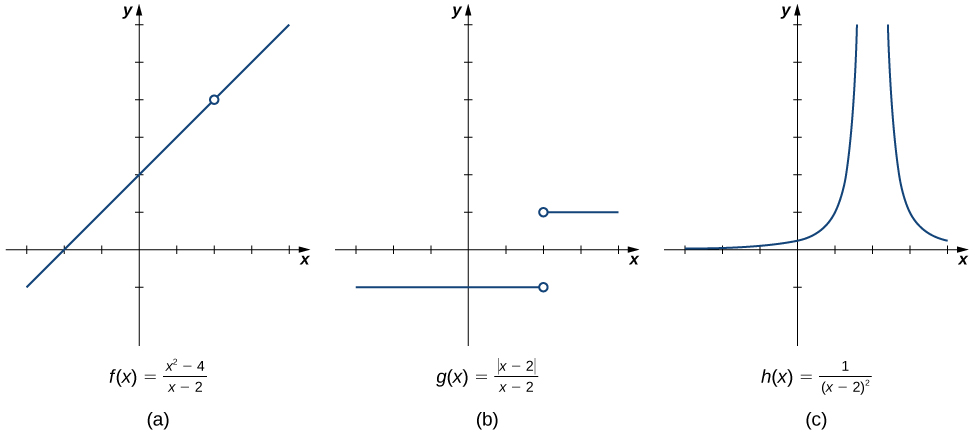
As [latex]x[/latex] gets closer to [latex]2[/latex], [latex]h(x)[/latex] increases without limit. This unbounded growth means that as [latex]x[/latex] approaches [latex]2[/latex], [latex]h(x)[/latex] heads towards positive infinity, which we denote as:
Infinite limits can be understood through the following general definitions.
infinite limits
Infinite limits from the left: For a function [latex]f(x)[/latex] within an interval that ends at [latex]a[/latex], we say:
- The limit is [latex]+∞[/latex] if [latex]f(x)[/latex] increases without bound as [latex]x[/latex] approaches [latex]a[/latex] from the left.
[latex]\underset{x\to a^-}{\lim}f(x)=+\infty[/latex].
- The limit is [latex]-∞[/latex] if [latex]f(x)[/latex] decreases without bound as [latex]x[/latex] approaches [latex]a[/latex] from the left.
[latex]\underset{x\to a^-}{\lim}f(x)=−\infty[/latex].
Infinite limits from the right: For a function [latex]f(x)[/latex] within an interval that ends at [latex]a[/latex], we say:
- The limit is [latex]+∞[/latex] if [latex]f(x)[/latex] increases without bound as [latex]x[/latex] approaches [latex]a[/latex] from the right.
[latex]\underset{x\to a^+}{\lim}f(x)=+\infty[/latex].
- The limit is [latex]-∞[/latex] if [latex]f(x)[/latex] decreases without bound as [latex]x[/latex] approaches [latex]a[/latex] from the right.
[latex]\underset{x\to a^+}{\lim}f(x)=−\infty[/latex].
Two-sided infinite limit: For a function [latex]f(x)[/latex] defined at all points except at [latex]a[/latex]:
- If [latex]f(x)[/latex] increases without bound from both sides as [latex]x[/latex] approaches [latex]a[/latex], the limit is [latex]+∞[/latex].
[latex]\underset{x\to a}{\lim}f(x)=+\infty[/latex].
- If [latex]f(x)[/latex] decreases without bound from both sides as [latex]x[/latex] approaches [latex]a[/latex], the limit is [latex]-∞[/latex].
[latex]\underset{x\to a}{\lim}f(x)=−\infty[/latex].
For the limit of a function [latex]f(x)[/latex] to exist at [latex]a[/latex], it must approach a real number [latex]L[/latex] as [latex]x[/latex] approaches [latex]a[/latex]. That said, if, for example, [latex]\underset{x\to a}{\lim}f(x)=+\infty[/latex], we always write [latex]\underset{x\to a}{\lim}f(x)=+\infty[/latex] rather than [latex]\underset{x\to a}{\lim}f(x)[/latex] DNE.
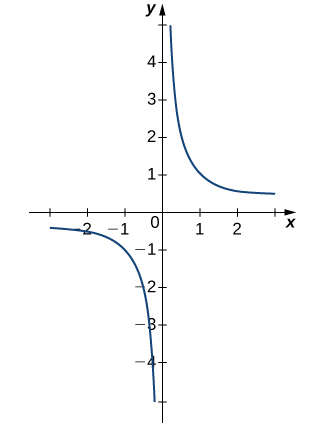
Evaluate each of the following limits, if possible. Use a table of functional values and graph [latex]f(x)=\frac{1}{x}[/latex] to confirm your conclusion.
- [latex]\underset{x\to 0^-}{\lim}\frac{1}{x}[/latex]
- [latex]\underset{x\to 0^+}{\lim}\frac{1}{x}[/latex]
- [latex]\underset{x\to 0}{\lim}\frac{1}{x}[/latex]