A Comparison Theorem
Sometimes evaluating an improper integral directly is difficult or impossible. In these cases, we can often determine whether the integral converges or diverges by comparing it to another integral whose behavior we already know.
The key insight is simple: if one function is always larger than another, then the area under the larger function must be at least as big as the area under the smaller function.
Consider two continuous functions [latex]f(x)[/latex] and [latex]g(x)[/latex] where [latex]0 \leq f(x) \leq g(x)[/latex] for [latex]x \geq a[/latex]. Figure 5 shows this relationship visually.
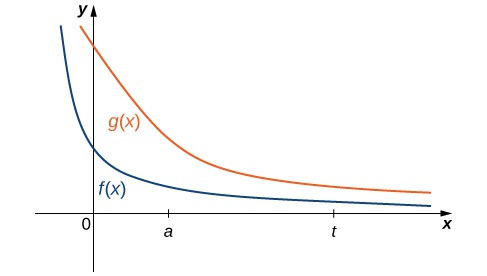
Since [latex]f(x)[/latex] is always below [latex]g(x)[/latex], we have:
[latex]0 \leq \int_a^t f(x) dx \leq \int_a^t g(x) dx \text{ for } t \geq a[/latex]
This inequality gives us two powerful conclusions:
- If the smaller function diverges, the larger one must diverge too.
If [latex]\int_a^{+\infty} f(x) dx = +\infty[/latex], then [latex]\int_a^{+\infty} g(x) dx = +\infty[/latex] as well. - If the larger function converges, the smaller one must converge too.
If [latex]\int_a^{+\infty} g(x) dx = L[/latex] (finite), then [latex]\int_a^{+\infty} f(x) dx[/latex] converges to some value [latex]M \leq L[/latex].
comparison test for improper integrals
Let [latex]f(x)[/latex] and [latex]g(x)[/latex] be continuous over [latex][a, +\infty)[/latex] with [latex]0 \leq f(x) \leq g(x)[/latex] for [latex]x \geq a[/latex].
- Case 1:
If [latex]\int_a^{+\infty} f(x) , dx = +\infty[/latex], then [latex]\int_a^{+\infty} g(x) , dx = +\infty[/latex]
- Case 2:
If [latex]\int_a^{+\infty} g(x) , dx[/latex] converges to [latex]L[/latex], then [latex]\int_a^{+\infty} f(x) , dx[/latex] converges to some [latex]M \leq L[/latex]
Since utilizing this comparison theorem requires the use of inequalities, it is helpful to note the following fact when comparing functions.
[latex]\\[/latex]
If [latex]0 < f(x) \le g(x)[/latex], then [latex]\frac{1}{f(x)} \ge \frac{1}{g(x)}[/latex][latex]\\[/latex]Remember: smaller denominators create larger fractions.
This comparison technique is especially useful when dealing with rational functions, exponential functions, or other expressions where direct integration is challenging.
Use a comparison to show that [latex]{\displaystyle\int }_{1}^{+\infty }\frac{1}{x{e}^{x}}dx[/latex] converges.
Use the comparison theorem to show that [latex]{\displaystyle\int }_{1}^{+\infty }\frac{1}{{x}^{p}}dx[/latex] diverges for all [latex]p<1[/latex].