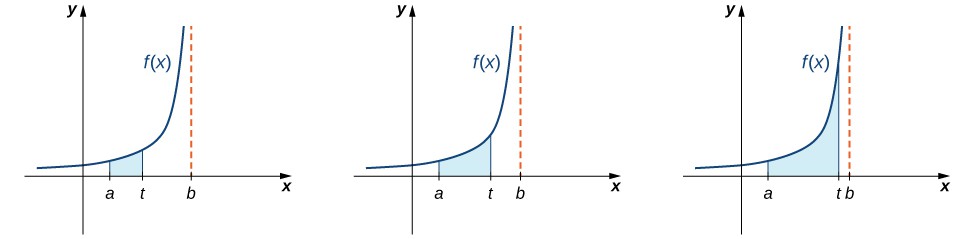
So far we’ve dealt with infinite intervals. But what happens when the function itself has a problem—like a vertical asymptote—somewhere in our interval of integration?
Consider [latex]\int_a^b f(x) dx[/latex] where [latex]f(x)[/latex] is continuous on [latex][a,b)[/latex] but has a discontinuity at [latex]x = b[/latex]. Think about [latex]f(x) = \frac{1}{\sqrt{x-1}}[/latex] on the interval [latex][1,2][/latex]—the function blows up as we approach [latex]x = 1[/latex].
Since [latex]f(x)[/latex] is continuous on [latex][a,t][/latex] for any [latex]t[/latex] with [latex]a < t < b[/latex], we can integrate from [latex]a[/latex] to [latex]t[/latex]. Then we see what happens as [latex]t[/latex] approaches the discontinuity at [latex]b[/latex].
Figure 4 shows this visually—as [latex]t[/latex] gets closer to [latex]b[/latex] from the left, we’re asking whether the area under the curve approaches a finite value.
Figure 4. As [latex]t[/latex] approaches b from the left, the value of the area from a to [latex]t[/latex] approaches the area from a to b.
improper integrals with discontinuities
Type 1: Discontinuity at the right endpoint
If [latex]f(x)[/latex] is continuous over [latex][a,b)[/latex]:
Important: For Type 3, both integrals must converge for the whole integral to converge.
Convergence: The limit exists and is finite.
Divergence: The limit doesn’t exist or is infinite.
Let’s see these definitions in action with some examples.
Evaluate [latex]{\displaystyle\int }_{0}^{4}\frac{1}{\sqrt{4-x}}dx[/latex], if possible. State whether the integral converges or diverges.
The function [latex]f\left(x\right)=\frac{1}{\sqrt{4-x}}[/latex] is continuous over [latex]\left[0,4\right)[/latex] and discontinuous at 4. Using equation 1 from the definition, rewrite [latex]{\displaystyle\int }_{0}^{4}\frac{1}{\sqrt{4-x}}dx[/latex] as a limit:
[latex]\begin{array}{ccccc}\hfill {\displaystyle\int }_{0}^{4}\frac{1}{\sqrt{4-x}}dx& =\underset{t\to {4}^{-}}{\text{lim}}{\displaystyle\int }_{0}^{t}\frac{1}{\sqrt{4-x}}dx\hfill & & & \text{Rewrite as a limit.}\hfill \\ & =\underset{t\to {4}^{-}}{\text{lim}}\left(-2\sqrt{4-x}\right)|{}_{\begin{array}{c}\\ 0\end{array}}^{\begin{array}{c}t\\ \end{array}}\hfill & & & \text{Find the antiderivative.}\hfill \\ & =\underset{t\to {4}^{-}}{\text{lim}}\left(-2\sqrt{4-t}+4\right)\hfill & & & \text{Evaluate the antiderivative.}\hfill \\ & =4.\hfill & & & \text{Evaluate the limit.}\hfill \end{array}[/latex]
The improper integral converges.
Evaluate [latex]{\displaystyle\int }_{0}^{2}x\text{ln}xdx[/latex]. State whether the integral converges or diverges.
Since [latex]f\left(x\right)=x\ln{x}[/latex] is continuous over [latex]\left(0,2\right][/latex] and is discontinuous at zero, we can rewrite the integral in limit form using equation 2 from the definition:
[latex]\begin{array}{ccccc}\hfill {\displaystyle\int }_{0}^{2}x\text{ln}xdx& =\underset{t\to {0}^{+}}{\text{lim}}{\displaystyle\int }_{t}^{2}x\text{ln}xdx\hfill & & & \text{Rewrite as a limit.}\hfill \\ & =\underset{t\to {0}^{+}}{\text{lim}}\left(\frac{1}{2}{x}^{2}\text{ln}x-\frac{1}{4}{x}^{2}\right)|{}_{\begin{array}{c}\\ t\end{array}}^{\begin{array}{c}2\\ \end{array}}\hfill & & & \begin{array}{c}\text{Evaluate}{\displaystyle\int}x\ln{x}dx\text{ using integration by parts}\hfill \\ \text{with }u=\text{ln}x\text{ and }dv=x.\hfill \end{array}\hfill \\ & =\underset{t\to {0}^{+}}{\text{lim}}\left(2\text{ln}2 - 1-\frac{1}{2}{t}^{2}\text{ln}t+\frac{1}{4}{t}^{2}\right).\hfill & & & \text{Evaluate the antiderivative.}\hfill \\ & =2\text{ln}2 - 1.\hfill & & & \begin{array}{c}\text{Evaluate the limit.}\underset{t\to {0}^{+}}{\text{lim}}{t}^{2}\ln{t}\text{ is indeterminate.}\hfill \\ \text{To evaluate it, rewrite as a quotient and apply}\hfill \\ \text{L'h}\hat{o}\text{pital's rule.}\hfill \end{array}\hfill \end{array}[/latex]
The improper integral converges.
Evaluate [latex]{\displaystyle\int }_{-1}^{1}\frac{1}{{x}^{3}}dx[/latex]. State whether the improper integral converges or diverges.
Since [latex]f\left(x\right)=\frac{1}{{x}^{3}}[/latex] is discontinuous at zero, using equation 3 from the definition, we can write
If either of the two integrals diverges, then the original integral diverges. Begin with [latex]{\displaystyle\int }_{-1}^{0}\frac{1}{{x}^{3}}dx:[/latex]
[latex]\begin{array}{ccccc}\hfill {\displaystyle\int }_{-1}^{0}\frac{1}{{x}^{3}}dx& =\underset{t\to {0}^{-}}{\text{lim}}{\displaystyle\int }_{-1}^{t}\frac{1}{{x}^{3}}dx\hfill & & & \text{Rewrite as a limit.}\hfill \\ & =\underset{t\to {0}^{-}}{\text{lim}}\left(-\frac{1}{2{x}^{2}}\right)|{}_{\begin{array}{c}\\ -1\end{array}}^{\begin{array}{c}t\\ \end{array}}\hfill & & & \text{Find the antiderivative.}\hfill \\ & =\underset{t\to {0}^{-}}{\text{lim}}\left(-\frac{1}{2{t}^{2}}+\frac{1}{2}\right)\hfill & & & \text{Evaluate the antiderivative.}\hfill \\ & =\text{+}\infty .\hfill & & & \text{Evaluate the limit.}\hfill \end{array}[/latex]