Hyperbolas
Like ellipses, hyperbolas have two foci and two directrices. However, hyperbolas also feature two asymptotes—lines the curve approaches but never touches.
hyperbola
A hyperbola is the set of all points where the difference between their distances from two fixed points (the foci) is constant.
Figure 12 shows the essential parts of a hyperbola that you’ll need to understand for working with hyperbola equations.
- The Transverse Axis: Also called the major axis, this passes through both foci and vertices. The hyperbola intersects this axis at two points called vertices.
- The Conjugate Axis: Also called the minor axis, this is perpendicular to the transverse axis and passes through the center. Unlike ellipses, the hyperbola doesn’t intersect the conjugate axis.
- The Asymptotes: Two diagonal lines that the hyperbola approaches but never touches. These lines help determine the hyperbola’s shape and orientation.
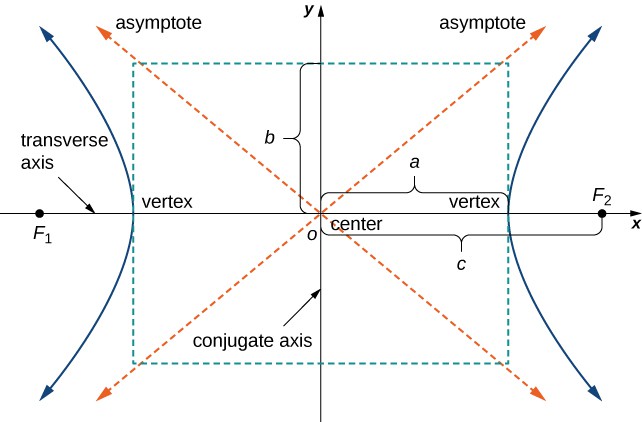
The derivation of a hyperbola’s equation follows the same process as for an ellipse, with one important difference in the definition. For a hyperbola, we consider the difference between two distances rather than the sum. Since this difference could be positive or negative, we use absolute value:
[latex]|d\left(P,{F}_{1}\right)-d\left(P,{F}_{2}\right)|=\text{constant}[/latex]
To simplify the derivation, let’s assume point [latex]P[/latex] is on the right branch of the hyperbola, which allows us to drop the absolute value bars. The vertex of the right branch has coordinates [latex]\left(a,0\right)[/latex], giving us:
For any point [latex]P(x,y)[/latex] on the hyperbola:
Add the second radical to both sides and square:
Isolate the radical and square again:
Rearrange the variables on the left-hand side of the equation and the constants on the right-hand side:
Dividing both sides by [latex]a^2 - c^2[/latex]:
For hyperbolas, [latex]c > a[/latex] (unlike ellipses where [latex]a > c[/latex]). This makes [latex]a^2 - c^2[/latex] negative. We define [latex]b^2 = c^2 - a^2[/latex], so [latex]a^2 - c^2 = -b^2[/latex].
Substituting this relationship:
When the center moves from the origin to point [latex]\left(h,k\right)[/latex], we get the standard form of a hyperbola.
standard form of a hyperbola
The standard form depends on whether the transverse axis (major axis) is horizontal or vertical.
Hyperbola with Horizontal Transverse Axis: Center at [latex]\left(h,k\right)[/latex]:
[latex]\frac{(x-h)^2}{a^2}-\frac{(y-k)^2}{b^2}=1[/latex]
- Foci: [latex](h \pm c, k)[/latex] where [latex]c^2 = a^2 + b^2[/latex]
- Asymptotes: [latex]y = k \pm \frac{b}{a}(x-h)[/latex]
- Directrices: [latex]x = h \pm \frac{a^2}{c}[/latex]
Hyperbola with Vertical Transverse Axis: Center at [latex]\left(h,k\right)[/latex]:
[latex]\frac{(y-k)^2}{a^2}-\frac{(x-h)^2}{b^2}=1[/latex]
- Foci: [latex](h, k \pm c)[/latex] where [latex]c^2 = a^2 + b^2[/latex]
- Asymptotes: [latex]y = k \pm \frac{a}{b}(x-h)[/latex]
- Directrices: [latex]y = k \pm \frac{a^2}{c}[/latex]
A hyperbola is called horizontal when its transverse axis is horizontal, and vertical when its transverse axis is vertical.
The general form of a hyperbola is [latex]Ax^2 + By^2 + Cx + Dy + E = 0[/latex], where [latex]A[/latex] and [latex]B[/latex] have opposite signs. To convert from general to standard form, use completing the square.
Put the equation [latex]9{x}^{2}-16{y}^{2}+36x+32y - 124=0[/latex] into standard form and graph the resulting hyperbola. What are the equations of the asymptotes?

For closed captioning, open the video on its original page by clicking the Youtube logo in the lower right-hand corner of the video display. In YouTube, the video will begin at the same starting point as this clip, but will continue playing until the very end.
You can view the transcript for this segmented clip of “7.5 Conic Sections” here (opens in new window).
Hyperbolas have a unique reflective property that makes them valuable in optical and radio applications. A ray directed toward one focus of a hyperbola reflects off the hyperbolic surface toward the other focus.
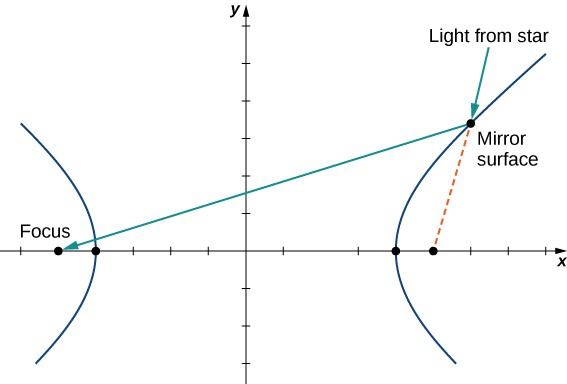
This reflective property has several important applications:
Radio Direction Finding: Since the difference in signal arrival times from two radio towers remains constant along hyperbolic paths, this principle helps determine the location of signal sources. Navigation systems use this property to triangulate positions.
Telescope Construction: Hyperbolic mirrors inside telescopes redirect light from the primary parabolic mirror to the eyepiece. This design allows for more compact telescope construction while maintaining optical precision.
Comet Trajectories: When a comet enters our solar system with sufficient speed to escape the Sun’s gravitational pull, its trajectory follows a hyperbolic path. The comet approaches the Sun along one branch of the hyperbola, swings around, and departs along the other branch. Objects with enough energy to escape a gravitational field follow hyperbolic paths (like some comets), while those with insufficient escape energy follow elliptical orbits (like planets and many asteroids).