Parabolas
A parabola forms when a plane intersects a cone parallel to the generating line. Unlike other conic sections, the plane intersects only one nappe of the cone.
parabola
A parabola is the set of all whose distance from a fixed point (the focus) equals the distance from a fixed line (the directrix).
The vertex of a parabola is the point halfway between the focus and the directrix. This point represents the parabola’s turning point.
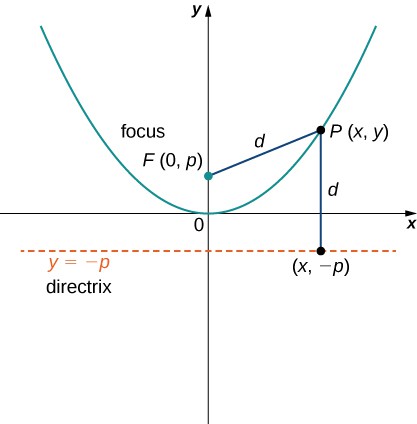
Using the distance definition and the distance formula, we can derive the equation of a parabola.
From Figure 3, we apply the parabola definition: the distance from focus [latex]F[/latex] to point [latex]P[/latex] equals the distance from [latex]P[/latex] to point [latex]Q[/latex] on the directrix.
Squaring both sides and simplifying:
[latex]\\[/latex]
For function [latex]y = f(x)[/latex], the graph [latex]y = f(x - h) + k[/latex] shifts vertically by [latex]k[/latex] units and horizontally by [latex]h[/latex] units.
- Positive [latex]k[/latex]: shift up; negative [latex]k[/latex]: shift down
- Positive [latex]h[/latex]: shift right; negative [latex]h[/latex]: shift left
The equation [latex]y = f(x - h) + k[/latex] is equivalent to [latex]y - k = f(x - h)[/latex]. When you replace [latex]y[/latex] with [latex]y - k[/latex] and [latex]x[/latex] with [latex]x - h[/latex] in any equation, the graph shifts according to these rules.
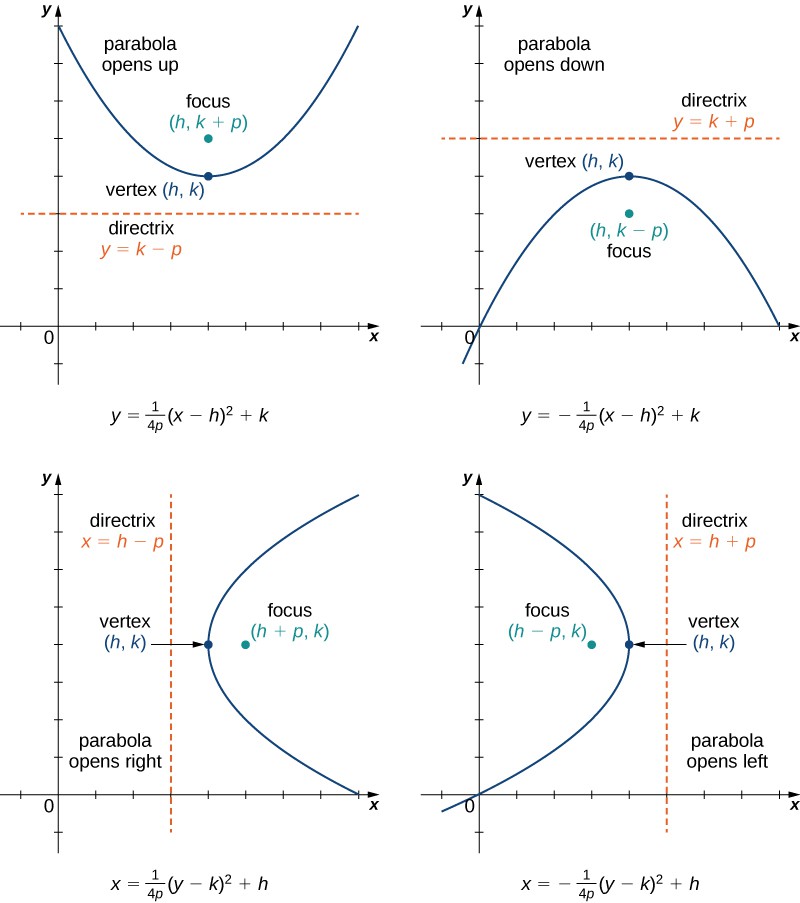
What if the vertex isn’t at the origin? We use coordinates [latex]\left(h,k\right)[/latex] to represent the vertex location. When the focus sits directly above the vertex, it has coordinates [latex](h, k+p)[/latex] and the directrix becomes the line [latex]y = k - p[/latex].
Using the same derivation process gives us [latex]{\left(x-h\right)}^{2}=4p\left(y-k\right)[/latex]. Solving for [latex]y[/latex] leads to our key theorem.
standard form of a parabola
Given a parabola opening upward with vertex located at [latex]\left(h,k\right)[/latex] and focus located at [latex]\left(h,k+p\right)[/latex]], the equation is:
This is the standard form of a parabola.
Parabolas can open in four directions: up, down, left, or right. Each orientation has its own standard form equation, as shown in Figure 4.
You'll also encounter parabolas written in general form, where the values of [latex]h[/latex], [latex]k[/latex], and [latex]p[/latex] aren't immediately visible:
- Vertical parabolas (opens up/down): [latex]ax^2 + bx + cy + d = 0[/latex]
- Horizontal parabolas (opens left/right): [latex]ay^2 + bx + cy + d = 0[/latex]
Put the equation [latex]{x}^{2}-4x - 8y+12=0[/latex] into standard form and graph the resulting parabola.

For closed captioning, open the video on its original page by clicking the Youtube logo in the lower right-hand corner of the video display. In YouTube, the video will begin at the same starting point as this clip, but will continue playing until the very end.
You can view the transcript for this segmented clip of "7.5 Conic Sections" here (opens in new window).
The axis of symmetry of a vertical parabola is a vertical line passing through the vertex. This creates a powerful reflective property that makes parabolas incredibly useful in real-world applications. When parallel rays (like light or radio waves) enter a parabola parallel to its axis of symmetry, they all reflect to a single point—the focus.
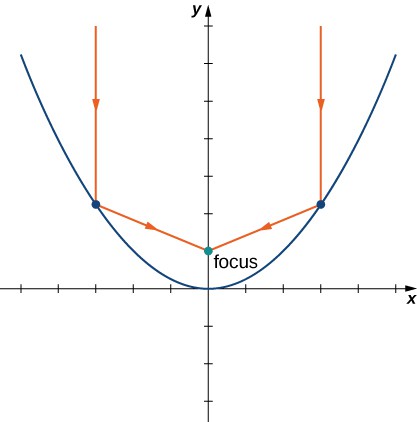
This reflective property explains why parabolic shapes appear in so many technologies—from car headlights to radio telescopes to solar collectors.
Satellite Dishes: A parabolic dish aims directly at a satellite in space, with a receiver positioned at the focus. Radio waves from the satellite reflect off the parabolic surface and concentrate at the receiver. This design allows a small receiver to gather signals from a wide area of sky.
Flashlights and Headlights: These devices work using the same principle in reverse. The light bulb sits at the focus, and the parabolic mirror behind it focuses the light rays into a concentrated beam straight ahead. This allows a small light bulb to illuminate a wide angle of space in front of the flashlight or car.