- Write the equation of a parabola when you know its focus and directrix
- Write the equation of an ellipse when you know its foci
- Write the equation of a hyperbola when you know its foci
- Identify which type of conic section you have based on its eccentricity value
- Write polar equations for conic sections using eccentricity
Parabolas
The Main Idea
A parabola isn’t just a U-shaped curve—it’s defined by a beautiful geometric relationship. Every point on a parabola sits exactly the same distance from two things: a fixed point called the focus and a fixed line called the directrix.
For any point [latex]P[/latex] on the parabola, the distance from [latex]P[/latex] to the focus equals the distance from [latex]P[/latex] to the directrix. This constant-distance relationship creates the parabola’s characteristic shape.
Standard form equations: Once you know the vertex [latex](h,k)[/latex] and the focus distance [latex]p[/latex]:
- Opens up/down: [latex]y = \frac{1}{4p}(x-h)^2 + k[/latex]
- Opens left/right: [latex]x = \frac{1}{4p}(y-k)^2 + h[/latex]
Key relationships:
- Vertex: Halfway between focus and directrix at [latex](h,k)[/latex]
- Focus: Distance [latex]p[/latex] from vertex toward the parabola’s opening
- Directrix: Line distance [latex]p[/latex] from vertex away from the parabola’s opening
This focus-directrix relationship creates parabolas’ most useful feature—parallel rays entering the parabola all reflect to the focus. This is why satellite dishes, car headlights, and solar collectors all use parabolic shapes.
Converting from general form: Use completing the square to transform equations like [latex]x^2 - 4x - 8y + 12 = 0[/latex] into standard form. Group the squared variable terms, complete the square, then solve for the other variable.
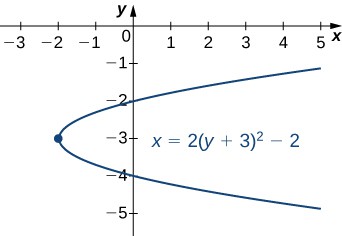
Put the equation [latex]2{y}^{2}-x+12y+16=0[/latex] into standard form and graph the resulting parabola.
Ellipses
The Main Idea
An ellipse has a beautifully simple defining property: every point on the ellipse maintains a constant sum of distances to two fixed points called foci. This constant-sum relationship creates the ellipse’s characteristic oval shape.
For any point [latex]P[/latex] on the ellipse, [latex]d(P, F_1) + d(P, F_2) = 2a[/latex], where [latex]a[/latex] is the semi-major axis length. This sum never changes, no matter which point you choose on the ellipse.
Key measurements:
- Major axis: The longest diameter, with length [latex]2a[/latex]
- Minor axis: The shortest diameter, with length [latex]2b[/latex]
- Distance between foci: [latex]2c[/latex], where [latex]c^2 = a^2 - b^2[/latex]
Always remember [latex]c^2 = a^2 - b^2[/latex]. This connects the focus distance to the axis lengths and ensures [latex]c < a[/latex] (foci are always inside the ellipse).
Standard form equations:
- Horizontal major axis: [latex]\frac{(x-h)^2}{a^2} + \frac{(y-k)^2}{b^2} = 1[/latex]
- Vertical major axis: [latex]\frac{(x-h)^2}{b^2} + \frac{(y-k)^2}{a^2} = 1[/latex]
In standard form, the larger denominator tells you the major axis direction. If [latex]a^2[/latex] is under the [latex]x[/latex]-term, the major axis is horizontal; if under the [latex]y[/latex]-term, it’s vertical.
Converting from general form: Use completing the square on both [latex]x[/latex] and [latex]y[/latex] terms separately. Group like terms, factor out coefficients, complete the square for each variable, then divide to get the equation equal to 1.
Put the equation [latex]9{x}^{2}+16{y}^{2}+18x - 64y - 71=0[/latex] into standard form and graph the resulting ellipse.

Hyperbolas
The Main Idea
A hyperbola is defined by a difference relationship rather than a sum. Every point on a hyperbola maintains a constant difference between its distances to two fixed points called foci. This difference-based definition creates the hyperbola’s distinctive two-branch shape.
For any point [latex]P[/latex] on the hyperbola, [latex]|d(P, F_1) - d(P, F_2)| = 2a[/latex], where [latex]a[/latex] is the distance from center to vertex. This difference never changes, no matter which point you choose.
Unlike ellipses (which are “closed” curves), hyperbolas have two separate branches that extend infinitely, approaching but never touching their asymptotes.
Key relationship: For hyperbolas, [latex]c^2 = a^2 + b^2[/latex] (note the plus sign, unlike ellipses). This means [latex]c > a[/latex] always—the foci are farther from the center than the vertices are.
Standard form equations:
- Horizontal transverse axis: [latex]\frac{(x-h)^2}{a^2} - \frac{(y-k)^2}{b^2} = 1[/latex]
- Vertical transverse axis: [latex]\frac{(y-k)^2}{a^2} - \frac{(x-h)^2}{b^2} = 1[/latex]
The positive term tells you the transverse axis direction. If [latex]x[/latex] is positive, the hyperbola opens left-right; if [latex]y[/latex] is positive, it opens up-down.
Asymptotes are crucial. They guide the hyperbola’s shape. For horizontal hyperbolas: [latex]y = k \pm \frac{b}{a}(x-h)[/latex]. For vertical hyperbolas: [latex]y = k \pm \frac{a}{b}(x-h)[/latex].
Converting from general form: Use completing the square on both variables, but watch the signs carefully. One squared term is positive, one is negative.
Put the equation [latex]4{y}^{2}-9{x}^{2}+16y+18x - 29=0[/latex] into standard form and graph the resulting hyperbola. What are the equations of the asymptotes?

Eccentricity and Directrix
The Main Idea
Eccentricity provides a single number that tells you exactly which type of conic section you’re dealing with. It’s defined as the constant ratio of distance-to-focus over distance-to-directrix for any point on the conic.
The eccentricity formula: [latex]e = \frac{\text{distance from point to focus}}{\text{distance from point to directrix}}[/latex]
The classification system:
- [latex]e = 0[/latex]: Circle (special case of ellipse)
- [latex]0 < e < 1[/latex]: Ellipse
- [latex]e = 1[/latex]: Parabola
- [latex]e > 1[/latex]: Hyperbola
Computing eccentricity from standard form:
- Ellipses and circles: [latex]e = \frac{c}{a}[/latex] where [latex]c^2 = a^2 - b^2[/latex]
- Hyperbolas: [latex]e = \frac{c}{a}[/latex] where [latex]c^2 = a^2 + b^2[/latex]
- Parabolas: [latex]e = 1[/latex] always
Directrix locations:
- Parabolas: One directrix at distance [latex]p[/latex] from vertex, opposite the focus
- Ellipses/Hyperbolas: Two directrices at [latex]x = h \pm \frac{a^2}{c}[/latex] (horizontal) or [latex]y = k \pm \frac{a^2}{c}[/latex] (vertical)
Eccentricity measures how “stretched” a conic is. A circle ([latex]e = 0[/latex]) has no stretch. As [latex]e[/latex] approaches 1, an ellipse becomes more elongated. A parabola ([latex]e = 1[/latex]) represents the boundary case. Hyperbolas ([latex]e > 1[/latex]) are “stretched beyond the breaking point” into separate branches. Think of eccentricity as measuring how far the conic deviates from being a perfect circle. The closer to 0, the more circular; the farther from 0, the more “eccentric” the shape becomes.
Determine the eccentricity of the hyperbola described by the equation
Polar Equations of Conic Sections
The Main Idea
All conic sections can be written in a single, elegant polar form that directly incorporates their defining geometric properties. This unified approach reveals the deep connections between parabolas, ellipses, and hyperbolas.
The universal polar equation: [latex]r = \frac{ep}{1 \pm e\cos\theta}[/latex] or [latex]r = \frac{ep}{1 \pm e\sin\theta}[/latex]
where [latex]e[/latex] is the eccentricity and [latex]p[/latex] is the focal parameter (distance from focus to directrix).
Analyzing the equation:
- Normalize the denominator: Make the constant term equal to 1 by factoring
- Identify eccentricity: The coefficient of the trig function is [latex]e[/latex]
- Determine orientation: Cosine means horizontal major axis; sine means vertical major axis
What each part tells you:
- [latex]e = 0[/latex]: Circle
- [latex]0 < e < 1[/latex]: Ellipse
- [latex]e = 1[/latex]: Parabola
- [latex]e > 1[/latex]: Hyperbola
The focal parameter [latex]p[/latex]:
- Parabolas: [latex]p = 2a[/latex] (twice the distance from vertex to focus)
- Ellipses: [latex]p = \frac{a(1-e^2)}{e}[/latex]
- Hyperbolas: [latex]p = \frac{a(e^2-1)}{e}[/latex]
Identify and create a graph of the conic section described by the equation
